Iraq

Accelerating the ‘kill chain’ – a terrifying glimpse of future warfare

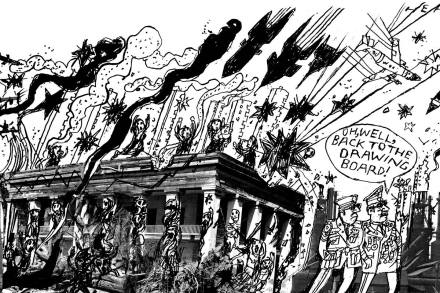
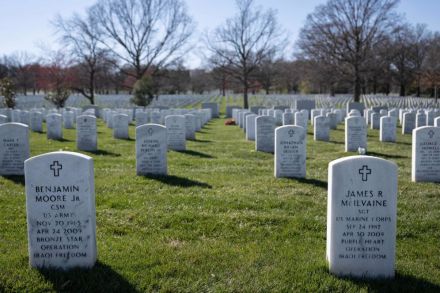
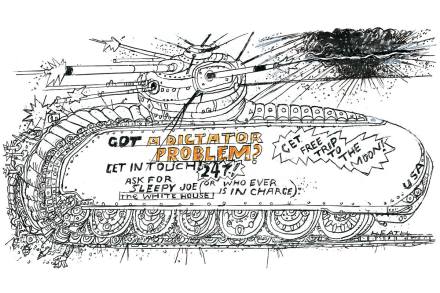
America possesses the most powerful military in history, but since 1945 it has not won a war against anyone other than Saddam Hussein. It appears not to understand why. In fact the only thing the US seems worse at than winning wars is learning lessons from its defeats. People such as the secretary of war Pete Hegseth think it’s all about woke. Lily-livered longhairs stateside stabbed the army in the back over Vietnam; then ‘stupid rules of engagement’ tied the military’s hands in Iraq and Afghanistan and caused the disasters there. The solution is to fight harder, if necessary even at the expense of ethics and the law. Another answer might be to get US forces fighting smarter.
Trump’s goals in Iran have always been clear

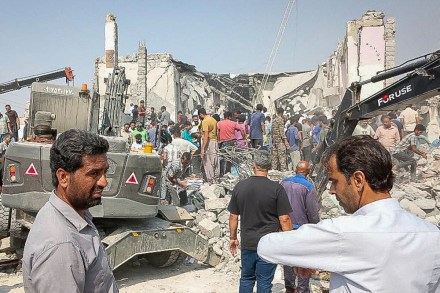
The bombing of the Revolutionary government in Iran is drawing comparisons with the war in Iraq. But the comparisons are with the wrong war. In 1981 there was an attack on Iraq which much more closely resembles what Donald Trump is trying to achieve in Iran. The story goes back to 1976, when the government of Jacques Chirac in France sold a nuclear reactor to the Iraqis – a deal for which the French have always managed to avoid much criticism. The French charged the Iraqi government twice the going rate. But as one of the Iraqi nuclear team later recalled: ‘We were happy to pay. After all, who else was going to sell us a nuclear reactor?’ Who indeed.

Why Iran marks the end of neoconservatism

45 min listen

Spectator World columnist – and Heritage Foundation fellow – Daniel McCarthy joins Freddy Gray to explain how Trump's war with Iran could mark the end of an era, that of neoconservatism. For Daniel, there is no contradiction between Trump's 'America First' policy and its overseas interventions: Trump is pursuing a version of hegemony that will reduce the need for future interventions. If all goes to plan, this could mark an ideological watershed that stretches back to the first Gulf War in the early 1990s – but it's a big 'if'. What if the conflict spirals out of control? To what extent was this driven by Trump, or by Netanyahu? And what are the dynamics at play between the leadership figures in Maga? Produced by Patrick Gibbons.

Why Iran marks the end of neoconservatism

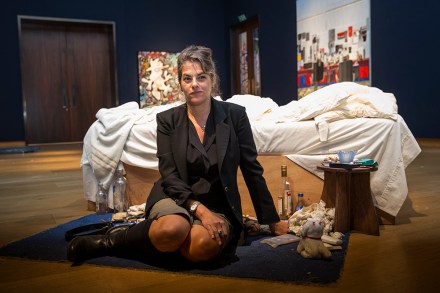
Tracey Emin should remake her bed

Sir Keir Starmer’s position on the US bombing of Iran is inglorious, but one should suspend disapproval to understand how he must have been thinking politically. His party had just lost the Gorton and Denton by-election to the Greens (backed by a strong Muslim vote). His leadership had never seemed weaker. So he calculated that he could not unequivocally back the actions of Israel and Donald Trump. He will have had the Iraq war in mind, particularly the role of the attorney general. Over Iraq, the then attorney general, Lord Goldsmith, was criticised for seeming to change his legal advice to Tony Blair in order to legitimise British participation in the invasion. Sir Keir’s Attorney General, Lord Hermer, is much more central to the administration than an AG ever should be.

If this play is correct, the Foreign Office is a joke

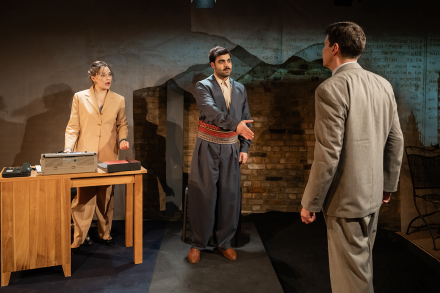
Safe Haven is a history play by Chris Bowers who worked for the Foreign Office and later for the UN as a human-rights activist. The two careers seem to be interchangeable. His drama follows an idealistic and oversensitive Oxford graduate, Catherine, who joins the diplomatic service during the first Gulf War in 1991. Catherine believes that the Foreign Office exists to throw money at basket-case countries that lack the maturity to govern themselves. The entire department acts as a sort of puppy rescue service for dysfunctional nations overseas. All her colleagues accept the wisdom of this approach even though it has the same effect as casting diamonds into quicksand. Catherine responds to historic events like a homeowner assessing a new lamp for the guest bedroom.

How many illegal migrants does Britain return?

Condemned leaders Former Bangladeshi prime minister Sheikh Hasina was sentenced to death for crimes against humanity, for using lethal force against student protests last year. But on past records, she might yet live to an advanced age. The last national leader to be executed was Saddam Hussein in 2006, during the Allied occupation of Iraq. Other leaders sentenced to death in their country’s courts have fared better: — Emile Derlin Zinsou, installed as president of Dahomey (now Benin) after a coup in 1968, was sentenced to death in 1975. That was rescinded and he returned to Benin in 1990. He died aged 98 in 2016. — Chun Doo-hwan, who led a coup in South Korea in 1979, was sentenced to death in 1996, later commuted to life imprisonment. He died in 2021 aged 90.

There are glimmers of hope for Iraq’s Christians

It is 43˚C in Erbil, which a friend here describes as ‘cool’. Unlike my first visit in 2015, when Isis was just a few miles from the airport, the flight in was smooth. The plane this time was full of Iraqis and Kurds, mainly those who have emigrated, returning to visit their families. Ten years ago, the plane was empty apart from a few American contractors in fatigues and one lone priest. The descent then was rapid, to avoid Isis missiles. Erbil is the capital of the north-east Kurdish region of Iraq. After the 2003 invasion, the Kurds were given greater autonomy but since then they’ve found themselves fighting Isis, Iraqi armed forces and even each other.

Are all great civilisations doomed?

To quote Private Frazer in Dad’s Army, ‘We’re doomed, doomed!’ That seems to be the message of Paul Cooper’s eminently readable series of essays about how and why 14 civilisations rose to greatness and then collapsed. He begins with the Sumerians in the fourth millennium BC, at the northern tip of the Persian Gulf, and he finishes with Easter Island in the 18th century. He then concludes with dark prophecies about how a few centuries from now an overheated planet will look in a simpler post-industrial age. The style is informal, based on a series of popular podcasts, and one can almost hear the spoken word as one reads.

A war reporter bravely faces death – but not from sniper fire

When you are a foreign correspondent and have covered wars in dozens of countries, the last place you’d expect a threat to your life to come from is your own cells. Yet this was the predicament in which the New York Times reporter Rod Nordland found himself in July 2019. Despite close shaves in Lebanon, Iraq, Afghanistan, Central America and Darfur, he only really became aware of his mortality after collapsing with a seizure in India and discovering the existence of a ‘space occupying lesion’ (SOL) in his brain – a euphemism for a growth, benign or malignant. On transfer to a hospital in Manhattan, Nordland learned that his was a stage 4 glioblastoma multiforme, a primary brain cancer with a poor prognosis.

Downhill all the way: the decline of the British Empire after 1923

The British Empire, the East African Chronicle wrote in 1921, was a ‘wonderful conglomeration of races and creeds and nations’. It offered ‘the only solution to the great problem of mankind – the problem of brotherhood. If the British Empire fails, then all else fails.’ Stirring words – and not those of some sentimental Colonel Blimp back in London. They were written by the newspaper’s editor, Manilal A. Desai, a young Nairobi-based lawyer and a prominent figure in the large Indian community in Kenya. But, as Matthew Parker observes in One Fine Day, an ambitious account of the empire at the moment of its territorial zenith on 29 September 1923, Desai’s encomium came with a caveat: Either the British Empire must admit the equality of its different people...

Ann Clwyd was a humanitarian unlike any today

Ann Clwyd, who has died aged 86, never held ministerial office or high office of any kind. Unless, of course, you count a stint as chair of the parliamentary Labour party, though that is more of a penance than a power trip. She did a few tours on the opposition front bench under Neil Kinnock, John Smith and, briefly, Tony Blair, but she was too independent-minded and probably not metro enough for a New Labour red box. That she was rebelling against the government a few months into its first term only confirmed that. Voting against an early Harriet Harman benefit cut, designed to force single parents into the labour market, Clwyd pointed out there were ‘about 1,500 single parents and only 200 jobs available’ in her Cynon Valley constituency.

Bush is leading us to tragedy (2002)

It's 20 years since the clamour for the invasion of Iraq was at its loudest. Boris Johnson, The Spectator's then editor, spoke to the Saudi ambassador to the UK, Ghazi Algosaibi. You can read more on our fully digitised archive. 'No, no,' says the Saudi ambassador. 'This is how you do it. You cannot lift your arm above the shoulder, and you must do it sideways.' He moves alongside, a big man with a faint resemblance to Leon Brittan, and makes a thwacking motion. Meet Ghazi Algosaibi, 62, a poet and author, the Arab world's leading envoy to London, who has recently earned not just a personal rebuke from Jack Straw, but the demands of the Jewish Board of Deputies that he be expelled from the country.

Do ‘ordinary Russians’ support the war?

There was a whiteboard in the BBC Baghdad bureau for noting down phrases we hoped to ban from the airwaves. It had nothing to do with political correctness or self-censorship. This was all about self-improvement. The list of words was titled ‘Not Martha Gellhorn’, in honour of the veteran war reporter who wrote so well – especially when compared with us. We were perfectly aware of our shortcomings, though, and strove to do better, with the whiteboard serving as an aide memoire. It helped keep the prose fresh when deadlines were hectic, and when the temptation was to reach for the cliché closest to hand.

Nadhim Zahawi: how I escaped Saddam’s Iraq

One night in December 1977, when Saddam Hussein was deputy leader of Iraq and already the strongman of the government, Nadhim Zahawi’s father was tipped off that Saddam’s secret police were after him. Zahawi, a Kurd working in Baghdad, decided to leave right away. He phoned the office to say that he was travelling to the north of the country for work and quickly set about his escape. The Baathist secret police did come for him that night, but by the time they arrived at his house, he was at Baghdad International Airport with a ticket to London.

Is Christianity about to end in the place it began?

Janine di Giovanni’s book begins in a Paris apartment during the first lockdown. She’s at a friend’s home, which she leaves for the odd shopping trip wearing a homemade mask and rubber kitchen gloves. Covid has made her anxious and she worries that we may lose things about our way of life forever. They need to be written down so we don’t forget. As she thinks about how her faith has comforted her during the pandemic she decides to tell the story of Christians in the Middle East who have experienced troubles of a different kind. She feels that Christianity is vanishing there, and if we don’t make a record of it, it will be lost.

Colin Powell: A great man – and a failure

My memory of Colin Powell feels personal, even though we were 6,000 miles apart at the time. I was in Baghdad, covering the invasion of Iraq for the BBC. Powell was giving the speech of his life at the UN Security Council, accompanied by Powerpoint, trying to convince the world that Iraq had weapons of mass destruction. I had just come from a press conference with senior Iraqi officials, who denied there were any WMDs in the country. They were shifty, oleaginous, terrified of Saddam. It wasn’t hard to believe they were lying and that dignified, decent Colin Powell, was right. ‘If Powell says so,’ I thought, ‘it’s probably true.

Isis’s weakness is now its strength

As coronavirus swept the globe a year ago, Isis began issuing pronouncements. ‘God, by his will, sent a punishment to the tyrants of this time and their followers,’ said one such; ‘we are pleased about this punishment from God for you.’ With the world on lockdown, Isis followers were urged not to sit around at home but to ‘raid the places’ of the enemies of God. ‘Don’t let a single day pass without making their lives awful.’ The virus might have begun as God’s punishment to China for persecuting the Uighurs but, as one Isis video put it, the pandemic was a chance to attack Americans, Europeans, Australians and Canadians. For a moment, the jihadis toyed with the idea of sending infected volunteers to sicken the enemy.

Why are Covid conspiracies so appealing?

The recent decision by several European countries to suspend the use of the AstraZeneca vaccine will have thrown petrol on the bonfire of conspiracies surrounding the pandemic. These range from believing that vaccines contain microchips so that Bill Gates can track you, to believing that the virus is a global conspiracy to allow governments to introduce new draconian measures to control their populations. Why are so many conspiracy theories thriving today and what do they tell us about ourselves? During my time serving in Iraq I heard lots of conspiracy theories. Many concerned exaggerated capabilities of the equipment we had, such as the belief that night-vision goggles and even Army-issued sunglasses gave the troops X-ray vision.

The British army in the 21st century under scrutiny

In his history of the Pacific War, Eagle Against the Sun, Ronald Spector described the state of the US army on the eve of the second world war: ‘The main enemies were boredom and debt. The answer to such problems was often liquor.’ When the officer corps was not boozing, it was sufficiently obsessed with athletics to derail training, for ‘success at football and boxing could be as important to a man’s career as success in manoeuvres’. Its weapons were decrepit and its ranks ragged. George Marshall, the future chief of staff, commanded a notional battalion that numbered fewer than 200 men. That portrait of antebellum decay came to mind when reading The Changing of the Guard, a scathing account of the British army in the years after 9/11.

We shouldn’t forget the horrific crimes of Isis returnees

Summer 2015. A five-year-old girl is chained up and left outside in the desert sun in Fallujah, Iraq – a punishment for wetting the bed while feeling unwell. The little girl slowly died of thirst in temperatures exceeding 50 degrees Celsius. Condemned to the same inhumane punishment was the girl's mother, made to endure the additional and unimaginable horror of helplessly watching the life drain from her daughter's tiny body. The mother and child were members of Iraq’s Yazidi religious minority. Their captors, members of Islamic State (IS), are said to be German and Iraqi. At the time, Islamic State recruits felt invincible. They taunted the West and ruled over civilians in their territory with cruelty and terror.