Mathew Lyons

Self-betterment through contemplation of the Seven Deadly Sins

From our UK edition

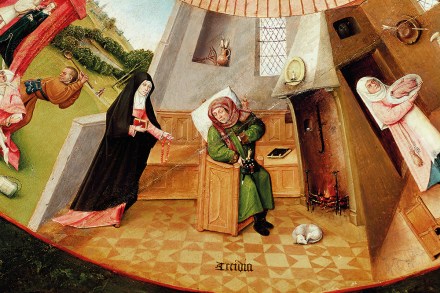
What mistake did Narcissus make when he looked into the water? To fall in love with his own ravishing self, we might think. But to the medieval mind, that wasn’t his problem at all. In John Gower’s 14th-century poem ‘Confessio Amantis’, Narcissus falls in love all right – but with someone else entirely. His fault isn’t that he loves himself; it’s that he doesn’t even recognise himself. Then, as now, as Peter Jones argues in this revelatory exploration of late medieval psychology, the path to self-betterment went through self-knowledge. Like our own, it was ‘a civilisation geared towards understanding the human mind’.
The pedants’ revolt

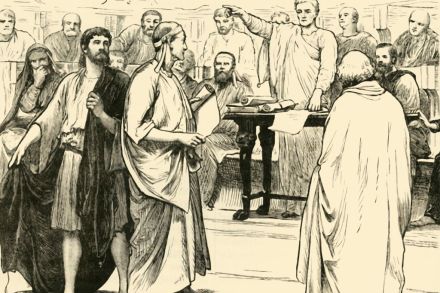
The scene is the imperial palace on the Palatine Hill in Rome in the 2nd century. The philosopher Favorinus is waiting to greet the emperor Hadrian when a grammarian corners him and launches into a lecture on the grammatical qualities of the word penus, meaning “provision.” “Well and good, master, whatever your name is,” Favorinus replies wearily. “You have taught us more than enough about many things of which we were indeed ignorant and certainly did not ask to know.” A thousand years later, the Muslim polymath Ibn al-Jawzi tells of an Arabic grammarian, notorious for punctilious use of archaic language, attempting to negotiate with a carpenter. “What is the price that this pair of doors costeth?” the scholar asks.

Intellectuals pedants

How Hans Holbein brought portraiture to England

From our UK edition

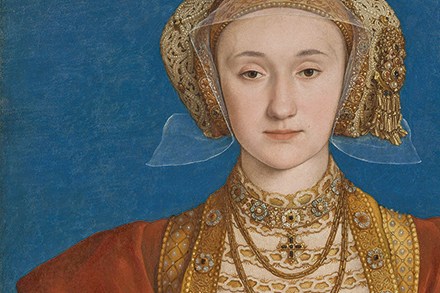
On the evening of 6 May 1527, Henry VIII entertained an embassy from France at a lavish party in Greenwich. The festivities took place in a banqueting house and a theatre, both built for the occasion. At the feast’s end, Henry led his guests out through a great archway. After a moment, he invited the French to turn around and look at a painting which hung behind them. It was a vast panorama of the 1513 siege of Thérouanne – ‘very connyngly wrought’, a chronicler reported. As Henry knew, the siege was a sour memory for his guests. Henry himself, in league with Maximilian I, the Holy Roman Emperor, had routed them there. So great had been their humiliation that it was known as the Battle of the Spurs, after the spectacle of the French cavalry fleeing the field.

A rare combination of humour and pathos: the sublimely talented Neil Innes

From our UK edition

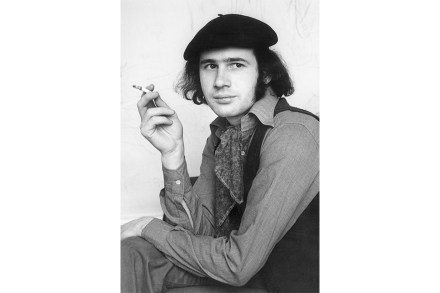
Fans of that beloved British cultural institution Doctor Who are wont to talk about ‘their’ doctor – that is, which iteration of the character was their entry point to the franchise. The same might be said of fans of Neil Innes, the much loved songwriter, musician and comedian who died in 2019, aged 75. Creating happiness seems to have been one of Innes’s gifts, in public as well as private In the 1960s, Innes was a key member of the exhilaratingly unpredictable Bonzo Dog Band, whose blend of verbal, musical and visual humour remains matchless in its absurdity, breadth and daring.

The stubborn resilience of Mexico

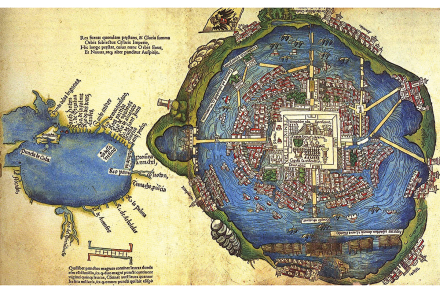
When they looked back, indigenous historians remembered how the fall of the Aztec empire to Hernán Cortés had been prefigured by terrifying omens and portents. The central valley had been plagued by comets, eclipses and supernatural storms. The previous emperor, Ahuitzótl, died after hitting his head on a lintel. A strange woman stalked the streets of Tenochtitlán, the capital, at night, crying “O my sons! We are about to perish.” But there were other signs that might have been heeded, too. The empire itself was only a few decades old when Cortés arrived in 1519. It was a patchwork of rebellious territories and city states, surrounded by yet more hostile peoples. Tenochtitlán fell after a three-month siege in 1521.

Mexico

Arabella Byrne, Sean Thomas, Mathew Lyons, Bryan Appleyard & Chas Newkey-Burden

From our UK edition

28 min listen

On this week’s Spectator Out Loud: Arabella Byrne on the social minefield of private swimming pools (1:13); Sean Thomas says that not knowing where you are is one of the joys of travel (5:34); reviewing Helen Carr’s Sceptred Isle: A New History of the 14th Century, Mathew Lyons looks at the reality of a vivid century (11:34); reviewing Tim Gregory’s Going Nuclear: How the Atom Will Save the World, Bryan Appleyard analyses the three parties debating global warming (16:07); and, Chas Newkey-Burden looks back to the 1980s nuclear drama that paralysed his childhood, Threads (20:42).  Produced and presented by Patrick Gibbons.

Heroines of antiquity – from Minoan Crete to Boudica’s Britain

From our UK edition

She must have been a powerful swimmer. Her name was Hydna and she grew up in the port town of Scione on the northern coast of the Aegean. It was 480 BC, and the Graeco-Persian Wars were raging. The Persian fleet was anchored off Thessaly in eastern Greece, waiting for a great storm to blow through. Hydna and her father were waiting too. When night fell they dived off the harbour wall and into the dark, cold sea. For hours, the two of them swam towards the Persian ships. No one saw them approaching. No one saw them cut, one by one, the anchor ropes. Untethered, the ships were at the mercy of the storm. They smashed into one another, wrecking hulls and rowing decks. By the time calm returned, some 300 lay on the sea floor.

End of the rainbow, rising illiteracy & swimming pool etiquette

From our UK edition

50 min listen

End of the rainbow: Pride’s fall What ‘started half a century ago as an afternoon’s little march for lesbians and gay men’, argues Gareth Roberts, became ‘a jamboree not only of boring homosexuality’ but ‘anything else that its purveyors consider unconventional’. Yet now Reform-led councils are taking down Pride flags, Pride events are being cancelled due to lack of funds, and corporate sponsors are ‘withdrawing their cold tootsies from the rainbow sock’. Has Pride suffered from conflation with ‘genderism’? Gareth joined the podcast to discuss, alongside diversity consultant Simon Fanshawe, one of the six original co-founders of Stonewall.

It seemed like the end of days: the eerie wasteland of 14th-century Europe

From our UK edition

In the early 1370s, Louis I of Anjou, the second son of the French king, commissioned a vast series of tapestries, now on display at the Château d’Angers, representing the Book of Revelation. In the middle of the narrative is a group of men on horseback wearing distinctively English armour; one wears pheasant feathers in his helmet – another mark of English soldiery. As for the Apocalpyse itself, its horsemen were led by Edward III. Edward’s 50-year reign dominated 14th-century England. But, as we see in Sceptred Isle, Helen Carr’s gripping narrative account of the period, Edward himself was dominated by the dream of taking the French crown. It led him to launch two great invasions, one in 1346 and the other in 1359.

The awful calamity of Stalin being a music lover

From our UK edition

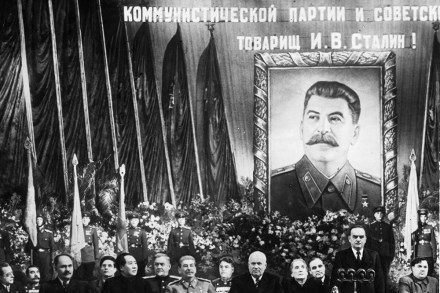
At around 9 p.m. on 5 March 1953 Sergei Prokofiev died of a brain haemorrhage on the sofa of his Moscow flat. He was 61, and had struggled for years with ill health. He had long complained of pain in his soul. Less than an hour later, the source of that pain, Joseph Stalin, died of a heart attack in his dacha on the outskirts of Moscow. Prokofiev’s death wasn’t so much forgotten as ignored. The leading music magazine Sovetskaya muzyka devoted the first 115 pages of its new issue to Stalin; only then did it mention Prokofiev. A million people thronged the streets to see Stalin lie in state; only 15 attended Prokofiev’s funeral. A string quartet played beside Stalin’s bier. Its violinist, Veronika Rostropovich, cried inconsolably. ‘Leave me in peace,’ she told her colleagues.

We’ll never know what treasures the Tudor Reformation robbed us of

From our UK edition

In 1693, quarrymen working near Caerleon, outside Newport in Wales, uncovered an alabaster sculpture of a figure they did not recognise. The man wore a suit of armour, which had once been covered in gold leaf. In one hand he held a sword, in the other a pair of scales. The scales themselves held a girl’s face and a globe of the Earth. The sculpture was donated to the Ashmolean, but experts there were baffled by it. Could it represent the goddess Astrea, one of them wondered. In fact, it represented the Archangel Michael, one of the most significant figures in the medieval church. Among other things, it will be Michael who wields the scales on Judgment Day.

The complexities of our colonial legacy

From our UK edition

It happened by accident. In 1829 the naturalist Nathaniel Bagshaw Ward was trying to hatch a moth pupa. He placed it in a sealed glass container, along with some soil and dried leaves, and set it aside. Sometime later he was surprised to find that a fern and some grass had taken root in the soil, despite having no water. As Sathnam Sanghera writes in Empireworld, the discovery ‘revolutionised the logistics of international plant transportation’. Suddenly there was a means of securely transporting seeds and seedlings across vast distances. Empireworld is a sequel to Sanghera’s wildly successful Empireland. Where the latter examined the legacies of empire in Britain, this book seeks to apply that template to the world.

Downhill all the way: the decline of the British Empire after 1923

From our UK edition

The British Empire, the East African Chronicle wrote in 1921, was a ‘wonderful conglomeration of races and creeds and nations’. It offered ‘the only solution to the great problem of mankind – the problem of brotherhood. If the British Empire fails, then all else fails.’ Stirring words – and not those of some sentimental Colonel Blimp back in London. They were written by the newspaper’s editor, Manilal A. Desai, a young Nairobi-based lawyer and a prominent figure in the large Indian community in Kenya. But, as Matthew Parker observes in One Fine Day, an ambitious account of the empire at the moment of its territorial zenith on 29 September 1923, Desai’s encomium came with a caveat: Either the British Empire must admit the equality of its different people...

What Shakespeare meant to the Bloomsbury Group

From our UK edition

In November 1935, Virginia Woolf saw a production of Romeo and Juliet. She was not overly impressed. ‘Acting it,’ she wrote, ‘they spoil the poetry.’ Harsh words, you might think, for a cast that included John Gielgud, Laurence Olivier, Peggy Ashcroft, Edith Evans and Alec Guinness. But Shakespeare on the stage was something of a bête noire for the Bloomsbury group. ‘We, of course, only read Shakespeare,’ Clive Bell later said. The Shakespeare that mattered was the one on the page. Shakespeare on stage was a bête noire for the Bloomsberries. ‘We, of course, only read Shakespeare,’ said Clive Bell Who was that ‘we’, though?

An obituarist’s search for the soul

From our UK edition

‘“Deep breath”, says the doctor. I take one and hold it.’ Thus begins the fourth chapter of Ann Wroe’s Lifescapes. It is apt because, although the book is part memoir, part essay on the art of biography, it is really about the breath of life itself. Wroe’s writing is intense and visionary, at times almost ecstatic. Reader, dive in. Wroe has written weekly obituaries for the Economist for 20 years, seeking out seemingly ephemeral moments that unlock people’s lives. ‘Time and again,’ she says, ‘some incident in childhood is the key to a career.’ The composer Karlheinz Stockhausen was delighted by the sound his toy hammer made on pipes and buckets at his family’s farm.

Britain’s churches need us to survive – but do we still need them?

From our UK edition

In the summer of 1992, Gloria Davey came upon a ruined church near Swaffham in Norfolk. It had no roof, no windows and no door. Satanists were using it for their rites; a grave had been opened, giving up its bones. Gloria’s husband Bob felt obliged to act. He disrupted their rituals, and when they threatened to kill him, he called in the local Territorial Army. They didn’t bother him again. Bob Davey was 73 when Gloria found the late 11th-century church of St Mary, in Houghton on the Hill; he died, aged 91, having visited it every day thereafter. He and a small group of friends built a mile-long access road and made the church watertight – made it good again, you might say. Then a kind of miracle happened.

Is human migration really a normal activity?

From our UK edition

Halfway up the high street in Totnes, a small town on the river Dart in Devon, a modest stone is set into the edge of the road. It claims to mark the point at which Brutus, legendary founder of Britain, first set foot on this island. The grandson of the equally legendary Trojan hero Aeneas, Brutus was said to have been born in Rome; but, exiled from his birthplace, he travelled western Europe before finally settling here. Most of us carry with us a little Neanderthal DNA. We are all mongrels of a sort That the legend of Brutus was a ninth-century fantasy concocted by a Welsh monk named Nennius need not concern us.

The squeeze: how long will the pain last?

From our UK edition

40 min listen

This week: How long will the pain last? The Spectator's economics editor Kate Andrews asks this in her cover piece this week, reflecting on Rishi Sunak and Jeremy Hunt's autumn statement. She joins the podcast with Professor David Miles, economy expert at the Office for Budget Responsibility, to discuss the new age of austerity (00:58). Also on the podcast: After Donald Trump announced that he will be running for office in 2024, Freddy Gray writes in the magazine about the never ending Trump campaign. He speaks to Joe Walsh, 2020 Republican presidential candidate, about whether Trump could win the nomination (18:42). And finally: In the arts lead in The Spectator Mathew Lyons celebrates the bleak brilliance of the Peanuts comic strip.

The bleak brilliance of Peanuts

From our UK edition

The numbers are extraordinary. Charles M. Schulz, whose centenary falls next week, spent nearly 50 years of his life producing daily comic strips for Peanuts. Between 2 October 1950 and his death in February 2000, he drew a staggering 17,897 of them. He retired in December 1999 after a series of strokes and a cancer diagnosis; he died the day before his farewell strip was published. It’s not just the longevity that is remarkable. At its peak, Schulz’s work had a daily global audience of some 355 million. More than 2,600 newspapers in 75 countries carried his strip. Meanwhile, the licensing industry created around his characters was introducing 20,000 new product lines annually. The property as a whole was turning over $1.1 billion a year.

Meet the real-life gangsters who inspired Guys and Dolls

Guys and Dolls, the musical loosely based on the Broadway stories of Damon Runyon, premiered on Broadway 70 years ago on November 24, 1950. It ran for 1,200 performances and has been frequently revived ever since. The film version, starring Frank Sinatra as Nathan Detroit and Marlon Brando as Sky Masterson, appeared in 1955. Last year, entertainment-industry bible Variety reported that a remake is in the works from TriStar. Runyon’s world, and his characters, live on. Even on the page, never mind in 1950s Technicolor, Runyon’s characters can sometimes seem larger than life. But many of them are, in fact, based on real people that Runyon knew on the Broadway of the 1920s and 1930s.

guys and dolls