Iraq

The victory over Isis has left Mosul at risk of more brutality

A grainy video posted to Twitter shows a bearded man, his hands raised, on his knees, pleading for his life. A few seconds later, a soldier in desert fatigues, and allegedly from the Iraqi Army’s 16th Division, enters the frame and pushes the petrified man over the edge of a cliff on to the banks of a river down below. The man appears alive, just, but as he attempts to slither to cover, the soldier unleashes a volley of a dozen or so rounds, leaving his bloodied body lifeless. His crime is unclear, though without jury nor trial his tormentors have accused him of being a member of Isis. It is

Hope in Mosul

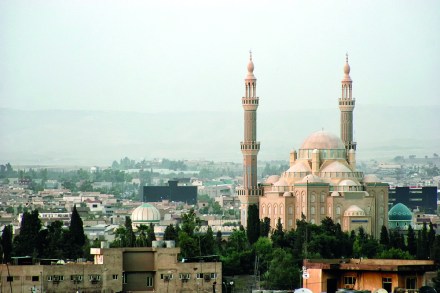
For the title of world’s most benighted city, Mosul takes some beating. Liberated from Saddam Hussein by US forces in 2003, the ancient Assyrian town was pummelled by years of insurgency before being seized by Isis in 2014 and its population subjected to militant theocracy. It has no water supply, no infrastructure, it has been gutted by occupation and there are some 850,000 displaced citizens. The Iraqi government’s long and bloody battle to regain what remains of Mosul culminated this week in a visit by Prime Minister Haider al-Abadi to declare victory. Many will find it hard to see anything to celebrate, given the destruction that has been wrought in

Moment of truth | 18 May 2017

Two extremes of the listening experience were available on Monday on Radio 4. The day began conventionally enough with Start the Week, chaired by the deceptively genial Amol Rajan (now in charge of The Media Show), whose warm, inviting voice fronts a keen, intense intelligence. He guided his guests through a conversation about our post-truth world which, apart from the subject-matter, could have graced the airwaves in the 1950s. This was a masterclass in elevated discussion, so graceful were the exchanges, so theoretical the ideas, yet so clear the meaning. Chief among Rajan’s guests was our former editor Matthew d’Ancona, who has just published a book about post-truth and why

Can Iraq’s Christians ever recover from Isis?

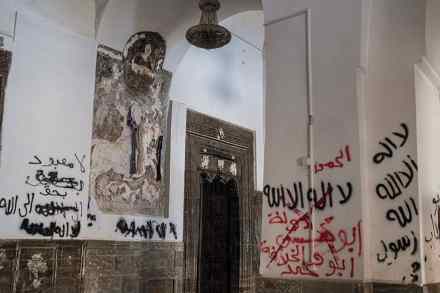
Since June 2014, when Islamic State attacked northern Iraq, the desks at Mar Ephrem seminary in Hamdaniya, a city 18 miles southeast of Mosul, have stood empty. Today, they are dusty and rooms once teeming with priests and nuns in training are dark; student ID cards, with titles such as ‘Syrian Catholic: Parish of Bashiqa, Iraq’, litter the floor and a statue of the Virgin Mary lies smashed. Now, Isis are gone. But in their wake an eerie quiet remains and the path of destruction is a visible reminder of their legacy, with thousands of houses destroyed in the fierce battle to retake the city last October. And for the Christians who live in Hamdaniya, the question remains: will they

Kaiser Donald

 Massachusetts All politicians wear masks. Donald Trump’s favourite is that of Maximum Leader. It was on display during this past week. ‘If China is not going to solve North Korea, we will,’ he said at the weekend, ahead of his meeting with Xi Jinping — a throwaway comment that could end up causing mayhem in the Far East. Next, his reaction to news of a chemical bombing in Syria. Trump blamed the atrocity on his predecessor’s ‘weakness and irresolution’, suggesting that he is keen to show the world what strength and resolve look like. The President, it seems, is not too dissimilar to the nightmare his political enemies warned us

Persecuted Iraqi Christians 'supported Trump 100 per cent' because they felt betrayed by Obama

There’s an extraordinary moment in this week’s Holy Smoke podcast when the aid official supervising the resettlement of 12,000 Iraqi Christians says that the latter supported Donald Trump ‘100 per cent’ in the US elections because they felt betrayed by the Obama administration. Stephen Rasche, legal counsel and head of resettlement programmes for the Chaldean Catholics of northern Iraq, confirms that this community – now on the verge of extinction, and due to run out of medicine in 45 days – has received no help from US aid agencies or the United Nations. We recorded the episode on Friday, the day after Rasche had addressed MPs and peers in Parliament. One hopes they listened

High life | 23 March 2017

A cloudless sky, crunchy spring snow, longer, warmer days. I’ve finally got in some good skiing, twisting around moguls like an arthritic champ. It’s all in the mind, as my old wrestling coach used to tell me. If you think the other guy’s better, you’re bound to lose to him. The same goes for the slope. If it scares you, stay in the club and have another drink. Otherwise, attack it with gusto and feel like a champ again. The same applies to the fairer sex. If you’re too nervous to speak to her, keep moving. We have four of the prettiest young women at The Spectator, all taken alas,

The Spectator podcast: Isis's last stand

On this week’s podcast, we discuss what the end of Isis means for a fragile Middle East, debate whether John Bercow should be packing his bags, and ask if the days of the Bullingdon Club have finally ended. First, the attempt by ISIS to establish a Caliphate has been on the rocks for some time, and with President Trump now at the tiller of the US military, its days may be numbered. Trump wants to retake the Syrian city of Raqqa quickly, but, in order to do so, he might have to rewrite the cautious approach of his predecessor, Barack Obama. Paul Wood writes about the situation in this week’s magazine cover piece,

‘Isis? Bomb those suckers’

These are the last days of the ‘caliphate’. The place Isis made their capital, Raqqa, in Syria, is encircled and cut off. They have already lost half of Mosul in Iraq, their largest city. Really, what did they expect? This was inevitable from the moment Isis declared war on everyone not in Isis. Defeat was even foreseen by one of the group’s leading thinkers, Abu al-Farouq al-Masri. ‘Announcing enmity to the world will strangle the caliphate in its cradle,’ he said last year. ‘This will bury our project alive.’ Al Masri (the ‘Egyptian’) is or was an elderly cleric and he was delivering a sermon in Raqqa meant as a

Rules of engagement

The BBC foreign correspondent Hugh Sykes was meant to be talking about how music has shaped his life with Sarah Walker on Essential Classics last week (Radio 3, Friday), but their conversation actually gave us far more crucial insights into why he has won awards for his work, reporting from troubled places such as Tehran, Baghdad, Belfast, Berlin and Islamabad. He stressed the importance of checking your facts, ‘Verify, verify, verify’, and especially now that the demand for instant news coincides and conflicts with the torrents of information flooding the internet. ‘Never report anything until you’ve got at least two sources,’ Sykes insisted. He also explained how easy he found

John Bercow consistently voted for the Iraq war. He's a colossal hypocrite, not a hero

The Twitter-cheering for John Bercow, the transformation of him into a Love, Actually-style hero of British middle-class probity against a gruff, migrant-banning Yank, could be the most grotesque political spectacle of the year so far. Not because it’s virtue-signalling, as claimed by the handful of brave critics who’ve raised their heads above the online orgy of brown-nosing to wonder if Bercow is really promoting himself rather than parliamentary decency. No, it’s worse than that. It’s the lowest species of cant, hypocrisy of epic, eye-watering proportions, an effort to erase Bercow’s and Parliament’s own bloody responsibility for the calamities in the Middle East that Trump is now merely responding to, albeit

'British values' are a load of old codswallop

Sometimes a combination of news stories crop up that so perfectly sum up the spirit of the age, its absurdities and hypocrisies, that there ought to be a name for it. This week, for instance, I learned that the Home Office had barred three Iraqi and Syrian bishops from entering the country, the same department that quite merrily welcomes some of the most unpleasant hate preachers from the Islamic world. Elsewhere, there was also a report about racial and religious segregation in schools and the need to teach something called ‘British values’ to children to help them integrate. And finally, the winner of the country’s most prestigious art award was announced, beating competition from

Soldiers of the Queen

It’s not immediately obvious, but the silhouette on the dust jacket — soldiers advancing in single file, on foot (‘boots on the ground’) isn’t one squad, but five soldiers from different campaigns. From left to right, first comes the British infantryman of the second world war; next is a ‘jock’ from (I think) the Korean war; then a jungle fighter from the Malayan Emergency or the Borneo ‘Confrontation’; then, unmistakably, the long-suffering foot soldier of Operation Banner, the 38-year counter-insurgency (or police action, no one ever quite knew which) in Northern Ireland; and finally, the technology-festooned warrior of Iraq and Afghanistan. Each is a little more erect, a little taller,

A tale of two battles

For the past few weeks, British news-papers have been informing their readers about two contrasting battles in the killing grounds of the Middle East. One is Mosul, in northern Iraq, where western reporters are accompanying an army of liberation as it frees a joyful population from terrorist control. The other concerns Aleppo, just a few hundred miles to the west. This, apparently, is the exact opposite. Here, a murderous dictator, hellbent on destruction, is waging war on his own people. Both these narratives contain strong elements of truth. There is no question that President Assad and his Russian allies have committed war crimes, and we can all agree that Mosul

We're too busy vilifying Putin and Russia to notice our own misdeeds

I have been wondering these last few weeks whether it would be cheaper to excavate a basement and buy a Geiger counter and iodine tablets, or emigrate to New Zealand. Call me frit, but I don’t like the way things are heading. Probably the second option is easier: Armageddon outta here, etc. I can re-enact Nevil Shute’s On the Beach from some rocky cove near Dunedin, waiting for the fallout to arrive. I was sentient only during the latter stages of the Cold War but from what I can remember, the two sides, them and us, behaved for the most part with a degree of rationality and common sense. (I

Stop the sabre-rattling

I have been wondering these last few weeks whether it would be cheaper to excavate a basement and buy a Geiger counter and iodine tablets, or emigrate to New Zealand. Call me frit, but I don’t like the way things are heading. Probably the second option is easier: Armageddon outta here, etc. I can re-enact Nevil Shute’s On the Beach from some rocky cove near Dunedin, waiting for the fallout to arrive. I was sentient only during the latter stages of the Cold War but from what I can remember, the two sides, them and us, behaved for the most part with a degree of rationality and common sense. (I

The battle for Mosul could create another refugee exodus

As the sun set over the frontline in northern Iraq on the first day of the long anticipated Mosul offensive, Kurdish peshmerga and Iraqi army soldiers began to celebrate the first victories over Islamic State. Almost a dozen villages had been taken yesterday, and more than 77 square miles liberated southeast of the Isis stronghold. The offensive to re-take Mosul, the last major city held by Isis in Iraq, has been more than a year in planning. It was long anticipated all along the hundreds of miles of frontline where the peshmerga and the Iraqi army have been fighting Isis. When I was in Tel Skuf in June last year, men would

Iraq’s endgame: The battle for Mosul

At night, the temperature around the Islamic State-held city of Mosul drops to around 80°F. At the Bashiqa front line, 15 miles northeast of the city, it would feel pleasant and almost calm, were it not for the steady sound of exploding shells. Most of life is tea and cigarettes. It’s like a quiet day on the Western Front, minus the mud. ‘It’s so peaceful you can’t imagine what’s happening — it’s surreal,’ says Allan Duncan, a former soldier with the Royal Irish Regiment who volunteered to join the Kurdish peshmerga here two years ago in order to fight Isis. ‘You almost forget that things are so close to the

The Spectator Podcast: Marriage for one | 27 August 2016

An increasing number of women are entering into the institution of marriage with their dream partner: themselves. In her cover piece this week, Ariane Sherine investigates the women who have brought a new literalism to saying, ‘I do’. But is this just a quirky fad? Or are we witnessing a profound social change? Lara Prendergast speaks to Ariane and Spectator editor Fraser Nelson on this week’s Spectator podcast. Ariane tells Lara: ‘There are an increasing number of women who have decided, because they don’t have a man – or maybe some of them don’t want a man – that if they can’t find Mr Right, well, I’m going to embrace

The Spectator Podcast: Marriage for one

An increasing number of women are entering into the institution of marriage with their dream partner: themselves. In her cover piece this week, Ariane Sherine investigates the women who have brought a new literalism to saying, ‘I do’. But is this just a quirky fad? Or are we witnessing a profound social change? Lara Prendergast speaks to Ariane and Spectator editor Fraser Nelson on this week’s Spectator podcast. Ariane tells Lara: ‘There are an increasing number of women who have decided, because they don’t have a man – or maybe some of them don’t want a man – that if they can’t find Mr Right, well, I’m going to embrace