Freedom

Stay within the lines to realise your full creative energy

The title of this book takes the adage about ‘thinking outside the box’ and inverts it. Instead of thinking outside the box, we should think inside the box, David Epstein argues. Which box? How big is this box? Whose box? He discusses these questions as well. The phrase ‘thinking outside the box’ emerges from the nine dots puzzle devised by psychologists before the first world war. There are nine dots on a page, evenly spaced, three on each line. You must connect all nine using four lines without removing your pen from the paper. A common response is to imagine that the dots form a box and to confine your work accordingly. This makes the puzzle impossible to solve; you have to think outside the box. Or not think of a box in the first place.

How Syria’s dream of freedom ended in further repression

Anand Gopal has form when it comes to war. In Afghanistan, distrustful of President Bush’s ‘good vs evil’ and ‘you’re either with us or against us’ narrative, he did what every good reporter does: ‘I learned the language, grew a beard and hit the road like a local.’ The result was No Good Men Among the Living: America, the Taliban, and the War through Afghan Eyes, a Pulitzer and National Book Award finalist. In its refusal to stick to the script – especially American and British propaganda about all the ‘progress’ which later proved so illusory – the book recalled Michael Herr’s classic Vietnam exposé, Dispatches.

Progress is destroying the planet: the rants of a self-hating American

In what may be the only joke in this book – it is hard to tell, because quite often reading it I started to believe the whole thing was an elaborate parody – Samuel Miller McDonald begins his acknowledgements by expressing his ‘infinite thanks’ to his editors (he merits six of them) on the grounds that ‘no work can be good without good editors’. Apparently some works can’t be good even with good editors – unless the author is trying to tell us that his, like his oeuvre, weren’t especially good at all. Progress is a prolix, tendentious book, radiating self-regard, arrogance and flannel.

Liberty is a loaded word

Just about everyone is for liberty, but we mean different things by it. Far-right libertarians want almost all constraints on their actions removed. They desire free markets, no unions, low taxes, free speech and the freedom to be very rich. The oppressed want freedom from tyranny: in extremis, they want to be free from jail and free to live without the threat of arbitrary arrest and torture. The moderately oppressed want more freedom than they have now, but within the context of a functioning democracy that is more equal, and more supportive, than the kind of society imagined by the right. They make a distinction between liberty and licence (complete freedom) of the kind that results in the pike dining at leisure on the minnows.

Caught between conflicting desires – for liberty and belonging

A friend recently moved back to the UK after living in China for ten years. Being English, he was always going to be an outsider in China, but what surprises him now is how foreign he feels in England too. He asked me whether this feeling ever ended. I told him that I suspect people like us will never fully belong anywhere again. The novelist and filmmaker Xiaolu Guo articulates this sense of alienation exquisitely, knowing exactly what it’s like: ‘Part of me is always in exile.’ She left China in her late twenties when she was already a published author. In Radical, she tries to come to terms with being an outsider, using language as metaphor (she says she’s pursuing ‘an etymology of myself’).

Can facial recognition be stopped?

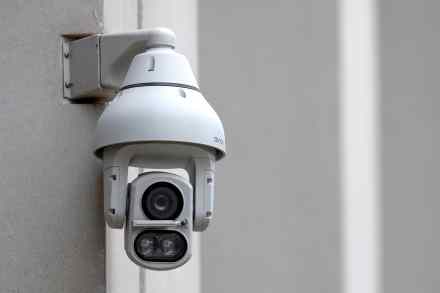
In recent years, facial recognition technology has been introduced into our lives in various benign ways. The ease of using it to unlock our phones, make purchases, replace passwords, and manage our digital wallets is irresistible. Before long, perhaps, it will be integrated into our ‘smart’ homes, shops and airports, and available on all our devices. Unfortunately, our love of convenience may be distracting us from the fact that facial recognition technology is the most sinister and uniquely dangerous surveillance mechanism yet invented. As it increasingly plays a central role in our lives, we are being lulled into accepting its use by the police. And if it is not resisted now, it will become a ubiquitous part of the security apparatus.

Macron’s vaccine passports are a betrayal of French values

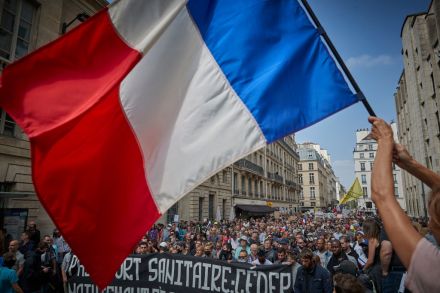
What a celebration of diversity I witnessed in Paris on Saturday as tens of thousands of demonstrators marched through the capital. Organisers put the figure at 50,000, the government at 18,000; I'd say the former is the more accurate estimation. It took two hours to walk the one and three-quarter miles between the start of the march, in the Place du Palais Royal, to its terminus at the Place Pierre Laroque outside the Ministry of Health. In total, and again depending on your source, between 114,000 and 150,000 people demonstrated across France on Saturday to protest against the planned introduction of the 'Pass Sanitaire', France’s vaccine passport. All ages, sexes, classes and colours were represented.

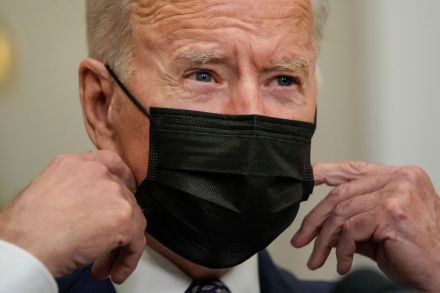
Joe Biden has dropped ‘vaccine passports’. Will Boris?

‘The government would love to put issues such as these beyond the bounds of debate by creating an air of national emergency.’ So this magazine declared on 27 November 2004 in response to Tony Blair’s proposal for national identity cards, which had just been announced in the Queen’s speech. Our editor then, Boris Johnson, argued that their very existence would threaten the character and liberty of the country. If you buckle in an emergency, he argued, the principle will be lost for ever. He urged Tory MPs to rebel and crush identity cards which, he later said, he’d abolish if he ever ended up in government. History now repeats itself. Blair is back, advocating identity cards in the form of vaccine passports or ‘Covid status certificates’.

Vaccine passports are a ticket to freedom

In principle I’m in favour of vaccination passports, and don’t understand how — again in principle — anyone could be against the theory. One can have severe doubts about whether our NHS, pubs, theatres, sports grounds and restaurants would actually be capable of operating such a scheme, yet at the same time think it would be an excellent thing if they were. To me it seems not just sensible and fair but obvious that access to jobs or spaces where there is an enhanced risk of viral transmission might be restricted to people who could demonstrate a high degree of immunity. I’d add that in order for the idea to command widespread public acceptance, it might be best to wait until anybody who wants to be vaccinated has had free access to vaccination.

Boris on liberty: the PM has always been against ID cards – until now

‘I loathe the idea on principle. I never want to be commanded, by any emanation of the British state, to produce evidence of my identity.’ From the ‘personal notes’ on Boris Johnson’s website, February 2005 ‘There is the loss of liberty, and the creepy reality that the state will use these cards — doubtless with the best possible intentions — to store all manner of detail about us, our habits, what benefits we may claim, and so on.’ Daily Telegraph, November 2004 ‘The government would love to put issues such as these beyond the bounds of debate by creating an air of national emergency. As far as the Prime Minister is concerned, Britain is at war: with terrorists, muggers and fraudsters.

How moral is it to refuse a vaccine?

Well thank goodness for that, eh? Just as we reached our darkest hour and resigned ourselves to an endless series of lockdowns and the ruination of everything we once took for granted, we heard that help might be at hand. With the announcement of a Covid vaccine, what the Prime Minister called the ‘distant bugle of the scientific cavalry’ was at last audible. Think Pheidippides staggering into Athens, or the great horn of Helm ringing out. My instinct, and I expect yours, was to think something like: ‘Phew! It’ll take a month or two, maybe a year, but we’re in sight of things going back to normal. There is light at the end of the tunnel.

Covid-19 shows us that virtue trumps freedom

Look at it this way: we’re all doing Desert Island Discs nowadays, and unless you’ve got the bug, it’s a damn good thing, too. I did the desert island bit around 30 years ago, when Sue Lawley was the presenter, and we got along fine, even after I commented on air that she had nice legs. I suspect it would have been a different story today, but another good thing about the virus is that it has knocked #MeToo off the front pages. For good, I hope, but I doubt it. Among my desert island picks was a version of ‘Lili Marlene’ sung by an army choir that I first heard as a four-year-old in an Athens street sung by a group of marching German soldiers.