Anand Gopal has form when it comes to war. In Afghanistan, distrustful of President Bush’s ‘good vs evil’ and ‘you’re either with us or against us’ narrative, he did what every good reporter does: ‘I learned the language, grew a beard and hit the road like a local.’
The result was No Good Men Among the Living: America, the Taliban, and the War through Afghan Eyes, a Pulitzer and National Book Award finalist. In its refusal to stick to the script – especially American and British propaganda about all the ‘progress’ which later proved so illusory – the book recalled Michael Herr’s classic Vietnam exposé, Dispatches. Through the lives and voices of a Taliban commander, a US-backed warlord and a village housewife, Gopal, a contributing writer at the New Yorker, told the devastating story of how America got it so wrong. It was visceral reporting which packed a mighty punch.
In Days of Love and Rage, he shifts his focus to Syria, another country which has been eviscerated by decades of savage repression followed by the slaughterhouse of civil war. It took him and his team of half a dozen Syrian researchers eight years to complete, a reminder that no one really does reporting like the Americans. Two thousand interviews were conducted for this work, with thousands more newspapers, diaries, letters, video clips and text messages consulted. That level of information-gathering borders on the obsessive, and the book is longer than strictly necessary. But as a many-layered portrait of revolution it is a triumph.

Through the lives of six ordinary-but-exceptional rebels, Gopal gives us a front-row view of the Syrian revolution, taking us to a remote northern city called Manbij, where in 2011 a small group of men and women started a movement which would culminate 13 years later in the overthrow of the despised dictator Bashar al Assad.
A landmark televised speech by Assad, surrounded by lackeys chanting the refrain ‘God, Syria, and Bashar only!’, shows how such regimes infantilise as much as they terrorise. The president’s tone-deaf response to the first stirrings of dissent fanned the flames of revolution.
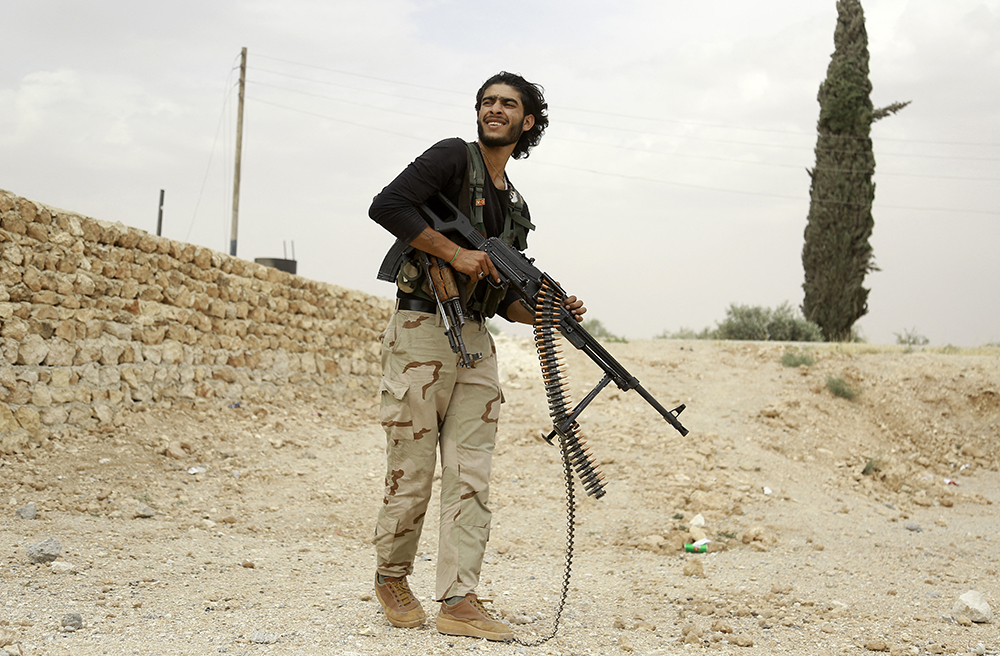
A long way from Damascus, Manbij was also far enough from Aleppo, Homs and Hama to escape the regime’s full attention. By 2012, having somehow weathered the storm of arrests, prison tortures, young men’s bodies ‘strung up by their wrists like flanks of meat’, cells streaked with blood and vomit, the rebels had managed to win control of their town, assisted by the defection of a local police commander.
There began ‘the daring and potentially absurd project of governing themselves’. High hopes led, with the inevitability of the rising sun, to an unravelling of revolutionary unity. Factions proliferated. Fitna, the dread Arab word for division and strife, stalked the town. Football teammates became political enemies. ‘We took down one dictator, we can take down another!’ barks Oday, an ardent young rebel, when the new head of the revolutionary council refuses a request to remove gunmen from the city hall. Revolution is infectious and easier than governing. Freedom, when rival factions all claim to be acting in its name, proves ‘a terribly imprecise concept’.
Gopal’s reporting, what he calls the ‘collective journalism’ stitched together from his team of research assistants, is never less than compelling. Here are the dangerous night-time meetings, the discreet lovers’ trysts in darkened alleys, the political and philosophical debates, the shouting matches, scuffles and fights, the tentative experiments in democracy in a society accustomed to silent obedience.
Should the new authority be secular or Islamic? What is the role of women? Mina and Israa, among others, courageously fly the flag of liberation, their efforts thwarted by a patriarchal society in which men take it upon themselves to police, protect and preserve the ‘honour’ of their women.

From the abattoir of the Assad dictatorship and the honeymoon of revolutionary freedom – complete with functioning law courts, an outspoken free press and an arts festival – Manbij passed into the inferno of rule by Islamic State, the self-styled caliphate, whose foot soldiers revelled in summary justice and executions, the paradise of ‘God’s rule on Earth’, as one puts it. Freedom disappeared. Abdul Hadi, one of the rebels, grew a beard and succumbed to the ‘moral disaster’ of joining Daesh.
In 2016, a combination of the Free Syrian Army (FSA) and Syrian Democratic Forces (SDF) helped prise Manbij from the Islamists, who made way for the latest acronym. The Kurdish-dominated SDF proved almost as repressive as the terrorists.
Gopal returned in 2024, in the aftermath of Assad’s flight from Syria. He found a community raw from its tribulations, confronting the bittersweet legacy of liberation and the corrupt officials who now ran the show. The people of Manbij were on the streets again, he writes, because once unleashed, the hunger for freedom, the courage to go out and win it, is ‘the fire that cannot be put out’. We are reminded once again that Gopal is American, a citizen of the most optimistic – and naive – nation on Earth.




Comments