Food

Spring’s perfect roast

From our US edition

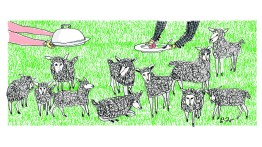
When I first moved to the country, I was intrigued by the sight of people walking sheep on a leash round and round the front garden of a neighboring farmer. City girl that I am, I wondered if they were receiving some kind of special therapy. Equine interaction is supposed to help with certain anxiety disorders, why not sheep-walking for, say, insomnia? It turned out, however, that the sheep-walkers were members of the local 4-H club preparing to show their market lambs at the fair, an event I was later privileged to witness. But I was put to the blush when the judge, a tall, competent-looking man in a checked shirt and green boots, commented loudly on the fine chops displayed by the winning entrant.

lamb

The best lamb in London: Blacklock reviewed

Blacklock is the fourth restaurant of that name – there are others in Soho, Shoreditch and the City of London. It sits in a former royal coach-makers in an alley near the Garrick Club under signage that says ‘Chop’. We descend to a cavern. The walls are exposed brick, the floors are dark wood, and the ceiling hangs over exposed pipework. There is a map of a more ancient and more interesting London on the wall, from the days in which chop houses were as common as raw sewage, or horses. It’s fiercely brown; committed to brown; washed with brown: chairs, tables, light fittings, food. There are tables of men looking expansive like Italian rugby fans. They love Blacklock for its brownness, its simplicity and its blood.

My dangerous flirtation with veganism

I have a confession to make to Spectator readers. It’s not something I’m proud of, but it’s time to come clean (no, I haven’t become a Labour voter – the Tories have been bad, but not that bad). I’ve been experimenting with using meat and dairy substitutes. Hear me out. I’m not proud of what I’ve done. As a right-of-centre comic, indulging in anti-woke sentiment, eating animal products is a badge of honour – the unspoken custom of our movement. Ceasing to do so is the kind of thing which could raise alarm within the ranks, like a bite on the neck in a zombie film. My main motivation for this possible lifestyle change is that my tour shows start at 7:30pm and I am 45.

How to bake a no-chocolate chocolate cake

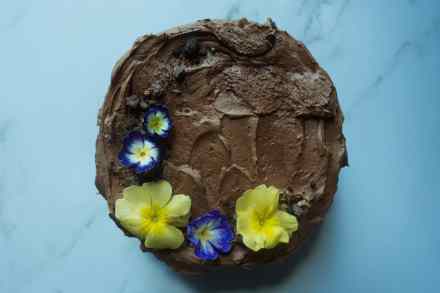
This week’s recipe is for a chocolate cake that is not a terribly traditional chocolate cake. But that is its charm. It uses only one egg, no butter and, most magically, absolutely no chocolate. Instead, it uses cocoa powder and boiling water: the boiling water releases a deeper, rounder flavour from the cocoa, which is enhanced by vanilla, a little strong coffee, and a pinch of salt. The cake’s flavour is a little like that of a packet mix of brownies – which is not to diminish it, but to signal its fudgy darkness. Feel free to swap the sugar for whatever you have: caster, granulated, even dark brown sugar would work here, or a mixture of whatever’s in your cupboards.

Are you man enough to eat raw offal?

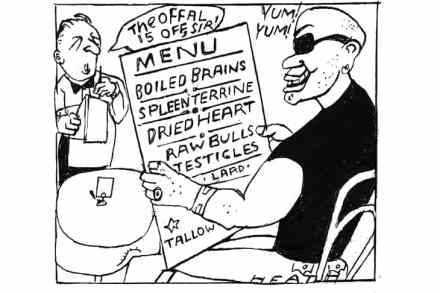
The dominant wolf gets the liver, at least according to the American podcaster Joe Rogan. In one episode, a bodybuilder called ‘CarnivoreMD’ (real name Paul Saladino) tells him: ‘If you eat liver, you get to be an alpha male… or alpha female.’ Offal has taken a markedly macho turn in recent years. No longer resigned to memories of the postwar school canteen, organs have become the preferred food of a certain type of gym bro. The word offal implies wastage – from the Middle Dutch for offcuts – but it can also be a delicacy. Recently saved from a government ban on cruel foods, foie gras is only the most obvious example. For the most part, though, the West has become squeamish about what was once called ‘variety meat’.

Food ruined by an existential crisis: Fallow reviewed

I was going to be jolly this week, for variety and denial, but I changed my mind. Instead, I wonder if, when Vladimir Putin – insert your own nickname, mine is unprintable – talks about the weakness of western civilisation (I paraphrase) and, therefore, our unwillingness to resist tyranny in the shape of a balding paranoiac unwisely given Botox by a beautician who lied to him because everyone lies to him, he means Fallow, which is a new restaurant in St James’s. I wonder if Putin has been to Fallow wearing a prosthetic head and, if so, did he do the soft launch or the hard one? Did he steal more hair? He has stolen so much money from Russia he could afford a room full of prosthetic heads each with their own hair. (You can buy hair on racks at wedding shows.

The trouble with boycotting Russian food

As the war in Ukraine worsens, the horrific scenes filling our screens have prompted a visceral reaction from the British public: 78 per cent now support Russian sanctions – up from 61 per cent in late February. Economic sanctions have undoubtedly hit the Kremlin’s spending power ­– and that’s to be encouraged. But what should we make of the broader cultural boycott of Russia that is rapidly gaining pace? So far, Britain's boycotts have had a peculiarly culinary bent. While Putin continues his onslaught, British shoppers have been encouraged to shun vodka and caviar. Lockdown revived an intense interest in cooking amongst the house-bound middle classes.

The ultimate spaghetti and meatballs

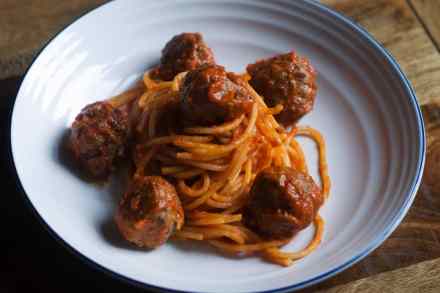
Spaghetti and meatballs is an iconic dish: whether it’s Lady and the Tramp that springs to mind at the name, cosying up over a shared bowl of the stuff, facilitating their canine kissing, or Henry Hill describing the prison meatballs that they make to remind them of home in Goodfellas, while Paulie slices garlic paper-thin with a razor blade, there’s no denying that this pasta dish is one which has taken on significance beyond the sum of its parts.

How to cook with wild garlic

In British cooking we have traditionally had a complicated relationship with garlic. Let the french use it to their hearts’ content: fine in a Toulouse but no thank you in a Cumberland. Suggestive of this wariness is wild garlic’s many names – ‘devil's garlic’, ‘gypsy's onions’ and ‘stinking Jenny’ amongst others. But in recent years British cooks have taken to wild garlic with unabashed relish (and indeed it makes rather a good one, as seen here). Food always tastes better having foraged or hunted for it yourself and so it is with wild garlic. The leaves appear in March and you will find them throughout spring but they are best picked early in the season.

London’s most unusual dining spots

With around 15,000 options to choose from, how can a London restaurant stand out? Some have pulled out all the stops – setting up kitchens on water, in the air or offering something completely new. Here is our selection of the venues that best combine uniqueness with top-notch cuisine. Hawksmoor Canary WharfHawksmoor's newest opening This new East London joint sits on a floating pontoon that softly rises and falls with the tide. Diners must walk the plank (well, bridge) to enter the sleek lounge, which is complete with the 1920s-style sconce lighting, leather banquettes and marble-top bar we’ve come to expect from Hawksmoor’s restaurants.

The giant pancake that feeds everyone

With Shrove Tuesday upon us, I am forced to face my annual pancake day gripe. It is, inevitably, the cook’s gripe: standard crèpe-like pancakes should be eaten as soon as they are cooked, each doled out to waiting mouths as soon as it’s ready. Yes, recipes tell you you can keep them warm in a low oven, but doing that tends them towards the rubbery and luke-warm. This means that the cook is standing at the stove ladling batter while everyone else eats. As a greedy cook, I resent this. But there is a pancake solution: the Dutch baby. The name does not point to a Holland heritage: instead, the dish is named after the Pennsylvanian Dutch, a group of German-speaking immigrants to America.

A victim of its own mythology: Langan’s Brasserie reviewed

Langan’s, a brasserie off Piccadilly with curling orange neon signage calling its name, is under new management after it fell into administration in 2020. It is a famous brasserie — London’s version of La Coupole — once owned by Michael Caine, a famous actor, and Peter Langan, a famous drunk, who would crawl across the floor and bite customers’ ankles and who once put out a kitchen fire with champagne. It opened in 1976 on the site of Le Coq d’Or and was treated by the diary columns as a person in itself, as famous as Annabel’s, Peppermint Park and the Ritz Hotel. Lucian Freud and David Hockney and Princess Margaret came here.

Be my Valentine

From our US edition

I don’t know when my father showed André Fleuridas, a friend, the chunk of jade he’d brought back from Burma, where my father was based as a war correspondent during World War Two. Nor do I know how my parents’ friendship with Bonnie and André Fleuridas began. I can only guess. It might have been through art, as both my father and André were artists, and in Weston, Connecticut, where I grew up, artists occasionally gathered in each other’s studios to draw or paint from live models. Or they might have met at the Weston firehouse where artists, writers, musicians, actors and TV news anchors made up, along with farmers, Weston’s all-volunteer fire brigade.

valentine
waffle

Welcome to Waffle House

From our US edition

"Snack bar,” “coffee shop” and such phrases once signified small eateries where customers sat on stools at a counter or in simple booths. Their orders were taken and served by waitresses in white aprons, and prepared by a short-order cook in a white paper cap. Hotel lobbies, railroad-station waiting rooms and airports all had them: private enterprises in public spaces purveying a cup of coffee and a donut, bacon and eggs, ham and cheese on rye, a hot dog, a hamburger, maybe a milkshake or an ice cream sundae. Little of this (for most were mom-and-pops) traveled well into the age of industrialized, assembly-line, eat-on-the-go feeding signified by the phrase “fast food.

pan

The pan handler

From our US edition

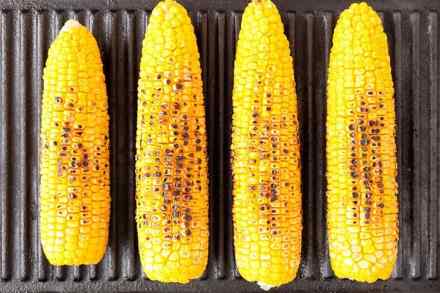
I have become a pan handler — a handler of cast-iron pans. I can think of few hobbies that are as rewarding as collecting and cooking on cast iron. Skillets, griddles, muffin tins, Dutch ovens, waffle irons, corn-stick pans and much else: there was a time when America produced the finest cast-iron cookware in the world. The iron ore was abundant. So was the coal to melt it. Foundries went up across this great land. American cuisine developed around it. From fried chicken to cornbread, the American menu should still be cooked on cast iron. Southern cooks never forgot this. The same goes for soul food; black America has always prized its cast-iron inheritance. Now I find I have little need to cook on anything else.

The trick to making blueberry muffins

I don’t quite know how the Americans got away with it: convincing first their own people, and then the rest of the world that a muffin is a suitable breakfast food? A foodstuff which is, let’s be honest, cake. But then, we are quite happy to sprinkle our worthy porridge liberally with demerara sugar, to use yoghurt in our overnight oats or alongside granola, to combine butter and flour in any manner of breakfast staples from toast to pancakes, what’s so different about combining all those things?

Why restaurant food at home beats eating out

‘The opposite of a correct statement is a false statement. But the opposite of a profound truth may well be another profound truth.’ That’s Niels Bohr. Or, as Oscar Wilde put it: ‘In art there is no such thing as a universal truth. A truth in art is that whose contradictory is also true.’ Like physics and art, many other fields require that you embrace contradictions — because you can’t avoid them. Take innovation. Yes, a great deal of progress is combinatory: two or more technologies are combined to accomplish some hitherto impossible task. But, as the Soviet-era scientist Genrich Altshuller noticed, much innovation follows the opposite path, separating things which were previously combined.

London’s best restaurants for British food

There was a moment, about 20 years ago, when Londoners began to realise, and then boast about, the transformation in our food scene. No longer deserving of mockery compared to other global centres, our restaurants were suddenly producing delicious food every bit (well, almost) as good as that associated with the likes of New York. The revolution began with fresh takes on exotic cuisines, especially South and East Asian, Spanish and Italian. But soon another, delightful development emerged: the reinvention of British food. Gastropubs began taking ploughmans and sausage rolls and roasts very seriously indeed, and posh restaurants began to show that homegrown food, when it comes from domestic seas and soil, can be sophisticated, innovative and richly satisfying.

Eggs en cocotte: the perfect Valentine’s breakfast

There’s something inherently romantic about eggs: whether you’re preparing them for another person, or being served them, they always strike me as a little act of love. Maybe it’s that they suggest breakfast in bed. Breakfast in bed is not about flirting or seduction, it’s more than that. You don’t make breakfast in bed for someone in whom you’re uninterested. Breakfast in bed is not a collaboration, it’s a gift from one person to the other, reserved for those you wish to impress, or to whom you wish to signal your love. That said, while in theory I like the idea, in practice I can feel a little allergic to breakfast in bed: the prospect of crumbs dropped and discovered the following evening is about the least romantic thing I can imagine.

Pass on Piggy’s, head to Hide: central London breakfasts reviewed

The centre could not hold, at least for Piggy’s. The drama of being the only greasy spoon in the West End — in Air Street, of all places — was too much, and it swelled, panicked, and fell apart. Yesterday I ate a mean sliver of almost cold bacon inside hard white supermarket bread. The butter had fled, possibly in the night, possibly with its luggage. There is a good, cheap bacon sandwich — I would argue the cheap bacon sandwich is the only good bacon sandwich — but it must have soft bread, crispy bacon, and butter as plentiful as a lover’s heart. This wasn’t it.