Europe

Merkel's fiscal union won't solve the euro's problems

Few people have been as vindicated about the failings of the euro as Marty Feldstein, who was chairman of the Council of Economic Advisers under Reagan. In 1997 he wrote a piece for Foreign Affairs called ‘The EMU and International Conflict’. In it, he argued that far from furthering peace and stability in Europe, the Euro would actually endanger it. Watching the events of the past few months, few could disagree with him. Feldstein has now returned to the debate pointing out that none of the current fixes being suggested will solve the single currency’s problems. He writes: ‘Although the form of political union advocated by Germany and others remains

Sarko's renaissance

When David Cameron sits down for lunch with Nicolas Sarkozy today, he is bound to ask his host how the presidential election is going. In response, President Sarkozy is likely to break into one his wide-faced smiles, and begin moving about energetically, as he tends to do when he is excited. Forget the polls that put Francois Hollande ahead in a two-way race. It is too early to tell what people really think and, crucially, it won’t be a two-person race. It is a five-person, two-round election. And so far, Sarkozy is doing very well. Besides Sarkozy and Hollande, four other candidates could make a difference to the outcome: Marine

Meanwhile, in Europe...

There probably hasn’t been a meeting of European finance ministers as important as the one tonight. The euro is still at risk; with new governments in Spain, Italy, and Greece incapable of calming the markets, and Angela Merkel unwilling to let the ECB act. In a speech in Berlin, Polish foreign minister Radek Sikorski put it clearly: ‘I fear German power less than I am beginning to fear German inactivity.’ It is a fear shared in London and Paris as well. The 17 finance ministers will discuss the range of options on the table: from setting up an EU Treasury to the possibility of eurobonds or establishing a supra-national process

On the road to break-up?

Before we plunge into the Autumn Statement, we really ought to mention the poison cloud hanging over Brussels today. European finance ministers, including George Osborne, are meeting there later — and it’s certainly not going to be good for their collective health. Klaus Regling, the head of the European Financial Stability Facility (EFSF), is expected to tell them that there’s basically no chance of them boosting the bailout fund to €1 trillion in the near future, as was promised at the end of last month. Back then, David Cameron urged eurozone leaders to bring a ‘big bazooka’ to the fight. They have barely managed a cap gun. This is far

Cameron may have more leverage in Europe than he thinks

There’s just over a week to go until the crunch EU summit on 8-9 December, so David Cameron has to decide how best to play his cards — and quick. The problem, as Daniel Korski has pointed out, is that Britain faces the risk of ‘structural isolation’ in Europe in the short-term. To counter this, Cameron effectively has two options. First, work with allies on both sides of the euro divide to seek political assurances — formal or informal — against the formation of a two-tier Europe with a more integrated eurozone in the driving seat. Or, second, press ahead with UK-specific carve-outs from the EU structure. The former would

Tobin tactics

The biggest bone of contention between the UK and its EU allies these days is the ‘Tobin tax’, the idea of levying a tax on financial transactions. To the UK this is folly. Unless it is levied globally, a tax will force business to move elsewhere. And there is a greater chance of Silvio Berlusconi being elected ECB chief than the Tobin tax being levied globally.   Based on the experiences of Sweden in the 1990s, the tax will achieve none of what its proponents believe it will — and at a considerable cost to Britain’s and Europe’s economy, as companies look to list elsewhere to avoid it. As Ryan

The Tories' latest frustration with the Lib Dems

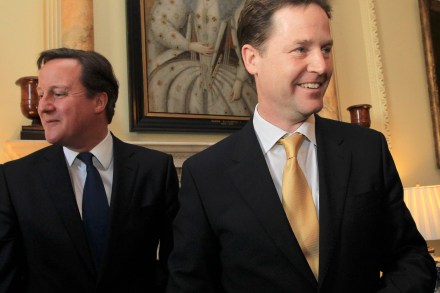
Nick Clegg’s interview in The Observer today highlights what is fast becoming one of the biggest tensions in the coalition: the Lib Dem desire to show that they are the governing party who cares. Allies of Iain Duncan Smith have been infuriated by Lib Dem suggestions that the government would be doing little about youth unemployment if it was not for them. But Clegg repeats the claim to The Observer: ‘Whether it’s on youth unemployment, whether it’s on youngsters, whether it’s on getting behind advanced manufacturing and not putting all our eggs into the City of London basket, I don’t think that would have happened without the coalition.’ A growing

How can Cameron protect our interests in Europe in the short term?

Chatting to people in Brussels last week, I couldn’t help feeling that David Cameron’s EU problem is one of timing. The PM will probably be able to piece together a repatriation package that includes measures such as a withdrawal from the over-implemented Working Time Directive and a reduction in the EU budget. But none of this is likely to be enough for his party. Indeed, I suspect the budget won’t be finalised until two minutes to midnight during the Lithuanian EU Presidency in 2013. Add to this the Tobin Tax, where there seems to be little leeway for the British government. Barosso, Merkel and Sarkozy are determined to introduce it,

Cameron cross-questioned

A quick post just to add the Guardian’s interview with David Cameron to your Saturday reading list. It takes the unusual approach of fielding questions to the PM from a range of ‘public figures’ — and, although many of those questions reduce down to ‘why aren’t you giving more money to X?’, the results are still generally engaging and occasionally insightful. And so we learn, after an enquiry by The Spectator’s own Toby Young, that Cameron doesn’t keep a diary. And we also have the PM justifiying his stance on Europe to Nigel Farage; skipping over a question about what he may or may not have inhaled during his time

Without growth, Osborne's best-laid schemes will go awry

Strikes, Olympic boycotts and obesity league tables — it’s a dreary set of newspaper front covers this morning. But none of them are quite so dreary as the Telegraph’s, which speaks of ‘The return of recession’. According to their story, the OECD has told ministers that its latest set of forecasts, released on Monday, will have the UK economy shrinking for the first six months of next year. They’re not the first forecasting organisation to suggest a double-dip — going by the Treasury’s overview of indpendent forecasts, Schroders Investment Management have economic ‘growth’ at -0.4 per cent in 2012 — but they are the most prominent so far. Shudder ye

Europe's debt overspill

That Italy is now paying around 7.8 per cent for two-year borrowing, compared to the 4.5 per cent it was paying just last month, is a reminder that the imposition of a technocratic government was far from a solution to the country’s problems. With €8 billion more debt to be sold on Tuesday, there’s little respite for Italy coming up. One does have to wonder how long they can carry on like this.   But Italy’s troubles need to be seen in conjunction with what happened at the German bund auction this week. The problems that even Germany is having in getting its debt away at a good rate is

What kind of Europe?

A couple of weeks ago I tried to lay out what the future of Europe could look like, given that some member states want to create an ever-closer Union while others prefer to remain in a looser kind of club. I wrote that the EU might end up evolving into a much more asymmetric arrangement, with a small group of European states integrating in some areas, while other states remain outside. Later I called this new arrangement the trade the ‘EF’, the European Framework, as opposed to the more integrative EU of today.   Now others have begun offering their ideas. Michael van Hulten, a former Dutch MEP, has gone

Opening Europe

It is an article of British faith that further liberalisation of Europe’s market is a worthwhile goal. But few people realise the boost the UK economy would actually get from the finalisation of the EU’s internal market – especially implementation of the Services Directive, creating an integrated market for energy, modernising public procurement rules and liberalising the digital market. Implementation of the Services Directive alone would add 1.5 per cent of GDP to the EU as a whole in the next nine years, according to European Commission calculations. As the UK has one of the strongest services sectors, this will have direct benefits here. Taken together, progress in all these

The dangers of ever-closer union

Yesterday, Fraser wrote that ‘reporting of European issues tends to ignore public opinion’. Today, Philip Stephens has neatly illustrated Fraser’s point in his Financial Times column. Musing on Britain’s possible exit from the European Union, Stephens writes: ‘I am not sure this is what the prime minister intends; nor, when it comes to it, that British voters will accept such an outcome.’ Stephens’ conjecture ignores the European Union’s own polling, which, as Fraser says, shows most Britons to be hostile to the EU. That said, Stephens’ article is substantial. He argues that ‘fiscal union carries its own remorseless logic: the progressive exclusion of Britain from Europe’s economic decision-making’. The magnitude of George

Sorry, Mr Gul, but Turkey won’t be joining the EU any time soon

It’s not going to happen. That’s what everyone says who knows anything about the subject that we’re going to be hearing quite a bit about this week: Turkey’s membership of the EU.  I’ve heard it from someone who works for William Hague, from a political editor, from a diplomat. Which makes this week’s state visit by the Turkish president, Abdullah Gul, on his three-day state visit to Britain seem pretty well beside the point.  The British government is right behind Turkey’s bid for EU membership, no country more so. David Cameron and William Hague have if anything been even more effusive in their support than Tony Blair and Jack Straw

How ambitious is Cameron on Europe?

Someone forgot to pack his handbag. We heard yesterday that David Cameron has agreed to let Merkel pursue full fiscal union – and in return she will… drum roll please… let him repatriate parts of the Working Time Directive. There’s nothing official from Number 10, but the well-informed Ben Brogan suggests this morning that this could well be Britain’s price for agreeing to Merkel’s deal. If so, this would be an opportunity squandered on a massive – perhaps historic – scale. Let’s recap. Cameron is in an incredibly powerful position: leading a government which is, in defiance of public opinion, giving £9 billion of overseas aid to EU member states each year.

Are the Lib Dems pro-EU?

This might seem a very odd question. A pro-EU position is part of the party’s internationalist DNA. Listen to any EU-related speech by the likes of Nick Clegg or Paddy Ashdown and heartfelt support for the European project is apparent. The Liberal Democrats have also made a virtue of reining in Tory euroscepticism, for example rejecting a call for repatriation of powers in the Coalition Agreement. The Deputy Prime Minister remains, in private and public, pro-EU. And to many activists and MPs, the party’s European stance is what makes it different to the Tories – and is the reason why they are Lib Dems. They see in Tory euroscepticism a

Cameron and Merkel: all smiles but no progress

David Cameron and Angela Merkel were clearly keen to show that, whatever the tensions over the role of the European Central Bank, they still get on. I lost count of the number of times in their press conference that they used the word ‘good’ to characterise their relationship and their discussions. But there did not appear to have been any actual progress on how to deal with the current crisis. Certainly, there was no softening of Germany’s opposition to using the ECB as the backstop for the Eurozone. Merkel conceded that she had raised a European-only financial transactions tax with the Prime Minister but that, unsurprisingly, no progress had been

Farage scolds Europe's wrecking crew

In his cover story for last week’s Spectator, Fraser described how the Frankfurt Group – which he dubbed ‘a new EU hit squad’ – has begun imposing it’s will on Greece and Italy. In the European Parliament on Wednesday night, Ukip leader Nigel Farage made the same case against them – and quite forecefully, too: It’s now going viral, with over 75,000 views so far.

What does the ‘carbon floor price’ mean? More emissions and fewer jobs

After the Conservative Party Conference, Fraser described this statement in George Osborne’s speech as the Osborne Doctrine: ‘Let’s at the very least resolve that we’re going to cut our carbon emissions no slower but also no faster than our fellow countries in Europe.’ The Government’s current climate policy clearly fails that test, as I set out for this site at the time, and there is no more egregious violation than the carbon floor price. It is one of those policies that can sound reasonable in theory: the EU Emissions Trading System creates a carbon market. That market produces a carbon price that is supposed to encourage business to invest in