Europe

Clegg ducks Cameron's conciliatory speech

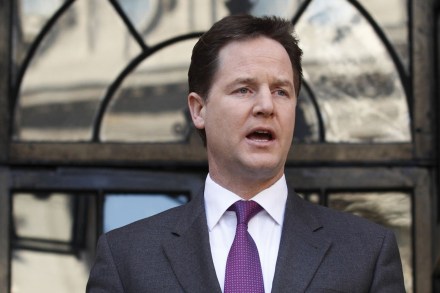
The text of David Cameron’s statement on the European Summit was clearly designed as balm for the coalition’s wounds. He devoted a large chunk of it to defending Britain’s membership of the European Union in a clear effort to reassure the Lib Dems about the future direction of European policy. But this effort was rather undermined by the absence of the deputy Prime Minister. This was, predictably,  the story of the session. In response to repeated Labour questions about where Clegg was, Cameron replied ‘I’m not responsible for his whereabouts. I’m sure he is working very hard.’ Nick Clegg has now given a TV interview in which he has escalated

Good news from Brussels

While the debate over Europe rumbles on, it’s worth highlighting one bright spot in the OBR’s recent document of doom which has largely slipped past Westminster’s radar: by their forecasts, we will pay the EU £2 billion less this year than we were expecting to in March. Instead of the £9 billion ‘net contribution to the EU budget’ forecast for 2011-12 nine months ago, the OBR now estimates it’ll be £6.9 billion. That represents a 17 per cent real terms cut on the £8.1 billion we paid last year, instead of an 8 per cent increase: Why the reduction? The OBR gives a few reasons:  By themselves, each of these

Cameron's winning the popularity contest over Europe

It’s no surprise that David Cameron’s actions in Brussels last week appear to be popular with the voting public, but it is significant nonetheless. The Times is carrying a Populus poll today (£) which suggests just how difficult Labour and the Lib Dems will find it to recapture ground over the Continent. 57 per cent of respondents say that ‘David Cameron was right to exercise Britain’s veto’, against only 14 per cent who believe he was wrong to do so. And it turns out that 49 per cent of the folk who voted Lib Dem at the last election support the PM too. With one particular exception (which we shall

The government's Sarkozy problem (and other euro dilemmas)

This week’s European Council meeting has been analysed by diplomats and commentators alike, but a number of issues have not been brought out as clearly as they need to be. The first is that Britain will now achieve political advantage, at the cost of economic setback, if the euro collapses. Although the government insists both that it is still wedded to the success of the euro and that it will not be isolated in Europe now or in the future, the simple fact is that eurofailure will ensure that efforts to organise among the 26, rather than the full 27, will finish. The economic costs would be considerable — possibly

The coalition's latest anxiety attack

It is starting to feel like the build-up to the AV referendum again, if not worse. No longer the casual bonhomie of the coalition’s early days, but a great show of mutual distrust and loathing between the Lib Dems and Tories. There was Nick Clegg’s interview on the Marr Show earlier, of course, which James has already blogged about. There are rumours that Vince Cable is set to quit. And there is also Paddy Ashdown’s caustic article in the Observer, which he has followed by attacking, Major style, the Tory ‘bastards’ on Sky this morning. For their part, many of those ‘bastards’ are looking on at the Lib Dems’ pain

Ten myths about Cameron’s EU veto

The EU veto that Cameron pulled in the early hours of Thursday morning has been widely misunderstood on all sides. Here are the 10 most common myths: 1. Because of Cameron’s veto, Britain lost a seat at the negotiating table. Not true. The UK was never itself going to take part in the Merkozy pact (and potentially be subject to EU sanctions), and therefore not in the monthly, parallel EU meetings that will begin in January, either. Even if he had approved the Treaty changes, Cameron still would not have had a seat at the table. Wider political challenges aside, the veto didn’t change anything structurally in terms of UK

The sort of influence we can live without

David Cameron’s decision, in the wee hours of Friday morning, to make clear that he would veto the proposed treaty change will have many far-reaching effects. One is that other European leaders know that Cameron is prepared to follow through on a threat to veto. As Charles Moore says in The Telegraph today, the dynamic that has existed throughout this country’s participation in the European project — that “Britain huffs and puffs, but always agrees in the end” — has now changed. This morning, those close to the Tory leadership were pointing out that a Cameron threat to, for example, veto the budget next year will be taken far more

Britain and isolation

The word ‘isolation’ is used a lot in today’s newspapers, as if Cameron walking away from the ongoing EU implosion were a self-evident disaster. Pick up the Guardian and you see Britain cast as a leper, a status conferred on her thanks to a tragic miscalculation by a Prime Minister whose sole aim was to assuage his swivel-eyed Tory MPs and get back on Bill Cash’s Christmas card list. Orwell would have great fun with the language that accompanies the Euro project: trying to suck up to its tiny elite is seen as a country being outward looking. A PM more focused on the people who sent him to office is

What Cameron can do next

What now? That’s the question. This morning it looks not like 17 versus 10, but like 1 versus 26, which is a cold and lonely place for Britain to be. But it is also the right place to be. David Cameron asked for a little and got less. He had to act as he did and will reap the benefit electorally and among his MPs. Labour’s position is not just politically weak, but also unrealistic: it has been clear for weeks it was not possible to run a ‘periphery strategy’ as the 10 states outside the Euro have different incentives to Britain and different long-term aims. And the idea that

A dozen questions for after the Brussels summit

Cameron will be depicted in tomorrow’s press as either a Tory Boudicca or an Essex Bulldog (© Tristram Hunt), depending on your point of view. I suspect the truth is somewhere in between. Cameron did not go in swinging a handbag, although it will suit No10 to make out that he did. But Labour’s caricature of him storming off and wasting the veto certainly doesn’t ring true to me. An EU27 deal was never likely, and EU17 deal always was. Cameron, on their account, just seems to be being blamed for what was going to happen all along. In any case, we are still trying to assemble the pieces of

Cameron on top — for now

Looking at the British political scene today, David Cameron is in a very strong position. His own party has rarely been happier with him. His coalition partners, despite being the most pro-European party in British politics, are standing by his decision to use the veto. What Liberal Democrats keep stressing is that the British government was not actually asking for that much and that Sarkozy’s behaviour left Cameron with little option but to wield the veto.   Labour are in good spirits today. But they don’t have an answer to the question of what they would have done in the early hours of this morning. Instead, they are saying that

Cameron's ‘No’ leaves Clegg in a tight spot

It’s days like this when we should remember that Britain is, officially, the most eurosceptic nation in the EU. Europe may not rank high on the average Brit’s list of policy priorities, but many will nonetheless cheer at the idea of us stepping aside from Merkel and Sarkozy’s bulldozing plan. Whether the PM swashbuckled or blundered into saying ‘No’, that ‘No’ is unlikely to harm the public’s perception of him — and will probably boost it. That’s what makes all this particularly difficult for Ed Miliband. Unlike some in his party, the Labour leader is not inclined to out-sceptic Cameron, so that leaves basically one alternative: to claim that the

Sarkozy's Victory

This is, according to the Spitfire & Bullshit brigade, a great triumph for David Cameron and, more generally, for euroscepticism. If so, I’d hate to see what defeat looks like. What, precisely, has the Prime Minister vetoed? It seems to me that the Franco-German european mission remains alive and well and, if viewed in these terms, Britain has been defeated. That is, the price of a short-term tactical success may be a longer-term strategic defeat. Of course, the Prime Minister had to avoid a treaty that would, sure as eggs be eggs, be vetoed by the British people via a referendum. In that sense, he prevailed. But this is a

Annals of French Diplomacy

This is scarcely the most important part of today’s EU shenanigans but, post DSK and all that, one must admire French diplomatic flair when it comes to this sort of thing: The French are very angry – one French diplomat says that Britain is acting “like a man who wants to go to a wife-swapping party without taking his own wife”. Correct or not, this is nicely put. One’s hard-pressed to imagine an FCO or State Department suit expressing his frustration in quite such colourful terms. The temptation to make sweeping nationalist generalisations on the back of an off-the-cuff remark such as this should, naturally, be resisted. [Thanks to LM]

The Merkozy Plan fails to convince

A day or so ago, the markets were rising in anticipation of what might be achieved at this Brussels summit. But this morning they’re mostly either unmoved, or — as in the case of borrowing costs in Italy and Spain — shifting in unpropitious directions. No-one, it seems, has been won over by yet another night of political bargaineering in Brussels. And understandably so. None of the measures mooted this morning are particularly concrete; all have a sogginess about them. More cash will be transferred to the European Financial Stability Facility, but it’s still some distance short of the €1 trillion that was, ahem, ‘announced’ at the end of October.

A defining moment

David Cameron’s use of the veto in the early hours of this morning changes the British political landscape. The first thing to stress is that if the euro collapses it will not be because of the British veto. The deal agreed between the 17 eurozone countries and six of those nations who still want to join it does not address the single currency’s fundamental problems.   What is, perhaps, most intriguing about what happened in the early hours of this morning is that Sarkozy and Merkel chose to put Cameron in this position. In truth, Cameron was not asking for that much. But Sarkozy and Merkel were not prepared to

Cameron says 'No'

It looks like Britain could be heading for renegotiation with the EU sooner rather than later. The UK, Hungary, Czechs and Swedes last night stayed out of a 27-member EU Treaty. ‘I don’t want to put it in front of my parliament,’ said Cameron. But in an historic move, the deal is going ahead anyway, with 23 members: the Eurozone, plus the six states who want to join. ‘We will achieve the new fiscal union,’ said Angela Merkel. Nicholas Sarkozy is upbeat saying it has been an ‘historic summit’ which will change the EU ‘radically’.  If so, then Owen Paterson is right in his interview with James Forsyth in the

Forget the Brussels Summit — here’s how Cameron could challenge EU power at home

Much has already been written this week about the negotiating hand that David Cameron should be playing in Brussels over the next couple of days.   I am fervently of the view that there is indeed a whole raft of policy areas over which he should be seeking to reclaim powers from Brussels, and they are detailed in a new paper by Dr Lee Rotherham, Terms of Endearment, which was published earlier this week by the TaxPayers’ Alliance.   But forget the European Council for a moment. For it is worth highlighting the things that the British Government could do immediately and unilaterally, here at home, to challenge EU power

Cameron plans Friday night reception for select Tory MPs

In a sign that David Cameron does not expect the European Council to go late into Friday night, he has asked a group of Tory MPs to supper at Chequers on Friday evening. It is hard to imagine that a full deal between both the 17 and the 27 could be thrashed out in time for Cameron to return to England for supper. Tellingly, the invitations to this event went out just last week.   This supper is part of a continuing attempt by Cameron to reach out to the parliamentary party. Interestingly, the guest list is not comprised solely of loyalists. Andrew Rosindell, who was part of the 81