Europe

Who will bail out the EU bailout fund?

While all eyes are fixed on Italy’s ever-increasing borrowing rates, a far larger problem may well be emerging. The EU bailout fund, set up to help countries who can’t borrow, may itself have trouble borrowing very soon. A sale this morning of 10-year bonds by the European Financial Stability Facility (EFSF) had a very muted response, barely bringing in the €3 billion it was meant to. This despite the fact that the offer was priced at a much more enticing yield, some 90 basis points (or 0.9 percentage points in non-market lingo) above a previous sale. Mind you, that’s better than last week’s sale, which had to be postponed due

Crunch time in Italy and Greece

Reports of Silvio Berlusconi’s imminent resignation yesterday may have been exaggerated, but it remains to be seen how greatly. He faces a big test today, in the form of a crucial vote on the Italian budget. Berlusconi has proved adept at surviving such confidence votes throughout his time as Prime Minister, but today’s opposition may be too much even for him. In the words of Italian academic Roberto D’Alimonte to the Telegraph: “Nobody knows what the result will be, I think even Berlusconi doesn’t know.” In the last few minutes, Umberto Bossi – the leader of Berlsuconi’s coalition partners Lega Nord – has said that he called on the Prime Minister

Cameron defends the IMF

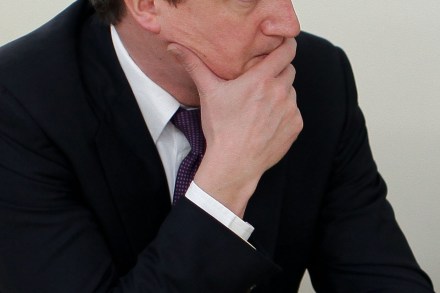
David Cameron’s statement to the House of Commons on the Cannes summit was dominated by the question of increasing Britain’s dues to the IMF. Cameron stressed that his message to the Eurozone countries was “sort yourselves out and then we will help”. He also tried to offer reassurance that the IMF would not contribute to any eurozone-specific bailout fund. But after Ed Miliband’s response, the Prime Minister tried to counter-attack. He began by saying of the Labour leader’s speech, “I don’t know who writes this rubbish” which drew one of Ed Balls’ infamous calm down gestures. Cameron then offered an aggressive defence of the IMF, calling it an “organisation that

After the EU

If the EU comes crashing down as a result of the Euro crisis, one thing is certain: the UK will be at the forefront of re-creating the bloc. Not exactly the way it is now, but not a totally different entity either. The reasons for this are three-fold, simple and are about Britain’s interests. First, Britain derives benefits from being part of, and determining the rules for, the world’s largest market. When the world is entering a “no-Doha” future, where pressure for protectionism will rise, there is no substitute for access to a relatively open market of some 400 million people. Neither transatlantic trade, commerce with the Commonwealth or links

Berlusconi may quit presto

The word sweeping across Italy is that the PM may be forced to step down in a matter of hours, even “minutes”. Ex-minister Giuliano Ferrara says: “That Silvio Berlusconi is about to resign is clear. It is a question of hours, some say of minutes.” And he couldn’t leave too soon. The Italian bond yield busted the 6.5 per cent threshold to reach 6.58 per cent this morning. It’s now close to what some traders call “bailout territory”. News of Berlusconi’s imminent resignation has sent Italian stocks soaring though – the FTSE MIB is up 2.4 per cent. Berlusconi’s scandal-ridden premiership and bunga-bunga antics have caused political deadlock in Rome

Papandreou to go, but uncertainty remains

The eyes of Europe, which have been focused on Greece all week, will see a slightly brighter picture today – albeit one still engulfed in heavy fog. The good news: a new coalition government will be formed – the government of “national unity” that EU leaders wanted – to approve the bailout package ahead of new elections. Prime Minister George Papandreou will step down, following his aborted call for a referendum on the bailout terms last week. His future had been a major part of the uncertainty surrounding Greece: reports of his resigntion on both Thursday and Friday turned out to be premature, if only by a matter of days.

Crisis a la Milanese

If Italy’s a country on the brink, it doesn’t show it. At least not in Milan. Along the city’s rainswept streets, thousand of designer-clad people hit the shops this weekend, unperturbed at the prospect of the government’s likely collapse and the risk of a financial meltdown. At a small deli called Pack overpriced but delicious pieces of Bresaola and Parmegiano are sold in green-and-gold Harrods-like wrapping. La Rinascente, the city’s upmarket department store, is packed with high-rolling shoppers and the nightclub under the main Armani store is heaving with models and their male accoutrements. Here life remains dolce. Of course Milan is not Italy – it is the country’s commercial

A belaboured EU position

While the Coalition is split over Europe, Labour does not look like they are in a much better position. Ed Miliband told the BBC that he was in favour of the Euro; Ed Balls would presumably tackle anyone to avoid that becoming the party’s policy. Meanwhile Douglas Alexander, Labour’s brainy Shadow Foreign Secretary, has yet to make a game-changing intervention. Their predicament is obvious. Should Labour accept the narrative of renegotiation but opt for different areas to opt out of than those favoured by the Tories? Or should they, like William Borroughs, stand astride history and scream “stop”, arguing for a pro-European position? Seemingly caught between the two views, the

Papandreou wins no confidence vote, but appears set to stand down

The political situation in Greece remains unclear this morning. George Papandreou’s government survived last night’s confidence vote. But the main opposition party has rejected the idea of a national government and Papandreou’s finance minister appears to be maneuvering to replace him. Papandreou’s victory in the no confidence vote means that there probably won’t be elections in Greece this year. But the huge difficulties involved in implementing the austerity plan remain. The measures continue to command little public support and the opposition will continue to criticise them. The debt deal proposals will also have to win parliamentary approval at some point soon and the French and the Germans are, The Independent

Cameron leaves Cannes with an IMF headache

The Cannes summit leaves the world no further forward on its quest for some kind of solution to the Eurozone crisis. Strikingly, the Germans still won’t agree — despite huge diplomatic pressure — to the ECB fulfilling the traditional emergency function of a central bank and acting as lender of last resort. This is a blow when you consider that Cameron thought there was a real possibility Merkel would budge on this after last week’s European Council meeting. It also provides Cameron with a domestic political headache. For if the ECB won’t act, the IMF will have to take more of the strain — and increasing Britain’s contributions to the

Envoy for repatriation

A few days ago Douglas Carswell laid out a way for the Prime Minister to regain the eurosceptics’ trust. One of his ideas was to replace the UK’s new chief diplomat in Brussels with someone directly accountable to Parliament. This idea has a snowball’s chance in hell of succeeding. First, the PM has resisted all sorts of political appointments – he’s even limited the number of Special Advisers – and I don’t think he’s about to start. Second, doing so would upend a constitutional principle: that officials report to the government, not the legislature. For this reason even generals are not approved by Parliament, as they are in the United

BREAKING: Greek PM Papandreou offers his resignation

The BBC reports that Papandreou will resign today and ask the Greek president to approve a new coalition government, with former ECB vice president Lucas Papademos likely to take over as Prime Minister. Opposition leader Antonis Samaras has said: “I’m asking for the formation of a temporary, transitional government with an exclusive mandate to immediately hold elections. And the ratification of the bailout deal from the current parliament.” This is now the main question: will Papandreou’s replacement approve the bailout before new elections are held? UPDATE: It now seems Papandreou might not be resigning after all. This from AFP: “Greek Prime Minister George Papandreou, who is facing a growing party

The euro is destroying Europe

This week’s issue of The Spectator hits the newsstands today. Here, for CoffeeHousers, is James Forsyth’s Politics column from it: Last week’s rebellion by David Cameron’s backbenchers in support of an EU referendum ended eight years of peace in the Tory party on the European question. Now, the offer by the Greek Prime Minister of a referendum on the bailout package — designed to appease nervous Greek Socialist party backbenchers — means that the uncertainty surrounding the eurozone will drag on into the New Year. George Osborne regards the confusion surrounding the future of the single currency as the single biggest obstacle to a British economic recovery. The Chancellor and

Merkel and Sarkozy try to hold the euro together

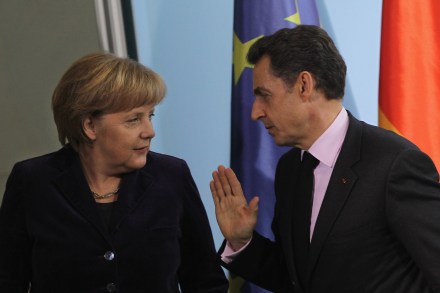
Right about now, Nicolas Sarkozy and Angela Merkel are having George Papandreou for dinner. There have been all sorts of rumours today about what Sarkozy and Merkel will demand from him. Thankfully, they seem to have abandoned plans to tell him to cancel the referendum. But they still seem keen to dictate the question and the timing to him. How that will go down with the Greek demos remains to be seen. One thing is clear, though: the euro is now destroying the whole European project. The European Union’s claim to be a force for peace, stability and democracy in Europe is rapidly disappearing into the Athens smog. The wholesale

The Greek land mines that Cameron must avoid

When the topic of Greece comes up at PMQs, David Cameron will need to avoid stepping on three land mines. The first task is not to say anything about what is going on in Athens, or Rome for that matter, that will exacerbate market anxieties. The second is a diplomatic challenge, to avoid anything that would sour Britain’s pitch ahead of the G20. The third, and perhaps most difficult one, is to keep his own backbenchers on side.   An ever growing number of Tories doubt that a 17 member Euro and fiscal union is in Britain’s, or Europe’s, interests. Already, some Tory backbenchers are talking about going to Greece,

A Damoclean sword hovers above Papandreou

This is not Greek tragedy, it is a farce. Prime Minister George Papandreou’s idea to hold a referendum on the Greek deal has done the exact opposite of what he must have intended. Instead of giving him a new mandate, it seems it will take the existing one away from him. Several MPs and PASOK officials have called for his resignation or for the formation of a National Unity Government. Some have even resigned, reducing the government’s majority in parliament. European reaction has arranged from studied politesse to outrage. Ireland’s Europe minister has called the referendum idea a “grenade”. Privately, European politicians are seething. The Greek PM must know he

The wisdom of Eurosceptic crowds

How much does public opinion on Europe matter? A poll for today’s Sunday Times found that 41 per cent want out of the EU and on the BBC1 Politics Show today, Jon Sopel confronted Douglas Alexander with this statistic. Wee Dougie replied that, on Monday’s vote, he was in the “no” lobby with the leaders of all British political parties – so of course he was in the mainstream. This raises a crucial issue: the vast disconnect over Europe between the political elite and the masses. To declare my hand: I’m in favour of our EU membership and regard the free movement of people, goods and services as a noble

American isolationism and its consequences

I’ve spent the last couple of days in the United States, far away from the brouhaha in Europe. What has struck me most during meetings with US officials is how low down their list of priorities Europe — and indeed Britain — comes. This is an Asian Century, and the US means to focus inwards and eastwards but not elsewhere. As an official put it to me, “we see Britain moving away from Europe and being distant to us.” There is even talk of closing down US European Command. This new focus will have a number of consequences. Take Libya, for instance. The UK and France could have fought the

The Great Repatriation Question

And the word of the weekend is ‘repatriate’. Not only do we have yet another poll showing that the British public, when asked, would prefer to tug powers back from Brussels, but there’s also this eyecatching story in the Daily Telegraph. No.10, we’re told, is pushing Whitehall departments to determine just exactly where Europe’s influence could be counteracted. There is also a backbench group of Tory MPs providing covering ideas.  So why hasn’t this been happening before now, particularly given how frustrated those around David Cameron have become with the constant torrent of EU directives? Part of the answer is that the events of the past week have made all

From the archives: Cut off in Brussels

Let’s end the working week how it began: with talk of a European referendum. The talk, in this case, is provided by Daniel Hannan, who wrote an article for us in 2008 about his efforts to promote a referendum on the Lisbon Treaty from within the European Parliament. Here it is, our latest excavation from the Spectator archives: For MEPs, public opinion is merely an inconvenience, Daniel Hannan, The Spectator, 22 November 2008 I’ve just done the most pointless thing an MEP can do: I’ve delivered a speech to the European Parliament. Actually, ‘speech’ is rather a grand word for my little soliloquy which, under the rules, had to be