Europe

Extended version: Our interview with Owen Paterson

As promised by Fraser earlier, here is an extended version of James’s interview with Owen Paterson that we posted yesterday: It is becoming increasingly clear what the Conservative party expects of its Prime Minister. If he is going to agree to 17 eurozone countries pushing ahead with the Franco-German plan for fiscal union, he needs to secure a new deal for Britain in exchange. Just what this new deal should look like is a matter of intense debate in Conservative circles. If France and Germany turn the eurozone into a ‘fiscal union’, what does that mean for Britain’s standing in the European Union? At the weekend, Iain Duncan Smith suggested that the nature of

Cameron's Europlan comes together

The Tory party may not like it, but David Cameron is now finally following a sensible EU policy. As today’s summit in Brussels starts, the Prime Minister appears to have decided what really matters to the UK, and realised that he needs to play nice with the Germans and French. At the top of the PM’s priority list — a priority voiced by Michael Howard on the Today Programme earlier — is avoiding the collapse of the euro. The consequences of a collapse on Britain’s economy are incalculable, but everyone knows they would be profound. Second comes the protection of the City. A Euroland tax on financial transactions would damage

Paterson pasted across the front pages

James Forsyth’s interview with Owen Paterson is on virtually every front page this morning, and deservedly. Boris, bless him, can make calculated explosions at times when it suits him. But Paterson is not one for pyrotechnics or mischief. His thoughtful interview with James shows how believes that the eurozone is about to become ‘another country’ — he used the phrase several times — and one that can dictate regulations on the rest of Europe due to Qualified Majority Voting. James is posting a longer version of this interview later today, and I’d urge CoffeeHousers to read it. His Euroscepticism is rooted in his business background and the urgency he feels

Europe is the story again

Today was one of those days when we saw just how divisive the European issue can be to the Conservative party. The sight of Malcolm Rifkind and Nadine Dorries treating each other with barely disguised contempt on Newsnight was a sign of just how poisonous relations in the parliamentary party could become. Intriguingly, the Daily Mail reports in its first edition that ‘Even some of Mr Cameron’s closest Cabinet allies are understood to be shifting to a much more Eurosceptic position, with a five-strong group of ministers planning to visit the Prime Minister as early as today to urge him to toughen his stance.’ Cameron now finds himself trapped between

Ed the arch-bungler lets Cameron off the ropes

Ed Miliband had an open goal today. And he whacked it straight over the bar. Cameron was in trouble from the start. Having placated the rebel wing of his party with vague talk about ‘repatriating powers’ he is now expected to deliver. But he can’t make specific demands without weakening his hand at the negotiations so he has to talk in generalities. The Labour leader spotted this weakness and tried to exploit it with one of his lethally brief questions. ‘What powers would the Prime Minister repatriate?’ Cameron gave several answers without addressing the issue. His aim in the negotiations, he said, was to resolve the eurozone crisis, ‘and that

Owen Paterson: A referendum on the EU is inevitable

It is becoming increasingly clear what the Conservative party expects of its Prime Minister. If he is going to agree to 17 eurozone countries pushing ahead with the Franco-German plan for fiscal union, he needs to secure a new deal for Britain in exchange.   Just what this new deal should look like is a matter of intense debate in Conservative circles. If France and Germany turn the eurozone into a ‘fiscal union’, what does that mean for Britain’s standing in the European Union? At the weekend, Iain Duncan Smith suggested that the nature of the EU would change so much that a referendum would be necessary. No. 10 quickly

Cameron attacked from all sides on Europe

David Cameron’s usual insouciance gave way to something approaching shouty panic as Europe dominated exchanges at PMQs. 8 Conservative MPs, all of them hostile to varying degrees, asked questions about Cameron’s intentions at the Brussels summit on Friday. This may not have surprised him, but the word around the Commons tearooms is that Cameroons are blaming Speaker Bercow for calling so many antagonistic MPs to their feet. It looked like a co-ordinated attack; and it’s no surprise that an opportunistic Boris has since taken to the airwaves renewing his call for a referendum. Cameron’s article in this morning’s Times may have been intended to quell disaffection by looking decisive, but it

Cameron’s plan

Much ado about a Cabinet split over Europe this morning. The Financial Times has interviewed Ken Clarke, whose europhile instincts are well known — something he shares with the senior Lib Dems. Clarke tells his eurosceptic colleagues not to expect powers to be repatriated from the EU at Friday’s summit. Meanwhile, David Cameron has written a piece in today’s Times (£), reiterating that he will veto any treaty that damages British interests. He also says that his ‘requests will be practical and focussed’. And therein, apparently, lays the split. The word ‘requests’ might open the possibility of repatriation. Cameron appears to be hedging his bets ahead of Friday’s summit, lowering his more

Cameron ramps up his rhetoric

The Conservative backbench disquiet on Europe has been building over the last few days, forcing David Cameron to quell the disaffection. He said earlier this evening: ‘When I go to Brussels I will be there to defend and promote British Interests, and the most important British interest right now is to sort out the problem in the Eurozone that is having the chilling effect on our economy that I have spoken about. That obviously means Eurozone countries doing more together and if they choose to use the European Treaty to do that than obviously there will be British safeguards and British interests and I will be there to protect that.

Fiscal union would hit eurozone credit ratings

There is predictable euro-rage today at Standard and Poor’s warning that there’s a 50/50 chance that the six AAA eurozone countries could see their credit rating downgraded. But if the eurozone does push ahead with fiscal integration, it will — obviously — have an impact on the credit worthiness of the stronger eurozone economies. One of the reasons that the German bund auction went so badly on November 23 was because of concerns that Germany would end up having to backstop the debts of other European countries. Fiscal union would require Germany to do just that for now and evermore. No ‘good solutions’ to the eurozone crisis exist. We are

Mutiny in the air

David Cameron’s European problems seem to be mounting. The usual suspects — Carswell, Redwood, Jenkin et al — have been only too happy to take the airwaves and talk of this ‘great opportunity’ to repatriate powers. Those sentiments are growing across the backbenches. The Guardian quotes an ally of Iain Duncan Smith saying that he and his friends ‘do not accept the prime minister’s argument that the changes will only affect the eurozone. Of course the changes will have an impact on Britain.’ The mounting disquiet appears to have been created, to an extent, by the PM hedging his bets and lowering expectations. Originally, the plan was to repatriate power; but the present

Yes, Virginia, History Matters: Eurozone Edition

Broadly speaking, there are two ways of viewing the eurozone crisis: it’s a problem of economics or a problem of politics. Neither explanation quite suffices, of course, since it is both but the emphasis you place on economics vs politics plays a part in how you’ll view the situation and how likely you are to think there’s any kind of solution that can satisfy the politics and the economics of the situation. Which is by way of suggesting that plenty of American commentators seem to think the problem is easy to solve and the main thing lacking in europe is the political will to do something about it. (Exhibit A:

The referendum question Pt. 2

Earlier this morning, Number 10 briefed that fiscal union in the eurozone would not trigger a referendum in this country because sovereignty will not be transfered from London to Brussels — a pre-requisite for any vote. The problem for Cameron is that some of his backbenchers say there should be a referendum. Bernard Jenkin was on the Daily Politics earlier, insisting that fiscal integration marks a new era in the history of the Eurozone, which he dubbed ‘Maastricht Plus’. On the other hand, some eurosceptic backbenchers caution that now is not the time to hold a referendum — stability in the eurozone is the order of the day. As I wrote yesterday, this cautious

Club Rules, Brussels Edition

Ben Brogan’s latest post offers a revealing glimpse into the oddness of the eurosceptic mind. He begins: To the dismay of many of his colleagues preoccupied by the euro crisis, the Prime Minister has been adept at nurturing strong personal relationships with Angela Merkel and Nicolas Sarkozy. Instead of confrontation he has engaged constructively with them, to the extent that they listen to him and are willing to consider his attempts to press the British interest. The German chancellor was delighted to discover that Mr Cameron was not the swivel-eyed euro loon she had feared, but a charming and reasonable young man. The French president meanwhile bonded with mon ami

The referendum question

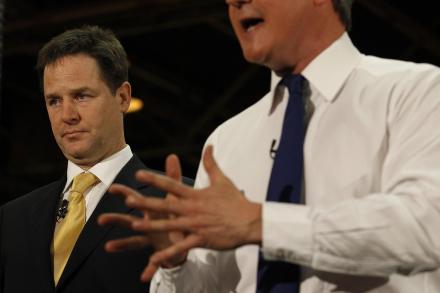
As French and German officials make final preparations ahead of tomorrow’s meeting on fiscal union, it’s worth reconsidering the coalition’s triple referendum lock. James Kirkup has an incisive post on the issue, describing a potential government split. The division was evident on TV this morning: Iain Duncan Smith told Dermot Murnaghan that a referendum would be held ‘if there is a major treaty change’, while Nick Clegg told Andrew Marr that only ‘an additional surrender of sovereignty from us to Brussels’ can spark a vote. Kirkup argues that IDS reflects the broader sceptic position on the Tory backbenches: that the PM has promised a vote on all substantial treaty changes.

The importance of being earnest | 4 December 2011

The absence of growth and the importance of credibility are recurring themes in this morning’s papers. John Lord Hutton has told the BBC that revised growth figures make pension reform even more urgent, and he added that the deal that was put before trade unions was ‘perfectly credible’. Meanwhile, David Cameron has insisted that ministers increase their pension contributions by an average of 4.2 per cent (more than the 3.2 average across the public sector) to show that ‘we are all in this together’. Pensions also feature in an Independent on Sunday interview with Tim Farron, the Lib Dem President. Farron says he has ‘sympathy’ with state employees who are caught

Austerity is not enough

The Euro crisis is terrifying, as Peter Oborne rightly says in today’s Telegraph. But what scares me even more is the paucity of the debate. Right now, the summitry is aimed at saving the euro as if this were an end in itself. Merkel’s logic (‘if the euro fails than Europe fails’) is dangerously simplistic: there are millions out of work, including half of young people in Spain, and they won’t be helped if their dole money is paid in euros. Recovery is needed. Jobs are needed. The euro has always been a project that puts politics first and economics second, with disastrous consequences. It cannot now be solved by

The Gospel according to Delors

An old enemy of England nestles in the pages of today’s Daily Telegraph. Charles Moore travelled to Paris to meet Jacques Delors, the architect of the euro and advocate of Europe’s ‘social dimension’. Moore found defiance where one might have expected humility, perhaps even repentance. Delors insists that the fault was in the execution not the design of the euro. He thinks that the euro’s ‘Anglo-Saxon critics’ were correct in their analysis of the euro’s structural failings; he believes that Europe’s political leaders did not go far enough in ‘founding [economic] co-operation between member states’, which would have promoted the beloved ‘social dimension’ by harmonising fiscal, welfare and employment policies.

A tale of two cities | 2 December 2011

Nicolas Sarkozy is grudgingly admired by French socialists as a political fighter, capable of thriving even in the most desperate situation. David Cameron is coming to understand what they mean. It is the best of times and the worst of times between Paris and London. Two months ago, David Cameron and Nicolas Sarkozy assumed the victor’s garlands in Benghazi; today, they met at odds, if not yet in animosity, over the contested logic of ever closer union in Europe. Sarkozy appears to have got his wish: the 17 countries of the Eurozone will deepen their economic and political relations in an attempt to save the single currency — and with it, he