Europe

An unwanted relation

In June 1981, the United States' Centers  for Disease Control noted in its weekly report that five 'previously healthy' young men in Los Angeles had been treated for pneumonia. Two of them had died. On the other side of the country lived soon-to-be third grader Marco Roth, the son of a doctor and musician. Receiving an 'experiment in nineteenth-century "middle-class" European education', he was surrounded by classical concerts, classic literature and medicine in Manhattan. Oblivious to the fact that that summer's bulletin included some of the first officially recognized deaths brought about by the AIDS epidemic, Roth was also unaware that his own father had been infected by the HIV virus at around the same time.

Mitch’s pitch on Europe

Andrew Mitchell’s piece in the FT today marks his return to normal politics post-Plebgate. Up to now, Mitchell has confined his post-resignation comments either to his old stomping ground of development or to the sequence of events that led to his premature departure from government. By contrast, today’s piece sees Mitchell getting involved in a frontline political issue, Britain’s relationship with Europe. The article is full of suggestions, joint-sittings of the UK-Polish parliament and meetings of the UK-Dutch Cabinets. But Mitchell is clearly determined to work within the framework set out by Cameron’s Europe speech. No one could say that the articles rocks the boat. But what makes it significant to my mind are two things.

The Myth of the Immigrant Benefit-Moocher, Part Two

I am afraid, dear reader, that I have misled you. Yesterday's post on immigrants and benefit-claimants contained an inaccuracy. I repeated a claim I'd seen in the Telegraph that there are almost 14,000 Polish-born people claiming unemployment benefit in Britain. This is not the case. The true picture of Polish benefit-dependency is very different. There are, in fact, fewer than 7,000 Poles claiming the Job Seekers' Allowance. Indeed, there are fewer than 13,000 JSA claimants from the "Accession Eight" countries (Poland, Czech Republic, Hungary, Slovakia, Lithuania, Latvia, Estonia and Slovenia). Whatever else these eastern europeans have been doing in Britain, they've not been mooching off the benefits system. And it is a lie - dirty and simple - to suggest they are.

Are the Tories united on Europe? Pull the other one.

Party unity is one of those things you can measure by the frequency with which the idea is mentioned. The more often it is talked about, the less it exists. When a political party is actually united there's no need to mention party unity. As Isabel notes, Sir John Major has long, wearying, experience of this. The speech he gave yesterday is full of sound advice. Like many other leading politicians, Sir John seems more impressive - and commands more respect - as the years roll on and the memory of his own time in office fades. At Conservative Home Harry Phibbs responds to Major's speech with a piece that notes, in its headline, this "strange outbreak of Tory unity on Europe".

Sir John Major on how to win an EU renegotiation

John Major knows a thing or two about naughty Tory MPs and Europe. So David Cameron would do well to listen to his Chatham House speech today in which he advised the PM to give up on the 'irreconcilables who are prepared to bring own any government or any Prime Minister in support of their opposition to the European Union'. He made two particularly strong points: 1. The Prime Minister should start preparing for the negotiation now. Major doesn't want the UK to leave the European Union, and neither does Cameron. So the former Tory Prime Minister gave a detailed briefing on how Cameron can avoid this. A referendum would only prevent a gradual drift towards the exit if the renegotiation preceding it is successful, and to ensure success, the PM needs to get planning right away.

‘We are the voice of the people’: the MEPs planning to block the EU Budget cut

The EU budget ‘victory’ cheers go on in the Commons, but the facts seem to have been lost in the Prime Minister’s ‘triumph’. What the cheering Tories can’t quite grasp is that all that came out of the European Council last week was an agreed position to make cuts in the EU’s long term budget. That’s all, an ‘agreed position'. It was not a deal. Under the Lisbon Treaty, there is no deal until the European Parliament agrees to one: and the Parliament is in no mood to agree any cuts in EU spending. And if the Council and the Parliament cannot reach an agreement? The Parliament would be delighted.

Cameron closes in on EU Budget success

The news coming back from Brussels is all pretty good for David Cameron, as Isabel noted this morning. He’s not isolated and looks set to succeed in his fight to see a cut in the overall EU Budget. Admittedly, the British contribution will still go up—a result of deals Tony Blair struck at the time of enlargement. But it is still a good result, and one that will please all but the most truculent members of his parliamentary party. Even better for Cameron, is the idea that the European Parliament might veto the deal in a secret vote. Now, this idea is so absurd that it is hard to believe that it is anything other than a Brussels rumour. But if it does happen, it will sum up the kind of spendthrift, opaque, unaccountable Europe that Cameron is opposed to.

Hague stays vague on EU renegotiation details

William Hague stayed remarkably jovial throughout his two-hour appearance before the Foreign Affairs Select Committee today, chuckling happily away even when he was asked to imagine what he'd do if the European Union had never existed. But the Foreign Secretary was considerably less revelatory than he was cheery, offering no new details at all on his party's position on renegotiating Britain's relationship with the EU or on a subsequent referendum. He told a slightly disappointed-looking John Baron that 'it's too early to speak of red lines [for a negotiation]… we don't publish our red lines: that doesn't necessarily help bring about a successful negotiation.

William Hague: Somalia, Pakistan and Afghanistan is where the threat to the British homeland is coming from

On the Sunday Politics, William Hague confirmed that the greatest terrorist threat to the British homeland come from Somalia, Pakistan and Afghanistan. But he argued that without intervention, the Sahel could become as dangerous to Britain. Those hoping for Hague to put flesh on the bones of the government’s European strategy will have been disappointed. The Tory leadership remains determined not to give out anything akin to a renegotiation scorecard. When pressed by Andrew Neil on whether he would advocate leaving if only the status quo was on offer, Hague said that the government would have to ‘use our judgment at the time.’ On gay marriage, Hague reiterated his support for it.

More Tory splits and plots

David Cameron arrived back in the UK this morning to newspapers full of talk of Conservative splits and plots. The moment of unity that followed his Europe speech has well and truly passed. There’s no doubt that the gay marriage is causing a ruckus in Conservative Associations up and down the country and that Conservative MPs will go through different lobbies on Tuesday night. To some extent, this division in the Conservative ranks was priced in. What was not is the continuing and increasingly frenzied leadership speculation. The Mail and The Independent this morning detail plans by allies of the Home Secretary Theresa May to position her for the leadership in the event of a vacancy.

Cheat sheet: the new Spanish corruption scandal

An unemployment rate of 26 per cent (and 56 per cent for young people); an economy that contracted by 0.7 per cent last quarter; tumbling approval ratings. Spanish Prime Minister Mariano Rajoy had enough problems, even before claims that he received about €280,000 (£240,000) in payments from ‘secret’ accounts managed by the treasurers of his People's Party (the PP). Protestors took to the streets of Madrid last night calling for his resignation. El País (Spain's biggest newspaper) published hand-written accounts that it claims were kept by PP treasurers Luis Bárcenas and Álvaro Lapuerta between 1990 and 2009.

William Hague goads Labour on Europe

What a lot of fun William Hague had this afternoon in the Commons as he opened a debate tabled by the Prime Minister on Europe. 'I have not yet exhausted the list of the Coalition's achievements,' he told an MP trying to intervene. His speech was rather like a slow motion version of the PM's address last week, but with words like 'subsidiarity' added in for good measure, and a longer tour of how wonderfully robust the Tory party is on Europe. Though some Tory MPs made their own thoughts on the referendum clear (James Clappison called for legislation in this parliament for a referendum in the next, and Bill Cash said he'd rather the plebiscite take place before the European elections), the focus was on poking fun at the Labour party: a rare moment of Coalition unity.

Cameron encourages his party to bang on about Europe

Something quite curious is going to happen in the Commons this afternoon. David Cameron is encouraging his party to bang on about Europe. He has called a general debate, with the motion 'that this House has considered the matter of Europe', and it promises to be rather strange. The strangest thing is that a month ago, David Cameron would never have dreamed of tabling this sort of debate: his camp were busy in October trying to quell an uprising of backbenchers over the EU Budget. But after the speech that delighted even Mrs Bone last week, Cameron finally doesn't have to wait for a backbencher to pounce on him with entreaties on referenda and renegotiations: he's got nothing to hide now.

The government’s attitude to Romania and Bulgaria is contemptible – Spectator Blogs

Pity the staff at the British embassy in Bucharest. Only last month they were cheerfully banging the drum for Great Britain, telling Romanians what a swell country this rain-soaked archipelago is. You see: The GREAT campaign invites the world to take a fresh look at the UK, and is designed to promote Britain as one of the very best places to visit, live, work, study, invest and do business. Oh dear. Time to reverse ferret. Brother Forsyth reports that the government is so spooked by the appalling thought that plucky Romanians and enterprising Bulgars might think the United Kingdom a land of opportunity that they are considering a new advertising campaign targeting the EU's newest members: Britain is crap. Don't come here.

Europe Minister won’t give renegotiation specifics

There’s ‘no secret plot to get Britain out of the EU’ declared David Lidington on the Sunday Politics. In an interview with Andrew Neil, the Europe Minister was determinedly vague on the issue of what powers the next Conservative manifesto will seek a mandate to repatriate. But he made clear that the free movement of people is not going to be part of the renegotiation nor will Britain seek the right to strike its own trade deals with other countries. Having given the speech, David Cameron and his team don’t want to give a running commentary on what they might or might not seek to change about Britain’s terms of EU membership. Indeed, I suspect that they would like to go into the next election seeking as vague as possible a mandate.

The view from Davos: Boris Johnson’s economic adviser on infrastructure

As the speaker for yesterday's Davos British business leaders’ lunch, Boris Johnson had the audience in his hand in his usual colourful way. I grabbed his very new Chief Economic Adviser, Dr Gerard Lyons, former Chief Economist at Standard Chartered, on the way out. How did he think we are doing economically? He told me the last big economic gathering was the IMF last October in Tokyo.  There, he said, the mood about the global economy was pessimistic, but now, three months later, the mood had improved, if only slightly.  There was more confidence about China and the US but still a lot of caution about Europe.

The view from Davos: Cameron’s mad to talk about leaving the EU

‘Cameron’s speech on Europe is badly timed; we must stop this endless European bickering when facing such huge worldwide political challenges’.  That’s the view of Neil Selby, the London-based Director of Executive Education for the Cheung Kong Graduate School of Business but who at the moment is, like me, here in Davos. ‘Let’s think instead of the links we can make with East Asia’, he tells me. It’s very disconcerting: while in Britain most columnists and commentators seem to be congratulating Cameron on his big Europe speech, here at Davos there’s no enthusiasm. Most of the people around me think the emphasis was all wrong. At a lunch on East vs.

David Cameron marries a Rothschild

In the Jewish joke a matchmaker calls on a poor tailor living in a Tsarist shtetl in the middle of nowhere. He tells the old guy that he wants to arrange the marriage of his middle daughter to the heir to the Rothschild fortune, no less. The tailor isn't impressed. He cannot marry off his middle daughter until he has married off her older sister, he says. He does not want his beloved girl to move far from him, and everyone knows the Rothschilds live in Paris and London. In any case, he is not sure about this Rothschild fellow: he has heard he is irreligious and a drunk. The matchmaker answers all the objections with great patience until, eventually, the tailor relents. 'Excellent,' says the matchmaker, 'now all I have to do is talk to the Rothschilds.

Will Cameron’s EU speech help his drive for gay marriage?

The government's gay marriage bill is published later today, after receiving its first reading in the Commons yesterday. How it's received by the Tory party will be an interesting indication of just how powerful David Cameron's EU speech was this week. When Maria Miller unveiled the 'quadruple lock' to protect the Church of England from being forced to conduct same sex ceremonies, she did so into a febrile Commons. In the tearooms, MPs quarrelled or shook their head at the exodus of stalwart Conservatives from their constituency parties. But the Prime Minister's speech gave the party such a shot in the arm on Wednesday that the atmosphere is currently very different.

PMQs sketch: David Cameron, saviour of Europe

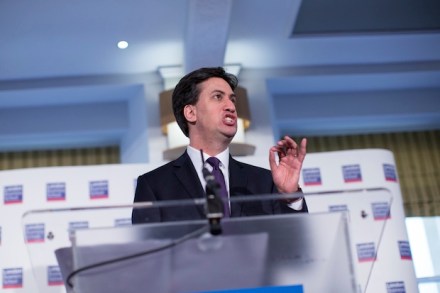
David Cameron’s entrance to the Commons at noon was cheered so ecstatically by his backbenchers that broadcasters decided to run the footage again, straight after PMQs. The Tory cheers redoubled when Ed Miliband rose to quiz the PM. Miliband, however, had discovered a flaw in the prime minister’s position. He probed him on his voting intentions in the European referendum. This should have been clear and simple. It was anything but. ‘Can he guarantee that he will vote Yes?’ said Miliband ‘Yes,’ said Cameron. And he immediately added, ‘I want Britain to be part of a reformed EU.’ So the answer slithered out into a single gloopy sound-bite. ‘Yes-I-want-Britain-to-be-part-of-a-reformed-EU.’ Very clever. And pretty devious.