M.E. Synon

Why you can’t live in a ‘country’ in the eyes of the EU

From our UK edition

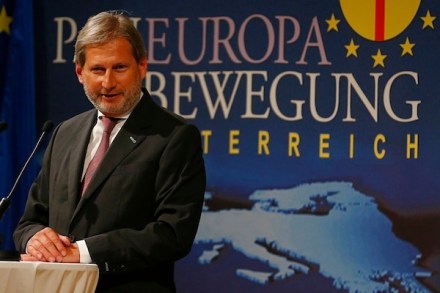
Here is a lesson from today’s European Commission midday press conference on how EU propaganda works, and works at all times and at every opportunity. Whenever a commissioner appears on the podium to make a statement, a specially-designed slide is projected onto the giant screen over his head. Today Commissioner Johannes Hahn (an Austrian, you’ve never heard of him) was on the podium to tell the press corps about his plans to make payments out of the EU disaster relief fund, known as the Solidarity Fund, faster and simpler. Fine. But what was more instructive than anything Hahn had to say was what was projected in giant letters behind him, over a picture of an unidentified town halfway under water: ‘EU Solidarity Fund: faster and simpler for disaster-hit regions.
Is José Manuel Barroso after the top job at Nato?

From our UK edition

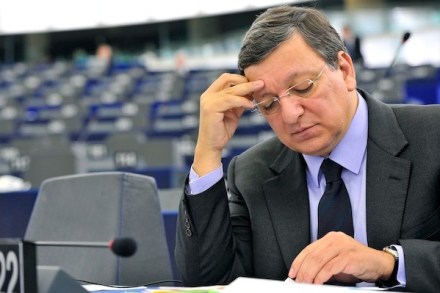
José Manuel Barroso, president of the European Commission, put on a suspiciously big-time press conference today to launch what were really no more than some modest proposals to standardise the European defence industry. On the podium with him at the Berlaymont, and you'd have to ask why, since they ended up looking like backing singers, were Michel Barnier, commissioner for the internal market, and Antonio Tajani, commissioner for industry. One of Barroso’s 24-hour on-call film crews was under his podium, of course, plus news broadcasting crews, and as good a turnout of the Brussels press corps as you could expect this close to beach time. All this to repeat the usual call to standardise the defence sector? Not everyone thought so.

Why William Hague’s ‘red card’ plan won’t work

From our UK edition

Alas, now we know William Hague has joined the list – and it’s a long list – of British government ministers who do not understand how the European Union works. His idea that national parliaments should demand a ‘red card’ system so they can block unwanted EU legislation is muddled in several ways. First is that, if national parliaments are where EU laws should be vetoed, where does that leave the prime ministers who make up the European Council?  Prime ministers – and foreign ministers, and agricultural ministers, and the rest -- go to Brussels and put their vote or their veto (when they’ve got one) on the table when there is any EU legislation that has to be approved.

We are all citizens of Europe now, and the benefits row is just the beginning

From our UK edition

Yes, that law case the European Commission is taking against the UK is mission creep, or ‘a blatant land grab’ as Iain Duncan Smith has it. The eurocrats are trying to extend EU control over the benefits systems of member states, and they are going to the European Court of Justice to do it. But what the commission is after is more than just that. Jonathan Todd, a European Commission spokesman, spelled it out at yesterday’s midday briefing in one line, and in his perfectly English voice: ‘UK nationals automatically have the right to reside in the UK. EU nationals do not have that automatic right.

The EU’s cut-out-and-keep economic timetable

From our UK edition

This morning two European Commission technocrats and a spokesman held an off-the-record press briefing to explain the EU’s economic ‘governance.’ (Governance is the word eurocrats use instead of the more precise word ‘government’, because that word panics the Anglo-Saxons.) They gave it an hour. That’s called optimism, but an hour is about the maximum level anyone in the press corps is going to give on this one, so an hour it was. Why an explanation had to be off the record I have no idea, but, okay, my lips are zipped.

The euro-elite responds to Nigel Lawson’s ‘dinosaur argument’

From our UK edition

I’ve just come from a briefing with a European Union official. He was asked whether Lord Lawson’s call for Britain to leave the EU was a ‘dinosaur argument.’ In response, the official paused. He smiled in an indulgent way. He tilted his head: ‘Mrs Thatcher’s finance minister, who is the father of such a good cookbook author – .’ Another pause, another smile, a gaze at the ceiling for a moment, then: ‘Of course it’s not a dinosaur argument, because it very much reflects debates in certain segments of British politics and as such is something we are constantly confronted with.’ Another pause. Perhaps that word ‘confronted’ was a bit too direct for a fonctionnaire.

Olli Rehn bosses George Osborne around

From our UK edition

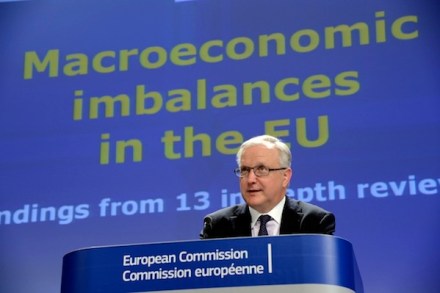
Olli Rehn, the European Commissioner who is in charge of economic affairs, called in the Brussels press corps this afternoon to announce the conclusion of his ‘in-depth review of the macroeconomic imbalances in 13 member states.’ I sat through the launch, and the questions and answers, noting that at no time did Rehn or any of the reporters approach the fundamental question: what exactly is a macroeconomic imbalance and why do we think that Rehn – whose full title includes European Commissioner for the Euro – is the man anyone would trust with analysis of anything macroeconomic? And before you ask, the reason I didn’t ask is that I ration any questions that I know the spokesmen who run these press conferences will consider obnoxious.

How long will capital restrictions last in Cyprus? ‘Can’t say’

From our UK edition

To the European Commission headquarters this morning for a briefing with Michel Barnier, the Frenchman who is commissioner in charge of banking. The press pack wanted to talk about – what else? – Cyprus. But Barnier wanted to talk about his green paper on the long term financing of the European economy.  Which made for the usual pantomime: the journalists sat and scrolled through emails while Barnier read out his plans on how to finance the EU economy without depending so much on banking (good luck there, commissioner). When he finished, the reporters looked up and started the questions about the banks in Cyprus. Reuters asked how long capital restrictions would last in Cyprus.

Cyprus: This isn’t a tax, it’s a bank raid

From our UK edition

You know this levy on Cyprus bank deposits? It’s not a levy. A levy is a kind of tax, and what is happening to the people with bank deposits in Cyprus is no kind of tax, although today the European Commission spokesmen have been insisting it is. How can it be a tax when the depositors are going to be ‘compensated’ with shares in the bank? I mean, when you pay your income tax, George Osborne doesn’t compensate you with shares in RBS.

America’s ‘gun culture’: Does anyone actually know what an ‘assault weapon’ is?

From our UK edition

Before British coverage of the American debate on gun control goes any further, I have to hope the BBC and a lot of other Anglo-Saxons who really ought to be better informed try to find out what they are talking about. The chatter started up again last week after President Obama’s State of the Union address. I don’t mean the ignorance here of the origin of the right to keep and bear arms protected by the Second Amendment to the US Constitution, thought there is that, too. The amendment was not an invention of James Madison, the principle author of first ten amendments, known as the Bill of Rights. In the Second Amendment, Madison was simply affirming the right to bear arms which the people of the 13 States had inherited from English law.

‘We are the voice of the people’: the MEPs planning to block the EU Budget cut

From our UK edition

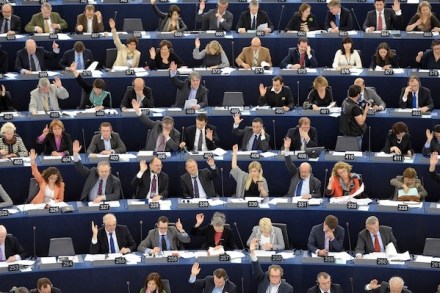
The EU budget ‘victory’ cheers go on in the Commons, but the facts seem to have been lost in the Prime Minister’s ‘triumph’. What the cheering Tories can’t quite grasp is that all that came out of the European Council last week was an agreed position to make cuts in the EU’s long term budget. That’s all, an ‘agreed position'. It was not a deal. Under the Lisbon Treaty, there is no deal until the European Parliament agrees to one: and the Parliament is in no mood to agree any cuts in EU spending. And if the Council and the Parliament cannot reach an agreement? The Parliament would be delighted.

EU Budget: Beware the European Parliament’s veto power

From our UK edition

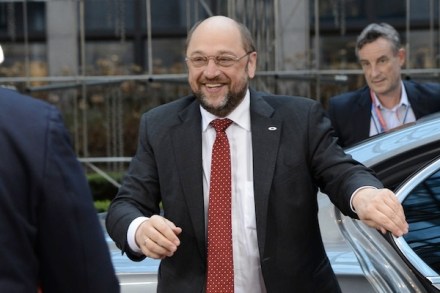
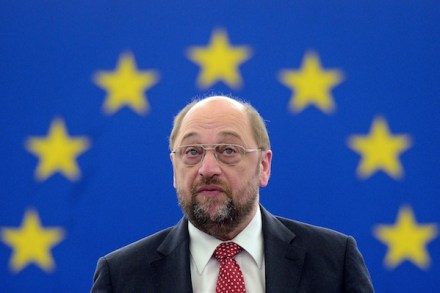
James Forsyth seems as happy as any Tory today, cheered by David Cameron's prowess in the EU Budget negotiations. Even better for Cameron, he says, is the idea that the European Parliament might veto the deal in a secret vote: this is ‘absurd,’ just a rumour. Even if it does happen, it will only point up how spendthrift the EU really is. All good for Cameron. Except from where I’m sitting in the European Council press room, it doesn’t look at all absurd that the parliament might veto Cameron's ‘victory’ budget deal. Martin Schulz, the unpleasant German socialist president of the European Parliament, is looking for a fight on this. And the new powers the Lisbon Treaty gives the parliament over the budget means Schulz can do just that.

Abraham Lincoln, the ‘specious humbug’

From our UK edition

This post by M.E. Synon is the first in a series about Stephen Spielberg's Lincoln. A counter-argument will be published tomorrow, followed by a comparison of screen and literary adaptations of the last months of Abraham Lincoln's life. Last week in Dublin there was the European premiere of Spielberg’s film on Lincoln. Why Dublin? Because the star Daniel Day-Lewis lives in Ireland and he wanted the premiere as a fundraiser for an Irish charity.

The EU renegotiation pantomime

From our UK edition

Today’s midday press briefing at the European Commission was of course dominated by questions about the Cameron speech. This was despite efforts by Pia Ahrenkilde Hansen, Barroso’s spokesman-in-chief. First she tried to downplay the implications of the speech by making an anodyne statement welcoming democratic debate in member states. Then she announced that questions on Cameron’s speech would be limited to three. A growl came up from the press corps that indicated she should think again. So she took more questions. She just didn’t much answer them. I asked Pia if she could describe for me any existing mechanism under present treaties by which Britain could claw back powers which have already been surrendered to the EU.