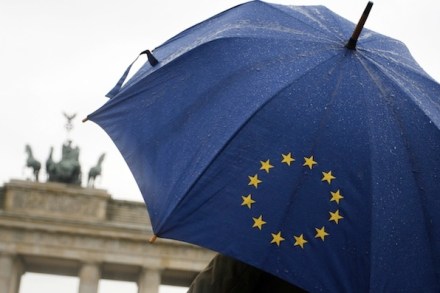
Europe

David Cameron should explain why Europe isn’t working

Philip Collins knows a thing or two about speech writing; but I can’t help thinking that his assessment of what David Cameron should say about Britain and the EU is misguided. Perhaps it’s his Labour blood, but he is fascinated with ‘those in Mr Cameron’s party who are obsessed with Europe in general or frightened of UKIP in particular’. Collins’ analysis seems to suggest (or hopes?) that Cameron’s speech will be primarily for Bill Cash et al. But the speech is the first step to a referendum renegotiating Britain’s position in the EU. The primary audience must be the public – Mrs Bone rather than Peter Bone. Therefore, its content should be about people rather than politics. What might David Cameron say?

David Cameron promises Tory MPs strong 2015 offer on Europe

David Cameron's appearance before the 1922 committee was designed to reassure his party, and he tried to do this by promising them that the Conservative party would be strong on Europe in 2015. It has been a hard term, and today's PMQs was savage, so the Prime Minister decided to start his speech by telling them to think about the Conservative party's record in government. He touched on welfare, on schools, on the NHS - in particular mixed sex wards and waiting times - and income tax. He is clearly looking forward to the next election, too, as he mentioned the appointment of Lynton Crosby, to cheers from those listening, as well as attacking the Labour party. He also told the MPs about the importance of a strong and united Conservative party.

Scottish Independence and Europe: Who does this Barroso guy think he is? – Spectator Blogs

Today's Think Scotland column takes a gander at the rumpus over an independent Scotland's accession to the EU. Until recently the SNP promised that said accession would be automatic. Now it's simply "common-sense".  This is because Jose Manuel Barroso, the Spanish Iberian agent* at the heart of the EU Commission, has made an awkward intervention. Scotland would, he says, not be an automatic member of the club at all. Intuitively this is obvious just as Scotland would not be an automatic member of the United Nations. It would have to apply. Once it applied it's application would most probably be accepted. There are few plausible grounds upon which to reject it. With regard to Brussels, however, the truth is that no-one quite knows precisely what would happen.

The Atlantic, the ocean that made the modern world

Just as the classical world was built around the Mediterranean, the modern world was built around the Atlantic. The Romans called the Med ‘Mare Nostrum’ – Our Sea. The Atlantic, on the other hand, was a place of contest for centuries. European nations fought for supremacy and plunder upon it, traded for wealth across it, and scrambled for territory around it. According to John K. Thornton, author of A Cultural History of the Atlantic World 1250-1820, the creation of an ‘Atlantic World’ was driven by the hunger of European states for hard cash. Money was needed to support the fantastically expensive armies which, from the late Middle Ages onwards, European nations were obliged to maintain as they engaged in a prolonged arms race.

A satisfactory outcome at the EU budget talks for David Cameron

So, the EU budget summit has — as expected — broken up without agreement. We await the date of the next discussion of the matter. But for the moment it means there is nothing that David Cameron will have to try to pilot through parliament. Talking to those close to the Prime Minister, I sense that they are not unhappy with this conclusion. In Downing Street, they feel that their criticisms of the running costs of the EU bureaucracy have struck a chord with other contributor countries. They’re also pleased that Cameron has managed to strike a tough negotiating position without isolating himself. But what is giving them the greatest satisfaction is how solicitous of the British position Angela Merkel was. They regard this as a promising sign for the coming renegotiation.

EU budget talks end

The EU Budget discussions have ended with no agreement, as seemed inevitable after yesterday’s struggles and rows. David Cameron has been copping a lot of flak for his intransigence, particularly from Francois Hollande, who has spent much of the time talking of the need for 'solidarity' with Europe - by which he means the Common Agricultural Policy. Despite these headlines, it's worth remembering that plenty of other countries objected to Van Rompuy's proposals, and for many different reasons. Indeed, far from being isolated, Britain may have forged closer relations with those countries thanks to the experience of these talks.

Where does power lie? Or where should power lie?

Iain Martin has written a cracking piece for the Telegraph entitled: ‘The coming battle with the EU is about sovereignty.’ Iain recommends a new play, 55 Days, which tells the story of the aftermath of the English Civil Wars and the execution of Charles I. He was gripped by this tale of power and politics, and asked Tristram Hunt and Douglas Carswell why the civil wars continue to resonate. Carswell, in his new book, The End of Politics: And the birth of i-democracy, argues that the 2010 intake, on both sides of the House, has revived parliament. MPs are defying the whips to assert their constituents’ views. The MPs are doing this, Carswell says, because the internet has brought them closer to their constituents.

David Cameron under attack from voters, Ed Miliband, David Davis and Angela Merkel on Europe

The Sunday Papers and the broadcast shows are packed with accounts of Britain’s fractious relationship with the European Union, and what that means for David Cameron. The Observer gives space to a poll, the headline of which says that 56 per cent of Britons would ‘probably or definitely’ vote to leave the EU against 30 per cent who would probably or definitely vote to remain in the union. The Independent on Sunday carries a ComRes poll on the more immediate question of next week’s EU budget discussions. The findings will give Mr Cameron a headache: 66 per cent of voters want the budget ‘cut rather than frozen’. The voters will be disappointed: a cut is a fantasy. Even a freeze is looking unlikely because recipient countries are likely to oppose it.

Britain, Scotland, Norway and Europe: lands of magical Sovereignty-Unicorns – Spectator Blogs

Even the cheapest, Poundland crystal ball will tell even a blind observer that Europe is pretty soon going to be a pretty hefty problem for almost all of Britain's political parties. Almost all, I say, because that includes the SNP* whose europhilia is, in some respects, a product of a time that no longer exists. Anyway, the odds of manifesto pledges promising an in-or-out referendum in the next parliament seem to be shortening all the time. I have no idea what this is supposed to achieve since, as best I understand the matter, neither the Conservative nor Labour parties wish Britain to leave the European Union. Asking the question necessarily increases the chances of receiving an answer you do not think sensible or in the national interest.

UKIP are being taken more seriously but they have got to cut out the unforced errors

With UKIP regularly challenging the Liberal Democrats for third place in the polls, the party is now beginning to be treated with the seriousness it deserves. In an interview on the Sunday Politics, Nigel Farage made his usual, spiky case for leaving the European Union. Farage argued that he wants a free-trade deal with the rest of the EU and that the other countries would agree because ‘they need us more than we need them’. Even if Farage is right on the numbers, there’s a major doubt if the rest of Europe would be inclined to cut a deal in the wake of a British exit: a country leaving and then prospering outside would be very damaging to the European project.

Nick Clegg’s opposition to renegotiation could risk the UK’s EU membership

Nick Clegg this morning fell into the usual 'all or nothing' fallacy on Europe. He said: 'As soon as we start talking about repatriation, we descend into the in-versus-out debate.' But the Deputy Prime Minister is wrong: the in/out debate is already underway, and rather than seek to defend the unpopular status quo, Nick Clegg should back renegotiation as the best option for those who wish to put the UK’s membership on a stable democratic footing. But instead of attempting to address the causes for the EU’s unpopularity, the inflated budget, democracy deficit and bureaucracy etc. Nick Clegg sought to channel the debate into his own in/out debate where the problems of ‘out’ justify doing nothing about the problems of ‘in’.

Clegg enrages eurosceptics with ‘false promise’ attack on plan to return powers from Brussels

One of the key challenges for David Cameron this autumn is to address his policy on Europe. A big speech is expected before European leaders meet in December, with some in the Conservative party hoping it will come as soon as next week in order to boost Tory chances in the Corby by-election. But because the Prime Minister is offering definition for his own party on the EU, the other party leaders must do the same. Nick Clegg's speech today set out where he stands, and he didn't mince his words.

Nostalgia fest

Yowser! It’s the mid-1990s all over again. I half expect to hear Ace of Base blaring out of a thousand Ford Cosworths. The Tories are split down the middle on the EU and Heseltine is stamping around, flogging his dirigiste interventionist stuff (which these days commends itself only to Labour, doesn’t it?). What next? Antonia De Sancha (come on, you remember her. “From Toe Job to No Job” was the memorable headline. She was very foxy. Certainly out of Mellor’s league, one would have thought.) There is a supreme arrogance in Nick Clegg telling Tory rebels that they do not stand a chance in hell of getting the EU budget reduced. We have a parliamentary democracy. It wishes the budget to be reduced.

Nick Clegg: There is not a cigarette paper between me and the PM on EU budget

The morning after the government's defeat on the EU budget, Nick Clegg has offered his own advice on the British negotiating position. The Deputy Prime Minister gave a speech to Chatham House in which he said that pushing for a real-terms cut in the budget - which is what 307 MPs including 53 Conservative rebels voted for last night - is 'unrealistic'. Clegg framed his attack on this negotiating position by focusing on Labour rather than Tory MPs. He said: 'Yet it was Labour who agreed to the last long-term EU budget settlement, which saw a major jump in EU spending and lost part of the UK’s rebate in exchange for virtually no real EU spending reforms.

Why David Cameron can threaten to veto the EU budget

When in 1996 the US Congress threw out Bill Clinton’s Federal budget they precipitated a partial shutdown of the US Government. However, anyone looking at the growing prospect of a UK EU budget veto and cheerfully imagining Eurocrats being shut out of their offices on 31 December 2013 will be disappointed. Because when it comes to EU budgets, a veto is not quite a veto - the EU will continue one way or another to claim its dues. Nethertheless, a UK veto is not meaningless. Not least because, as we have set out here, the scenarios that could play out after a UK veto may not be that much worse for the UK than those already on the table (including, ironically, the UK’s own suggested 'freeze').

The Conservative renegotiation strategy

In The Spectator this week, Charles Moore argued that David Cameron — despite his oft-stated desire to renegotiate the terms of Britain’s EU membership — doesn’t actually have a European policy. Charles’ criticisms have clearly stung. For in his Telegraph column, he outlines what post-2015, the Conservatives would seek in any renegotiation: “In essence, the scheme is to turn the EU into two concentric rings. The inner ring shares the euro and undergoes political union. The outer ring avoids both these things and has a looser, trading membership grounded in national parliamentary sovereignty. You could say that this split already exists, in fact if not in theory, but the difference is that, in the emerging model, the EU would be legally reconstituted.

Jimmy Savile and the dangers of received wisdom

What does the Jimmy Savile case tell us about received wisdom? Over the last few weeks it has become clear that one of the most famous people in Britain was known by very many people to be an active, abusive paedophile. Many other people in broadcasting knew it. People in charities he was associated with knew it. People in hospitals he was associated with warned child patients about how to get around it. The person who founded Childline, no less, had heard about it. But nobody said or did anything. We are told that there were various reasons for this. Savile himself is said to have threatened that there would be some funding shortfall for Stoke Mandeville hospital should claims about his rape of children be made public.

Margaret Thatcher and the Tory party’s change on Europe

Charles Moore’s biography of Margaret Thatcher promises to be the most important British political book in decades. Tonight, we got a preview of it when Charles delivered the Centre for Policy Studies’ second Margaret Thatcher lecture. The subject was Thatcher and Europe. I won’t say too much about it because we’re running a version of it in the coming issue of The Spectator. But one thing that Charles demonstrated was that even when Thatcher was campaigning for British membership of the European Community, as then was, she was never in favour of the European project. One of the other thing that Charles’s lecture brought out was the shift in the balance of power in the Tory party on Europe.

Review – A Doomed Marriage by Daniel Hannan

When Dan Hannan's book, A Doomed Marriage: Britain and Europe, arrived through the post I was alarmed to see that it was shrink wrapped in the same way as top shelf pornographic material. For those of you Europhiles who rather warm to the idea of a federal Europe and look forward to the day when we join the Single Currency, this will not be a happy read. But if you are of the Amish wing of the Conservative Party (or even a Kipper), convinced that it won't be too long before the clank of jackboots will be heard on the Mall and that her Majesty will be evicted from Buckingham Palace and replaced by a fat sweating Belgian, then this is not just a book of biblical importance, it will be a masturbatory aid.

Dr Liam Fox on what voters want: anything but the truth?

Dr Liam Fox is no dummie so I'm not sure quite what he means when, as reported by Isabel, he told Tories gathered at a Carlton Club fringe event: What I want is to see us keeping faith with the British people and I want to see us having a slogan at the next election which says ‘Back to a Common Market’, back to an economic and trading relationship with Europe that parks all the political interference in the running of our economy, our workplace, our legal system and all the other things that we don’t like.’ How, pray, is this going to work? Dr Fox surely knows that much of the "interference" to which he objects are laws, directives and other regulations designed to improve, broaden, manage or otherwise regulate the Common Market of which he is so enthused.