Covid

Britain’s bizarre Italian travel guidance

Here’s a tip. When the Foreign Office advises against going somewhere, hop on the next plane. The mandarins have advised against visiting Italy because of Covid-19. It’s as bizarre as everything else that our rulers have said about the virus. Confirmed cases in the UK are currently more than twice as high per 100,000 as in Italy. Anyone with our welfare at heart should be telling us to go to Italy at once. I left the next day. The Italians could be forgiven for serving us our own medicine and quarantining all arrivals from the UK. As it is, they test you at the airport, and quarantine is only required if you test positive. It is rational and very efficient. It takes only ten minutes and costs nothing. Generally, however, the Italian government has much to answer for.

The joy of drinking alone

Thanks to a combination of night-time curfews, social-distancing rules, pubs closing, restaurants failing, the ‘rule of six’ and compulsory mask-wearing, that basic and necessary human need for people to meet for a drink has never been so difficult. Now, with the government’s new three-tier Covid strategy in place, anyone at any moment could find their local pub shut, their parties cancelled, and all forms of indoor mixing prohibited. Millions in the UK are already living under these restrictions. It’s a fair bet that millions more will soon join them. And if the government gives in to demands for a ‘circuit breaker’ — a short-term lockdown — it would in effect totally suspend social drinking as we know it.

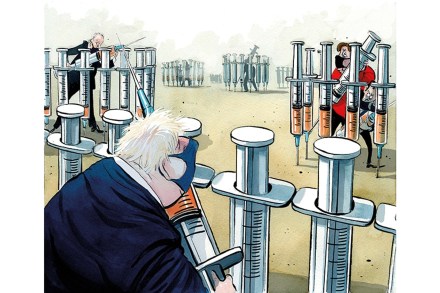
Boris Johnson needs to face down his own people

To beat the virus, the government is asking us to keep to simple hands-face-space guidelines. When these are not followed, the virus spreads, but it is still (apparently) the government’s fault, i.e. the people can do no wrong. That was the case too in Athens’s direct democracy, where anyone whose proposal was ratified by the people’s assembly, but then turned out badly, could still be prosecuted for ‘misleading the people’. Even Pericles. In 431 bc war broke out between Athens, a sea-based power, and Sparta, a land-based one. Since Athens’s walls embraced its harbour Piraeus, Pericles proposed withdrawing the whole population inside the walls, and using their marine dominance to supply Athens and attack Sparta and its allies by sea.

London’s war on motorists isn’t helping anybody

Late one evening in Yangon in Myanmar a few years ago, I noticed a grey Morris Minor van patrolling the streets. It had an old-fashioned double--ended trumpet loudspeaker on its roof blaring out an amplified voice. ‘What’s it saying?’ I asked my guide. ‘It tells the people “It’s late! Stop drinking and go to bed! You have a busy day tomorrow!”’ That’s the spirit. We should get some of that in London. ‘Stop eating! Get on your bike! Pedal faster!’ Why has Covid brought out a rash of virtuous bullying? I have lost count of the number of times that Radio 4 has asserted that this plague needs to create a better, more caring, more aware, lovelier human race. (And if not, we can, of course, be ordered to be so.

Why isn’t the germaphobe President afraid of coronavirus?

The weird thing about Donald Trump’s handling of Covid-19, alongside all the other weird things, is that he has always been a near-pathological germaphobe. He likes fast food, we’ve been told, in part because it is barely touched by human hands; he prefers not to press the lowest button on an elevator; he asks Oval Office visitors to wash their hands in a nearby bathroom; he routinely has a bottle of Purell sanitiser available whenever he has to touch hoi polloi; he lost some real estate deals in the past because he wouldn’t shake hands. Last year, Politico called him ‘the most germ-conscious man to ever lead the free world’.

Why we should consider testing Covid on prisoners

The Covid problem lies as much in the delayed action of the virus as in the virus itself. Since symptoms emerge only days after infection, testing often comes too late to reveal how transmission occurs, and often too late to prevent onward transmission, since many people may be most contagious before symptoms appear. This delay makes the targeting of restrictions far more complex — like weather-forecasting in reverse. (For this reason, what we may have to fear most from bioterrorism is not pathogens that are most deadly but those with delayed action.) If Covid had immediate effects (your hair instantly turned purple) we might have cracked the problem by now. Yet we still don’t know, say, whether the size of the initial dose affects the severity of the disease.

Covid has killed off our civil liberties

It started with smoking. The 1960s and 1970s saw little popular objection to legislation restricting advertisements by private companies purveying a legal product. Little objection was raised thereafter when these same companies were banned from promoting their wares at all. Broadly shamed, even smokers have mutely accepted confiscatory taxes on cigarettes. As laws to protect the public from passive smoking have extended parts of the US to beaches, parks and even one’s own apartment balcony — locations where the danger to others is virtually nonexistent — few have cried overreach. It’s a truism: tobacco companies are evil (and so are smokers). The suppression of smoking is widely regarded as a public health triumph.

Students who catch Covid may be saving lives

It is counterintuitive but the current spread of Covid may on balance be the least worst thing that could happen now. In the absence of a vaccine, and with no real prospect of eradicating the disease, the virus spreading among younger people, mostly without hitting the vulnerable, is creating immunity that will eventually slow the epidemic. The second wave is real, but it is not like the first. It would be a mistake to tackle it with compulsory lockdowns (even if called ‘circuit breakers’), whether national or local. The cure would be worse than the disease. If you cannot extinguish an epidemic at the start, the best strategy is for the healthy to get infected first. Lockdowns ensure that the vulnerable and the healthy both get infected with similar probability.

The jackboot zealotry of ushers is ruining theatre

Southwark Playhouse has revived an American show, The Last Five Years, whose run was cancelled in March. In advance, I received an email outlining the theatre’s new rules, which appeared to exceed the minimum legal requirements. At the venue, I found that the main entrance had become the exit while the side door had become the main entrance. What for? Perhaps an unsubtle reminder that ‘everything’s changed now, pal, so get used to it’. The queue on the pavement moved at a turtle’s pace because the usher gave each playgoer a homily about the new regime before allowing them to pass through Checkpoint Charlie. Inside it was like an army hospital. Sentries in the corridors regulated our access to the loos.

Letters: what unites the two sides of the mask debate

Wind worries Sir: You are right to side with the 2013 version of Boris Johnson, when he claimed that wind power could not pull the skin off a rice pudding (‘Boris’s second wind’, 10 October). However, it was wrong to claim that offshore wind at £40 per megawatt hour makes Hinkley Point C, at over twice that price, look like a bad deal. The nuclear plant will be able to provide reliable, constant baseload power for up to 50 years. A wind plant will provide power only when the wind is blowing (and not blowing too hard). To provide reliable baseload requires fossil-fuelled backup. Second, the £40 per megawatt hour is the current strike price offered by the winners of projects to build new capacity.

Who will have more informants: the Stasi or Covid marshals?

Information overload The government’s plan to put ‘Covid wardens’ on the streets to enforce the new rule against more than six people meeting in public has been likened to the practice of the East German Stasi relying on mass informants. How many East Germans worked on behalf of the Stasi? — According to historian Helmut Mueller-Enbergs, 620,000 Germans acted as informers during the 51-year history of East Germany, including 12,000 West Germans. — When the Berlin Wall fell in 1989, 189,000 East Germans were Stasi informants, just over 1 per cent of its 16 million population, and one in 20 Communist party members. Back in business? In which sectors is the jobs market recovering most strongly?

Why I’ve given up on handbags

I have given up handbags. Men may think this a trifling thing. Women will understand it was not a painless decision. In my adult life I had rarely left home without a bag. Sometimes just a small clutch bag, but more likely a bucket bag which hung, with the weight of a Yorkshire terrier, from my shoulder. I have a dent in my collarbone to prove it. Then came Covid. You may remember that obsessive hand-washing was the first thing asked of us. It preceded social distancing, mandatory masks and the proscription of everything that makes life enjoyable, and though I’m not a herd animal I did give some thought to my normally relaxed attitude to germs. For one thing, I use public transport a lot. Wherever I went, my bag went with me.

Letters: Why does No.10 seem so oblivious to the threat of Scottish independence?

Referendum risk Sir: James Forsyth’s excellent analysis (‘To save the Union, negotiate independence’, 5 September) has one flaw: it is not quite correct to say that ‘there is no way a legal referendum can take place without Westminster’s consent’. That is true for a decisive referendum that would commit the UK to the outcome, but not necessarily true for an advisory one. The Commons Library briefing paper (29 May 2019) says that the devolution legislation is unclear and the matter ‘has not been resolved’. This view is supported by the Institute for Government. Nicola Sturgeon is likely to take the issue to the Supreme Court which, with its two Scottish judges, is quite likely to side with Edinburgh.

The danger of following ‘the science’

I have decided to divorce my wife after 31 years on scientific grounds. Though perfectly happy, on reassessing my original decision to enter matrimony it has emerged that at no point was that choice subject to peer review, there was no randomised control trial, the experiment could not be replicated and the data-set on which I based my decision failed to provide the levels of statistical confidence required. In reality, what you don’t know is always more critical than what you do I don’t think my decision to marry was bad, but it was definitely unscientific. Most important decisions are. Indeed if one phrase has most irritated me in the past few months, it is ‘the science’. What is ‘the science’ on masks?

How scared are we still about Covid?

Pink and twisted Bernard Matthews, which stopped making Turkey Twizzlers in 2005 after criticism about unhealthy school dinners from Jamie Oliver, announced it is reintroducing the product. It will contain up to 70% turkey, compared with 34% originally. — Bernard Matthews came up with the idea of making twisted pieces of turkey, allegedly as an accidental by-product from a machine which stamped out imitation drumsticks from reconstituted turkey meat. — The name ‘Twizzler’ was also used by a Pennsylvania confectionary company, Y&S Candies, from 1929. The product, still sold in the US, is made from corn syrup, flour and sugar, with strawberry flavouring. Covid courage How brave have the British public been feeling over Covid-19 in the past week?

If the office is ‘too dangerous’, why is everyone jetting off on holiday?

The whole of Surrey and south-west London seem to have gone abroad on holiday so I’ve got my sanity back. All the people who were working from home because they couldn’t risk Covid-19 but who had to go out walking and cycling in the countryside all day long have simply vanished. Anecdotal evidence suggests that many of the Covid-phobics have got on planes and enthusiastically breathed as much re--circulated air as it takes to get them to a villa by the sea. The cyclists and the runners and the ramblers with backpacks with cooking pots sticking out of the top have all evidently decided they didn’t need to bother me any more by trespassing through my horses’ field, and have gone somewhere they really wanted to be. That was half the problem.

The dying need real conversation, not false cheeriness

A nurse friend recently finished six weeks in a Covid intensive care unit where she witnessed many deaths and always ensured that nobody died alone. She sat holding a hand, listening, reassuring. Now on leave, she is writing down some of her experiences with the dying. A wise priest I knew said that no matter how strong your faith, your view of what happens at death and ‘the life of the world to come’ should be an agnostic one. But he still recounted some remarkable things he witnessed when sitting with the dying, and my nurse friend described similar experiences.

No place but home: how Covid will change the property market

It took a trip to the Land of Oz to make Dorothy value her home. For the rest of us, it took a global pandemic. During the past two months, our residence — whether that be a mortgage-free house or shared rental flat — has become our entire world: office, restaurant, cinema, gym and shelter, all rolled into one. If we didn’t know the ins and outs of our quarters before, we do now. Many people have developed a more personal understanding of a market that has played a vital role in shaping the British economy for decades. Housing costs in Britain are some of the highest in the world, more than quadrupling since the 1970s.