Conservatives

Gove gets into gear

‘This government ends if the red wall reverts back to type and we lose 45 seats then end up in hung parliament territory,’ warns one secretary of state. This comment is a reminder of how vital it is for Boris that levelling up is seen to be a success. The rewards of getting it right are considerable. The Tories’ reward for that would probably be another decade in power: one cabinet loyalist says, ‘The boss wants to see a world where Labour are shut out. We consolidate the red wall.’  Michael Gove and Andy Haldane have found inspiration in 15th-century Florence But fixing regional disparities isn’t easy: it is hard to find any country where levelling up is a mission accomplished (as opposed to a work in progress).

Will the Tories cut taxes before the next election?

The Tory party has reached a fork in the road, I say in the Times today. One path involves sticking to the spending plans, hoping to cut taxes before the next election and getting rid of the new perception of them as tax raisers. The other drags them into ever more spending, led by big increases in public sector pay, and ends with them going to the country as a high-tax party. In his Budget speech and his address to Tory MPs, Rishi Sunak made clear that his preference was for the former approach, which should cut taxes before the country goes to the polls again. But sticking to even the spending limits set out this week will require tough choices that the Tories have not wanted to make in recent years.

Andrew Mitchell relives the agony of Plebgate

Andrew Mitchell, as he readily admits, was born into the British Establishment. Almost from birth, his path was marked out: prep school, public school, Cambridge, the City, parliament, the Cabinet. At every step along the way he acquired the connections that would propel him to the stratosphere. But for one extraordinary event, who knows where he might have ended up? Certainly in one of the top jobs. In other circumstances this might have been a conventional story. Posh boy goes into the City, makes loads of money and then takes time out to come and govern us. In fact this is an unusual memoir — honest, self-deprecating and rich in anecdote. A fundamental streak of decency runs throughout.

Rishi Sunak’s low tax pitch to MPs

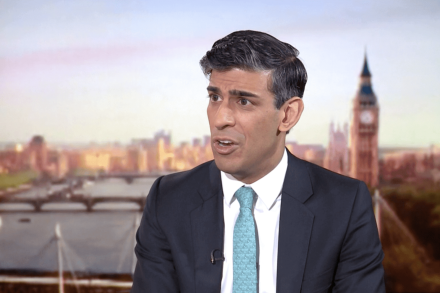
Is Rishi Sunak a low tax chancellor? He certainly likes to tell anyone who will listen that he is. Yet his actions tend to suggest the opposite. The tax burden is currently on track to reach its highest level since the early 1950s, and while Sunak unveiled one big tax slash in the Budget in the universal credit taper rate cut, the main thrust of Sunak's announcements was spend, spend, spend. Tonight Sunak addressed Tory MPs at a meeting of the 1922 committee. After announcing £150 billion in extra public spending, Sunak sought to convince his party that, despite this, he was committed to lowering taxes.

Why did we decide that Covid was over?

Look, I don’t know much epidemiology. Can’t pretend to. So what follows is, necessarily, a personal finger to the wind. But perhaps it chimes with your experience.  First time round — back in the days when we were all huddled indoors, leaving the house only to stand on the doorstep of a Thursday night to bang pans with a wooden spoon, or making solo expeditions to a denuded supermarket where we do-si-dohed around each-other in the aisles… yes, back in those days, I didn’t know very many people who got Covid. Acquaintances, the odd friend. Some scary stories. Some scarier statistics. But not so many ‘rona stricken friends. Could we inch towards herd immunity down a road scattered with corpses rather than heaped with them?

MPs gather to pay tribute to Sir David Amess

Boris Johnson announced this afternoon that Southend will receive city status as a tribute to the campaigning work of Sir David Amess, who was killed. Sir David's best known Commons contributing was Inserting Southend's bid to become a city into any question, no matter how tenuous, and it seemed an inevitable way of the government marking his death. MPs paying their respects to the Southend West MP have all focused on his dedication to his constituency, but also on his kindness. Johnson told the chamber that 'he was... one of the nicest, kindest, and most gentle individuals ever to grace these benches'. Everyone mentioned his smile and his sense of humour.

It’s no wonder young people don’t understand levelling up

There are two ways Number 10 can look at new polling which shows only 14 per cent of Britons understand the slogan ‘levelling up’. The first: the government has utterly failed to communicate its signature policy. The second: at least they didn’t poll the Cabinet. The findings, which come in research by Redfield & Wilton Strategies for PoliticsHome, are interesting for what they tell us about now much the slogan has cut through (66 per cent have heard of it) versus how much it's been understood (one in three haven’t the foggiest what it refers to).

David Amess was killed doing one of the most crucial parts of an MP’s job

Sir David Amess was killed in the line of duty. He was doing one of the most important – and vulnerable – parts of an MP’s job, and he was killed while doing it. Most of the week, MPs go to work in a palace under armed guard. They live in houses with CCTV, panic alarms and rapid police response mechanisms in case of trouble. These measures have gradually been added to their lives as the perceived threat has increased. But in just over a decade, three serious attacks against MPs have taken place in the one place where they lack such security: their constituency surgeries. Stephen Timms was stabbed at his surgery in 2010. Jo Cox was murdered leaving hers five years ago. Today, Amess was killed at his.

Why Covid means the big state is back

History suggests that when the state expands in a crisis, it doesn’t go back to its pre-crisis level once the emergency is over. After the first world war, the Lloyd George government extended unemployment insurance to most of the workforce, fixed wages for farm workers and introduced rent controls. The second world war led to Attlee's nationalisations, along with the creation of the NHS and the modern welfare state. In the magazine this week I ask if Covid will lead to a permanently bigger state. There is another danger in all this intervention: can the country afford it? Last year, state spending exceeded 50 per cent of GDP for the first time since the end of the war.

David Frost’s protocol diplomacy

As a general rule in post-Brexit politics, when David Frost makes a public intervention on the Northern Ireland protocol, it tends to dampen rather than soothe UK-EU relations. Frost, charged with improving the protocol, is a divisive figure in Brussels who is seen to catch flies with vinegar rather than honey. His speech was expected to be an escalation in the current war of words between the two sides. In the end, the talk itself was slightly less confrontational than expected. Frost effectively declared the Northern Ireland protocol dead and called on the EU to work with the UK Frost effectively declared the Northern Ireland protocol dead and called on the EU to work with the UK to come up with a new protocol to prevent a hard border on the island of Ireland.

The Tories will pay a price for Boris’s housing strategy

One of the themes of Conservative conference was that the government has dropped plans for a radical reform of the planning system, which was designed to get more houses built in the south east. Both Boris Johnson and the new party chairman Oliver Dowden were keen to stress this point. But, I say in the Times today, this is a mistake. The Tories are the party of the property-owning democracy, and live and die by this The Tories have been spooked by the Chesham and Amersham by-election where the Liberal Democrats ran hard against planning reform and took the seat on a 25 per cent swing from the Tories. Boris Johnson will pay little immediate electoral price for this U-turn. Indeed, at the next general election he’ll probably benefit from it.

Build Back Boris!

As a clarion call, a sounding of hosannas, a piece of fiery rhetoric to hold puissance over the soul of the nation, 'Build Back Better' is a raspberry. It is a stock that will never sell, a verbal wreck. It lacks zing and pep and, above all, Boris. If Lenin had disembarked from his sealed train and told the frenzied crowds that he would 'Build Back Better', they would have packed him back to the Huns. Having said that, there were times yesterday when Boris riffed on the theme and seemed a bit more himself. ‘Build Back Beaver,’ he said. (Was Carrie backstage?) And even ‘Build Back Burger,’ which sounded encouragingly like the Boris of yesteryear that we have missed so sorely. That’s when a thought struck me.

Levelling up is Johnsonian cakeism

Until this morning, few people in Britain will have heard of the works of Wilfredo Pareto (1848-1923). Now, thanks to prime ministerial recommendation, his name is suddenly on everyone’s lips. Maybe he was even the inspiration for the name of Boris Johnson’s one-year-old son. Pareto, apparently, is the inspiration behind the whole idea of ‘levelling up’ But was it good idea to raise the memory of the Italian economist and political philosopher? Pareto, apparently, is the inspiration behind the whole idea of ‘levelling up’.

Watch: highlights of Boris Johnson’s conference speech

So that’s it. The end. Tory conference wraps up today with Boris Johnson delivering a policy-light leader’s speech to close the four day Conservative jamboree in Manchester. Surrounded by campaign placards like a traditional electoral rally, Johnson made an hour long speech peppered with talk of ‘building back better.’ And in traditional Boris style, there were, of course, jokes - ones which fortunately landed better than some of the more laboured ones he’s been making at evening receptions. Below are five of the PM’s best moments from his address to the Tory faithful. https://www.youtube.com/watch?v=3Vj0kdN08dg https://www.youtube.com/watch?v=Kn7TgiJHMPc https://www.youtube.com/watch?v=GqdaZAG2l68 https://www.youtube.com/watch?

Johnson’s speech will have reassured his supporters

When Boris Johnson addressed his party in his first in-person conference leader's speech since winning a majority of 80 seats, he did it in a different hall to the room his ministers have spoken in this week. The larger set not only helped make the Prime Minister's speech stand out, it also meant that it could take on the form of a rally. The main stage was surrounded by supporters holding placards with various government slogans. It was a theme of Johnson's rallying speech as he crowbarred 'levelling up' and 'build back better' (at one point morphing into 'build back beaver') into a lively address to his party — aimed at reminding them why he was an election winner.

Liz Truss: ‘It’s raining men’

It’s the final day of Tory party conference today, with all eyes on Boris Johnson’s speech at midday. But will all the cabinet be there to watch it, bright-eyed and bushy tailed? Judging from last night’s antics, Mr S suspects that the answer may be: no. Truss, wearing a striking green number, stood out a mile in a sea of identikit Tory boy blue suits Work and Pensions Secretary Therese Coffey was seen belting out ‘The Time of My Life’ at the legendary inHouse comms karaoke party while many of her fellow ministers attended The Spectator’s own champagne-fuelled shindig.

Sunak faces the free-marketeers

Rishi Sunak didn’t give too much away tonight when he spoke in the 'ThinkTent' at Conservative Party Conference. The Chancellor is known for being cautious with his words, and has been increasingly tight-lipped in the weeks leading up to his October Budget. But his presence at the fringe event was telling in itself. Sunak was only billed for one public fringe event this year, co-hosted by the Institute of Economic Affairs and Taxpayers’ Alliance. Their ‘ThinkTent’ boasts some of the most free-market, libertarian events you’ll find at conference: both organisations are strong advocates for a low-tax, smaller state. So, not necessarily an obvious place to find the Chancellor who has overseen record peacetime spending over the past 18 months.

Priti Patel strikes a bullish tone

The theme of Priti Patel's party conference speech this afternoon was very much 'large and in charge'. She devoted much of her address to talking about the immigration system, as you'd expect, promising stronger crackdowns on people being smuggled across the Channel in boats. Patel focused on the Vote Leave favourite: taking back control Whereas Boris Johnson and Michael Gove have talked about Britain 'voting for change' in 2016, Patel focused on the Vote Leave favourite: taking back control. She told the conference hall this was the key theme of her reforms to immigration, saying: 'My new plan for immigration is already making its way through parliament. At the heart of this plan is a simple principle. Control. That is not unreasonable.

The fantasy world of Boris Johnson

In One Thousand and One Nights, Scheherazade must begin a new story every evening. She must make sure that the sultan is so eager to hear its conclusion he postpones his plans to execute her. On they go, month after month, year after year, a different story every day. I want you to imagine Boris Johnson as Scheherazade. He is taking the stage at the Conservative party conference dressed in diaphanous silk harem pants, a velvet top with chiffon sleeves, a veil to hide his true expression, and with pearls taken from the jewellery collection of a Russian oligarch’s wife laced through his hair. Johnson, too, knows he must come up with a new story every day.