Books

Let’s just go ahead and ban books

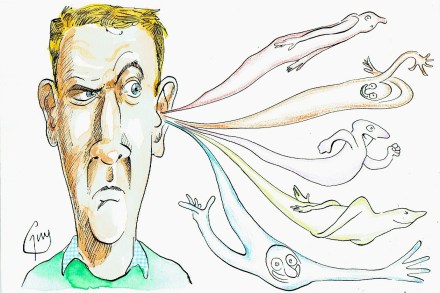
We should save ourselves some time and ban all books. They’re too much trouble. For example, Elin Hilderbrand, author of Golden Girl, hates Anne Frank. We know this because a teenager in the novel quips that hiding in a friend’s attic for the summer would make her 'like Anne Frank’. Didn’t Hilderbrand get the memo? Teenagers are not allowed to make jokes (or mistakes). One presumed reader wrote to the book’s publisher, 'As a Jewish woman, one who lost 18 members of her family in the Holocaust I'm disgusted in you as a publisher that you allowed that line to be published. It's inexcusable.’ Good for her! Hilderbrand was clearly insulting Anne Frank’s legacy, making excuses for the Holocaust and pledging her allegiance to Hitler.

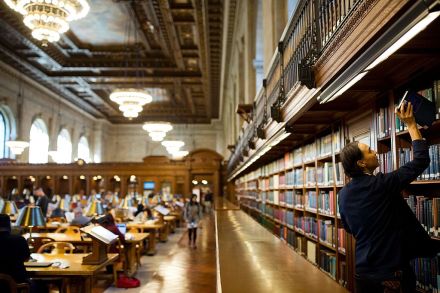
unread library

Remembering David Storey, giant of postwar English culture

From our UK edition

There is a famous story about David Storey. It is set in 1976 at the Royal Court where, for ten years, his plays had first been seen before heading away to the West End and Broadway. That same week he had won the Booker Prize with his novel Saville. With unrivalled success across fiction, theatre and cinema, Storey was a giant of postwar English culture. He was also, compared with most writers, an actual giant. This Sporting Life, his novel made into a groundbreaking film, grew out of his experience of playing rugby league for Leeds. Unlike Saville, his new play Mother’s Day was greeted by a raspberry fanfare after Alun Armstrong dried during a speech containing 27 uses of the f-word.

What does your wedding reading say about you?

From our UK edition

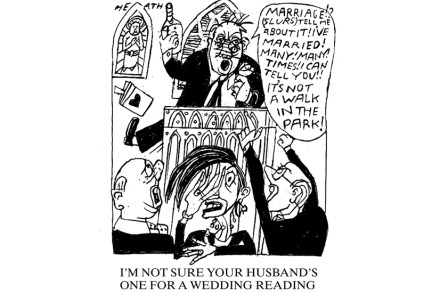
Arts journalism, like crime, doesn’t pay. So I’ve been thinking of getting a side hustle. ‘You know about books and stuff,’ say friends who are getting married. ‘What should we have for our readings?’ If I can advise friends, why not strangers? By the laws of wedding economics — pick a number and add some noughts — I could make a marital mint. We’d start with a couple’s questionnaire. No good my offering Rainer Maria Rilke if they’re more of a Purple Ronnie pair. Then a consultation over Zoom, before proposing something old, something new, something sonnet, something haiku. It is, tentatively, wedding season again. Boris and Carrie kicked us off last weekend. I wonder what they went for?

How TikTok can turn a book into a bestseller

From our UK edition

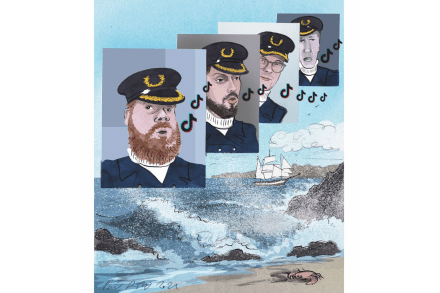
I have an American friend who loves reading, but is clueless about technology. The last time I visited him he was still using Internet Explorer, which even Microsoft has given up on. My friend was puzzled when he walked into his local bookshop and was met by a table of books with the sign ‘#BookTok made me read it’. Soon afterwards I received a bewildered WhatsApp message: ‘What is BookTok?!’ Until recently, I didn’t know. Before the pandemic, I was a working stand-up comic. I’ve never been on television and you probably haven’t heard of me, but I was happy. I worked six nights a week, made enough to pay the bills and was recognised occasionally by someone in Tesco. And then came lockdown.

The problem with decolonising Shakespeare

From our UK edition

Scarcely a day passes without a major British institution announcing it is ‘decolonising’ itself. Most recently it was the turn of Shakespeare’s Globe, which announced a series of ‘anti-racist Shakespeare webinars’ as part of its ‘commitment to decolonising the plays of Shakespeare’. That brought me up short. At the time of Shakespeare’s birth, England didn’t have any colonies, although other European states did. True, The Tempest can be read as a metaphor for colonialism, with Prospero taking Sycorax’s island from her and enslaving Caliban, but Prospero is Milanese, not British. And it’s not exactly an argument in favour of colonial rule. Prospero wants nothing more than to return to Milan to reclaim his dukedom.

Help yourself to self-help

Self-help has been a popular American pastime at least since Dr Diocletian Lewis toured the countryside in the 19th century. Dr Dio preached to huge, rapt crowds about the salutary effects of gymnastics, chastity, sobriety and loose clothing. He eventually cofounded the temperance movement. Having deprived Americans of their preferred entertainment, Dr Dio went on to invent the beanbag. A century later, The 7 Habits of Highly Effective People by Stephen Covey sold tens of millions of copies and inspired spinoffs for families, companies and teens, as I learned when my mother gave me a copy during a particularly ineffective period of my adolescence. Covey, a Mormon, was the spiritual heir to the clean-living crusaders of the temperance movement.

self-help

The soul of Flannery O’Connor

Since the racial riots last summer, Flannery O’Connor has been scrutinized by literary critics and activists for reasons wholly unrelated to her literary artistry and her formidable oeuvre, whose size, though not large, is remarkable for a writer who died at the age of 39 after having been diagnosed in her mid-20s with lupus. The abruptly renewed interest in Miss O’Connor could be said almost to amount to an O’Connor revival were it not focused on a single question: ‘Was Flannery O’Connor a racist, or was she not?’ Attempts to answer it have involved an evaluation of her character based on her novels, stories and voluminous correspondence, and led in one instance to the critical conclusion that she was ‘not a saint’.

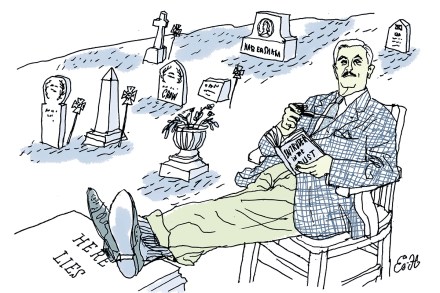
O'Connor

Books you shouldn’t read in public

Headed to the hospital recently for a rather unpleasant surgical procedure, I figured I’d bring a book to pass the down time. I was about to grab Ron Hansen’s Mariette in Ecstasy, the novel I’d been reading about a nearly 20th-century Catholic postulant who may or may not have seen a vision of Christ and suffered stigmata on her hands and feet. But the thought of nurses and order-lies glancing at the title, thinking ‘pervert’ and perhaps surmising that my demise really wouldn’t be all that great a loss for human-kind dissuaded me. Instead I brought along the Buffalo News sports section. I told a Kentucky woman about this titular discretion.

books

Spells and bindings

In 1791, Isaac D’Israeli, father of future prime minister Benjamin, published his most famous work, the Curiosities of Literature, a collection of freewheeling mini-essays on whatever literary topics happened to tickle their author’s fancy: ‘Titles of Books’, ‘Noblemen Turned Critics’, ‘On the Custom of Saluting after Sneezing’, ‘Cicero’s Puns’. One of its joys is its capaciousness — completely unsystematic, yet seeming somehow to touch a little on everything. The book is long, but the essays are rarely more than a couple of pages, sometimes less.

library

The SNP’s nonsensical Covid book ban

From our UK edition

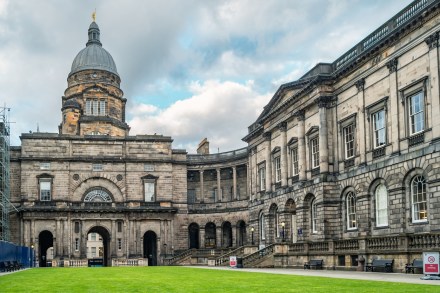
Why is the SNP banning books? On 5 January the Scottish government introduced a strict new lockdown in response to the spread of a more infectious strain of Covid-19. As a student at the University of Edinburgh, one particular restriction has baffled me ever since. Unlike in England, Wales or Northern Ireland, the Scottish government decided to ban students from reading, borrowing or even touching books in their university libraries. Even as fears rose over the rapidly spreading ‘Kent’ variant, it seemed that this policy lacked any scientific foundation. The Scottish government’s explanation for its book ban is baffling, and seems to be just copied and pasted advice from public websites and bluster over the importance of fighting Covid.

What does science say about souls?

From our UK edition

Until the mid 19th Century, most of us believed that we had a soul. It was what separated us from the animals. This belief could be modified to accommodate slavery, Malthusian economics and to allow dogs into Heaven, but the principle was pretty stable. A hundred years later, thanks largely to Darwin, and innovations such as quantum mechanics and Auschwitz, such a view seemed childlike, romantic, or in the case of the Clergy, downright dogged. The 'soul' became just another invention of the under-informed, over-excited primitive imagination, like faeries, Valhalla and insidious whispering serpents. We have Science now.

How I learned to love audio books

From our UK edition

According to a charity called Fight For Sight, 38 per cent of people who’ve been using screens more during lockdown believe their eyesight has deteriorated. I am definitely in that category. This time last year, I didn’t need reading glasses; now I do. When I’m working at my desk this doesn’t much matter, but it has made reading in bed more difficult because I was in the habit of doing this on an iPad under the covers so as not to wake Caroline. Keeping my glasses in place while lying on my side, with one hand clutching my iPad and the other pulling the duvet tight over my head to eliminate any light pollution, is surprisingly difficult. The upshot is I’ve switched over to talking books.

The Sistine Chapel as you’ve never seen it before

From our UK edition

‘The World’s Most Lavish Art Book’ is a pretty big claim, but when two men lugged it through my front door I conceded that The Sistine Chapel is one monster tome. Three, actually. Three hardback volumes, each two feet-tall, each weighing nearly two stone, each in its own calico bag, comprising of digitally perfect photographic recreations of the artwork in the 15th-century chapel. The first volume deals with the masterpieces along the walls, while volumes two and three are a quasi-Greatest Hits, one covering the Sistine ceiling and one the ‘Last Judgment’, both of course by Michelangelo and one of the most famous art sequences on the planet.

From ancient Greece to TikTok: a short history of the sea shanty

From our UK edition

Many things are now normal that would have seemed unlikely a year ago. But even in this strange new world the sudden rise of the sea shanty is, perhaps, strangest of all. It all started in December when Nathan Evans, a postman from North Lanarkshire, posted a video of himself online — a lone figure filmed in no-frills close-up, hoodie high under the chin, beanie pulled down to the eyes — singing the 19th-century whaling song ‘Wellerman’. A trickle of views became a storm, thousands turning to millions (now billions) and just like that sea shanties went from kitsch, Last Night of the Proms novelty to global phenomenon. The song went viral — the centre of a new internet craze: #ShantyTok. Fast forward a few months and Evans, whose song went to No.

When the past becomes a page-turner: our pick of the best history books

From our UK edition

'May you live in interesting times’. So the Chinese curse goes, and we undeniably live in interesting times, alas. But that doesn't mean the past has lost any of its allure; indeed, quite the opposite. Right now, it's just the tonic we need. If you found history dull at school, being merely an endless parade of facts and heavy-handed analysis, then you are the perfect potential reader for these superb examinations of past eras by some of Britain's best popular historians.  Here are half a dozen of our favourite page-turning history books, guaranteed to have you rapt and astonished at the revelations therein. Dan Jones – The Plantagenets (William Collins, £10.99) Perhaps the most popular new historian of our generation is the medieval writer Dan Jones.

The best novels to read this year

From our UK edition

There will be many great new novels published this year, but, sadly, even in lockdown, not enough time to read them all. Here are just a few that might be worth adding to the reading pile:  Mother for Dinner by Shalom Auslander  This is the novel I’m most looking forward to this year. Shalom Auslander’s Hope: A Tragedy is one of the funniest books I’ve ever read, telling the story of a frazzled family man living in a rural US town whose life is made even more stressful when he discovers an elderly Anne Frank hiding in his attic. The premise for this long-awaited new novel, which comes just the nine years after Hope: A Tragedy, is equally as delicious - or perhaps not, as it’s about a man whose mother’s dying wish is for him to eat her.

Will Camilla’s book club sink or swim?

From our UK edition

If nothing else, the nation's latest online book club will be its poshest. The Duchess of Cornwall has thrown her feathered fascinator into the ring with Oprah Winfrey, Reese Witherspoon and Richard and Judy to found — as she announced on her Instagram feed — an online book club called The Reading Room, in which she’ll be sharing personal recommendations, author interviews and kits of suggested questions for exploring the texts.  There’s every reason to welcome this as a serious project. Camilla has been closely involved with the Booker Prize for many years, is a patron of seven literacy charities, and is known to read widely and intelligently.

Most artistic careers end in failure. Why does no one talk about this?

From our UK edition

It is a standard narrative in all showbiz reporting, and one that arts hacks seem to be duty-bound to abide by. It is the fairy tale of ‘Making It’; the story of a star whose career took time to get off the ground but, thanks to perseverance and self-belief, went stratospheric. It goes like this: ‘I was a nobody, and I was turned down from everything. And I nearly didn’t go to that final audition, but whaddya know? I turned up and… Shazam! Oscars raining down and a mini-series on Netflix.’ There is an encyclopaedia of stars who toughed it out before making it big.

The grumpy genius of Raymond Briggs

From our UK edition

Raymond Briggs has often spoken of his annoyance at being associated with Christmas. His Snowman may fly across our screens each Christmas day, but in the book there is no Father Christmas, no sleigh, and certainly no figgy pud. The North Pole scene featuring the jolly elf was written into the story for John Coates’s TV adaptation in 1982 and struck Briggs as rather mawkish at the time. As readers and viewers of Father Christmas know, Briggs’s Papa Noël is anyway rather a grouch at this time of year. As if the cold isn’t enough for him to contend with, there are the chimneys, the tasteless presents, and, oh yes, ‘blooming Christmas’ itself.

Every page of this astonishingly beautiful ode to the citrus is a treat

From our UK edition

There’s an episode of Yes Minister called ‘Equal Opportunities’. Minister Jim Hacker is under pressure to recruit more women to the civil service. The hunt is on for female mandarins. ‘Ah,’ says principal private secretary Bernard. ‘Sort of… satsumas?’ At this time of year, I can’t help thinking of Bernard as I hover in the Co-op over nets of tangerines, mandarins, clementines, satsumas and ‘easy peelers’, whatever they are. ’Tis the season for citrus. For oranges at the bottom of stockings, for Buck’s Fizz on Christmas morning, for smoked salmon blinis with slices of lemon, for Milanese panettone with candied parings of peel, and for J.C.