Books

‘I came, I saw, I scribbled’: Shane MacGowan on Bob Dylan, angels and his lifelong love of art

From our UK edition

We join Shane MacGowan, much like a character from one of his songs, in a world where prosaic, often harsh realities vie with feverish flights of fancy. The former Pogue conducts this interview remotely, ‘sitting on a vastly uncomfortable lime green leather chair, within reach of a grey bucket, in a small but surprisingly unspeakable room. In a corner, Jimi Hendrix is repairing some broken guitar strings, while in the kitchen behind me, Bono is loading the dishwasher and a leprechaun with a gold earring is rolling what he says is a cigarette. On the walls are a selection of my wife’s multidimensional angel paintings and one or two of my drawings. Clint Eastwood is on the telly and Maggie Barry is on the record player.

The chief characteristic so far has been nervousness: Chivalry reviewed

From our UK edition

Chivalry – written by and starring Sarah Solemani and Steve Coogan – is a comedy drama about post-#MeToo Hollywood life. It’s perhaps not surprising, then, that the show’s chief characteristic so far has been nervousness. Somewhere inside it, you feel, lurks an impulse to really let rip. But if so, Thursday’s first two episodes successfully resisted it. Now and again, we did get some jokes that might just frighten the admittedly neurotic horses of the new Moral Majority. The overall effect, though, was of a game of How Far Can You Go? in which the contestants’ answer was a firm ‘not very’. Still, even this level of unorthodoxy seemed unlikely when the programme began.

A wonderfully unguarded podcast about the last bohemians

From our UK edition

Ordinarily, if a podcast purports to be revelatory, you can assume it is anything but. There’s a glut of programmes at the moment featuring interviewer and interviewee locked in passionate heart-to-hearts in which a few, carefully selected beans are spilled to no real consequence or effect. The Last Bohemians makes no claim to shatter the earth with secrets, but the guests are so unguarded that the episodes possess that longed-for bite. Maggi Hambling reels off a to-do list she made at art school while she was seeking to lose her virginity: ‘Older man, younger man, black man, woman’. Dana Gillespie, singer and former flame of David Bowie, describes undoing her top button to be photographed in the cleavage-obsessed press of her youth.

The cult of sensitivity

From our UK edition

I was extra pleased to have swerved the modern curse that is Wordle when I read that ‘sensitive’ words have been removed from it. A spokesman proclaimed: ‘In an effort to make the puzzle more accessible, we are reviewing the solutions and removing obscure or potentially insensitive words over time. HARRY is an example of an obscure word.’ Other more obviously ‘insensitive’ words had already been removed, such as ‘sluts,’ ‘bitch’ and ‘whore’, and though I’m the most rad of femmes, I do wish they’d stayed. Removing ribaldry makes the language increasingly bland. ‘Sensitivity’ is one of those words that’s changed its meaning. It was once used mostly to refer to sore teeth and gums.

Et in Arcadia ego

"Oxford I do not enjoy,” wrote T.S. Eliot to Conrad Aiken in February 1915. “The food and the climate are execrable, I suffer indigestion, constipation, and colds constantly.” The poet was clearly having one of his bad days. Since arriving at the university the previous October, he had found himself in and out of love with the place, which was hardly surprising, given the timing. Most of the undergraduates at Oxford had either left or were on the verge of leaving to fight for their country, meaning that the lecture and tutorial rooms were almost empty, the sports fields green through lack of use, and the centuries-old traditions stalling like motor cars on the long stretch of the High.

Oxford
Rowling

Standing with J.K. Rowling

When Roland Barthes wrote his 1967 essay “The Death of the Author,” he probably didn’t intend that, fifty-five years later, a major American news outlet would be provocatively suggesting that the world’s bestselling author should be de-personed, de-platformed or de-materialized from history. And yet that is exactly what has happened with the New York Times. They recently ran a series of advertisements on the subway featuring a reader named “Lianna” who is, as much of their subscriber base now are, “breaking the binary,” experiencing “queer love in color” and meditating on “heritage in rich cues.” So far, so predictable. But the ads took a grimmer turn when one suggested that Lianna was “imagining Harry Potter without its creator.

reading

Stop reading

Like you, I enjoy reading. I know, of course, because you are reading this. But perhaps you also share my interest in preventing others from reading. In case you are not yet enlisted in the Restricted Literacy Movement, allow me to point out our three basic claims. (Call it RLM, why don’t we: acronyms don’t have to be read, after all.) First, literacy beyond the rudimentary has become unnecessary. Most people can do their jobs and find fulfilling leisure without it. Second, attempting to produce literacy in the unwilling is an expensive, typically futile undertaking. Third, literacy is simply harmful to many who have acquired it. It engenders discontent, self-doubt and destructive impulses.

Who’s ready for another Biden family memoir?

Americans are about to get what they desperately need: another book from the Biden family! Valerie Biden Owens isn’t just the president’s little sister; she's also the author of Growing Up Biden: A Memoir. The book’s cover features a photo of a young Valerie and her siblings sitting on a couch with their mother. According to Amazon, the book "details Valerie’s decades-long professional career in politics, and the central role she played in her brother’s life as an insightful adviser, an ever-loyal advocate and best friend.” The timing of the book’s release — it will hit shelves next week — is almost as terrible as Joe Biden’s recent poll numbers. Almost.

biden family memoir

Waugh in Hollywood

The English author and curmudgeon Evelyn Waugh (1903-66) is today best known for his 1945 novel Brideshead Revisited. A luxuriant evocation of the beauties of pre-World War Two Oxford, coupled with a cautionary narrative about the destructive power of Catholic guilt, it has remained a constant favorite with everyone from college students to literature scholars. It was memorably filmed for British television in 1981, and it launched the careers of Jeremy Irons and Anthony Andrews as, respectively, the novel’s narrator Charles Ryder and the flamboyant aesthete Sebastian Flyte.

waugh
psychopath

Femmes fatales in fiction and life

In her memoir written from a prison in New York, Dorothy Daniels gives readers a whistle-stop tour of “flashy female psychopaths” who have existed throughout history. Daniels is a food critic and a cannibal, a woman who exhibits an acute awareness of her own commercial value as a true-crime story. Before being caught by police, she considered the most humiliating moment in her life to be when she was fired from the masthead of a popular food-and-drink magazine: an experience, she bemoans, that belongs to “ordinary people.” Dorothy Daniels is, of course, fictional.

realists

Dirty realists

I recently finished yet another predictable novel about Brooklyn neurotics and needed a gritty palate cleanser. Raymond Carver’s Where I’m Calling From: Selected Stories seemed ideal. Carver, a master of the short-story form, has long been one of my go-to writers, but, in recent years, he has increasingly lost literary relevance. Twenty years ago, Carver’s terse, minimalistic style was all the rage. Like Hemingway and Bukowski, Carver birthed a sea of mediocre imitators onto the American literary scene. In most US short-story collections published in the Eighties or Nineties, Carver’s stylistic and thematic influence is evident from the first page.

On receiving books in the mail

I receive a lot of books in the mail. Perhaps you do, too. Some of these I order. Most come from publishers or authors hoping for a review. A few are gifts. I prefer to buy books at used bookstores. You never know what they might have on hand, and there’s nothing better than discovering a gem of a book by a writer you’ve never heard of. Plus, the price is always right. Independent bookstores are great, too. I’m no snob. I bought a book just the other day at the gamified Barnes and Noble in town — the atrociously overrated Call Us What We Carry by Amanda Gorman, who read at Joe Biden’s inauguration (more on that at some point, perhaps). But I prefer independent bookstores because, like at used bookstores, there’s an element of surprise in the store’s stock.

mail

The books that made me who I am

From our UK edition

Gstaad This is my last week in the Alps and I’m trying to get it all in – skiing, cross-country, kickboxing, even some nature walking along a stream. (I did my last downhill run with Geoffrey Moore, one that ended in a collision with a child at the bottom of the mountain, and I’m thinking of calling it quits on the downhill-skiing front.) The trouble with athletes is that we early on enact the destiny to which we are all subject, an early death. The death of sports talent is a subtle process. The eyes go first, then the step falters. Eventually you feel like an old man who is not in the same league as his opponent. I was lucky to get old late – in sport, that is.

Some of the best social commentary around: Celebrity Book Club with Steven & Lily reviewed

From our UK edition

When I was ten years old I had a babysitter who was a beautiful graduate student at an Ivy League university who loved to read celebrity gossip tabloids to ‘turn her brain off’. After I’d finished my homework, she and I would watch the only reality TV show I’ve ever loved, The Hills, and read magazines about Brangelina. This all ended when I was with my mom at the grocery store and I tried to buy a tabloid, and my mother, a Woman of Taste, asked what on earth I was doing. I said, copying my babysitter, ‘it’s to turn my brain off’, and my mom flipped out and made me to go to my room and read something like Stella Gibbons’s Cold Comfort Farm.

In praise of the Dome

From our UK edition

London’s City Hall stands empty. The bulbous, Foster + Partners-designed ‘glass testicle’ — in Ken Livingstone’s words — occupies one of the best sites in the capital: Thames-side, squaring off to the Tower of London, and overlooking Tower Bridge. But in December, its occupiers — the Mayor, the London Assembly and the Greater London Authority — deserted their glitzy £43 million headquarters for a cheaper building more than five miles east at the Royal Docks in Newham. It took them less than 20 years to outgrow their purpose-built home. According to the architectural commentator John Grindrod, City Hall is a giant glass-and-steel metaphor.

I’m a Latinx person of letters

A development has reshaped the world of letters. The literary universe is no longer a boys’ club but the playground of woke Brooklyn ladies who’ve swallowed up editorships and literary-agent gigs. The results continue to be predictable: a constant bombardment of books from elite white women about the travails of neurotic Brooklyn ladies, and victim narratives about brown suffering. The fetishization of people of color has come to define the woke relationship with so-called marginalized communities. Virtually every literary book — except for those based in Brooklyn — details the struggles of a victimized minority. The Booker Prize longlist or the National Book Award finalists will annually bombard you with weepy tales of generational POC suffering.

poc
failure

Succeeding at failing

My London agent calls to break the news gently. “Your book is dead. I can’t sell it. Sorry. But you do have the most fabulous collection of rejections from publishers I’ve ever read.” “Really? Can you get me a book deal for a book of my book rejections? Failure is a hot topic now.” “You’re funny...” “Thanks.” “...but not commercial. Still, there is some good news.” “Really?” “I’ve sold your ex-wife’s new book for a huge advance!” My ex-wife and I have the same agent so I’m well practiced in the art of the fake congratulation. It’s what we men do, our equivalent of the fake orgasm. “That’s such wonderful news!” Two weeks later, more failure.

Why don’t I come with a trigger warning?

From our UK edition

Last week brought the news that some universities have attached more ‘trigger warnings’ to certain books, concerned that students may find their contents offensive and upsetting. No, we’re not talking about Lolita, American Psycho or The 120 Days of Sodom. The works judged too disturbing for young people of a sensitive disposition include Oliver Twist, Nineteen Eighty-Four and Harry Potter and the Philosopher’s Stone. I’m not making that last one up. The English department at the University of Chester has included it as a set text on its Approaches to Literature module and cautioned students that it may ‘lead to some difficult conversations about gender, race, sexuality, class, and identity’.

Getting the jokes in Proust

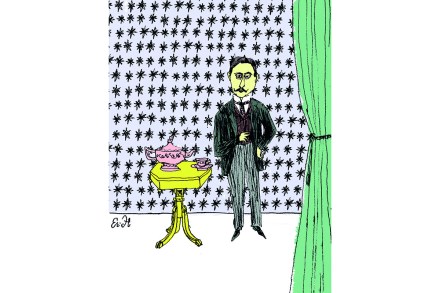
Did you read Proust in lockdown? Lockdown, it seemed, offered the eons of vacancy apparently required to finally get around to À La Recherche Du Temps Perdu, aka “The Big One”: a book to be attempted only by the pretentious one percent in the discharge of their services to intellectual snobbery. I did. I read it twice. I read it because it’s always a pleasure and a novelty, and because I want to get it made as a long-form television series. Proust is perfect for TV: better than anything else, the format can show the passage of time. This is the sine qua non of any Proust reckoning, and it has defeated all attempts so far to make the book into a feature film. We are doing well.

proust
genis

Reading gaol

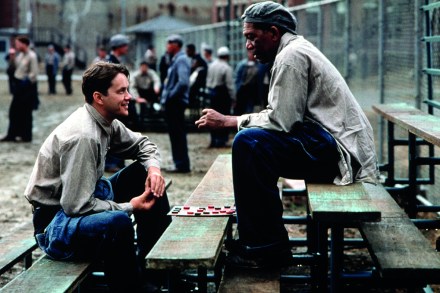
In my more whimsical moments, when I’m worried that I don’t have the time and opportunity that I once had to read great works of literature, I have occasionally wondered about committing a minor felony of some sort. I would then be incarcerated for a couple of months and aim to use the time as a reading retreat. All I would need was earplugs, comfy bedding and a prison library card. Now there’s precedent, too. The author Daniel Genis used his time inside jail to read more than a thousand books during his ten years’ incarceration, and this memoir, Sentence, is his account of his education inside, both literary and (un)sentimental. But by the time I finished reading it, any idea of straying from the straight and narrow had well and truly left my consciousness.