Books

How a small publisher survived the digital age

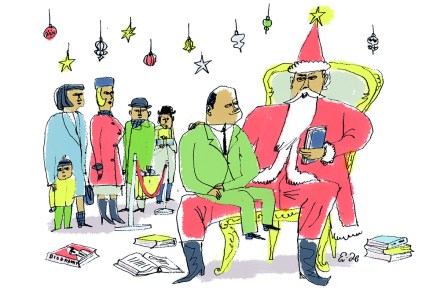
Godine at Fifty: A Retrospective of Five Decades in the Life of an Independent Publisher, by David R. Godine, David R. Godine, 2021 In The Truth about Publishing, Sir Stanley Unwin writes: “It is easy to become a publisher, but difficult to remain one.” David R. Godine has accomplished the difficult task of remaining one for fifty years, and in the beautifully designed and set Godine at Fifty — would we expect any less from a Godine book? — he tells the story of the company’s beginning and survival and of each book he has published over the years, chock-full of reproductions of the company’s covers, woodcuts, and illustrations. This is a book about books for book lovers. Raised in Boston, David R.

The best crime books to buy for Christmas

From our UK edition

Want to treat an avid crime fiction reader to a book or two this Christmas? Or simply want to do a bit of literary self-gifting? From a beguiling South Korean mystery to a grizzly serial killer procedural, here are six new novels to consider. Lemon by Kwon Yeo-sunPeople Like Them by Samira Sedira This pair of short books, both published in translation, are two of the finest crime novels of 2021. Firstly, Lemon, by the South Korean author Kwon Yeo-Sun takes a well-worn starting point, the murder of a beautiful female high school pupil, and spins an idiosyncratic and beguiling mystery from it. A riveting police interview kicks things off, but this is the one nod to convention.

Meet climber, photographer and filmmaker extraordinaire Jimmy Chin

From our UK edition

‘Why did you want to climb Everest?’ reporters quizzed mountaineer George Mallory in 1922. That the question even needed asking shows mountaineering is fundamentally different from other pursuits. No journalist would ever ask a footballer why they kick a ball around. But mountaineering is gruelling and you’re way more likely to perish from it than to make a fortune. So why would anyone climb any mountain, let alone Everest? Mallory’s rationale was short and sweet: ‘Because it’s there.’ And what about Jimmy Chin? Why does he climb? Chin, 48, is part Bear Grylls, part David Attenborough.

Books of the Year 2021

Matt Labash I read a lot of books. Probably well over sixty in the last year. I’m not saying that in some little-kid braggadocious way. After all, I’m fifty-one years old. Though some have said I read on a fifty-two-year-old level. In addition to the couple of books I have open at any time, a good deal of my book consumption comes via audio: I have an audiobook going in my car or on my MP3 player at all times. And at my advanced age, if I don’t dog-ear and underline a book, it’s lost down the memory hole forever, no matter how much I liked it. But one I do remember liking so much that it bears mentioning, is John Green’s The Anthropocene Reviewed: Essays on a Human-Centered Planet (Penguin, $28).

books

In Bennington it was a badge of dishonour not to have slept with your professor

From our UK edition

It is incredibly hard to convey the fleeting invincibility and passionate self-significance that we feel on the cusp of adulthood. Youth goes: the skin fades, the face slackens, the lower back begins to groan in protest. The world dims and we dim with it. Yet generally speaking, we’re as personally winded by that realisation as we are indifferent to it in others. When everyone suffers, no one cares. Why should I bother with someone else’s wasted youth? I’ve got one of my own right here. Still, I was intrigued by the appearance of Once Upon a Time at… Bennington College, an eight-part oral history of three literary superstars’ time at university together.

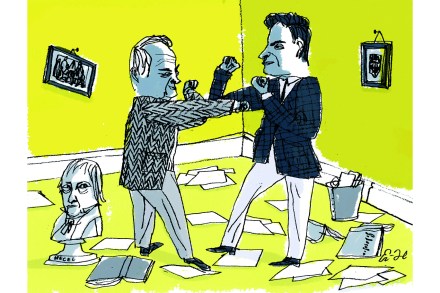
Fight club: when book groups turn nasty

From our UK edition

‘Small friendly village book club is looking for three or four new members.’ I was infuriated to read this in our village newsletter, an alternative to the parish magazine. I had just been ‘cancelled’ by this ‘friendly’ club from featuring at one of their evenings. A text, sent by a hitherto pleasant woman who’d liked my last book, explained: ‘There are many hurt feelings in the village. We in the book group believe that your email, put on the parish council notice board, was hurtful and upsetting. So the feeling is that at the moment it would be better to postpone your visit.’ ‘Hurt’ seems to be a current buzzword for those who don’t share others’ views.

Why we should venerate Evelyn Waugh

Evelyn Waugh is popularly known today as a comic author, despite the fact that Brideshead Revisited, made famous by the eponymous 1981 television series, is certainly not a comedy. Not everyone agrees. Years ago, a well-read friend of mine remarked to me that he was not fond of Waugh’s work. When I asked why, he replied, ‘Because I don’t think he’s that funny.’ I answered that the way to appreciate the exquisite wit of Evelyn Waugh is to approach him in the expectation of something other than humor, in which case the absurd incongruities, outrageous juxtapositions and ludicrous extremes that occur throughout the novels are in fact supremely funny. Waugh never set out to write comedic stories in the manner of P.G.

waugh

Granada’s Brideshead Revisited remains the sine qua non of mini-series

From our UK edition

It is 40 years ago today since Granada’s masterly adaptation of Evelyn Waugh’s Brideshead Revisited first beamed into British homes. This 11-part serialisation of a book originally entitled A Household of the Faith soon gathered millions of faithful householders. The autumn of 1981 was an especially cold and wet one and it was still too soon in the Thatcher premiership for her patron saint, Francis of Assisi, to have worked his magic. So while ITV was not able to deliver harmony, truth, faith or hope, it certainly provided 659 minutes of romantic escapism.

Dave Eggers cancels Amazon

From our UK edition

Selling books through Amazon is now part and parcel of a working author’s life. It would be a brave writer who decided to refuse to allow their work to be sold through earth’s biggest retailer. But that is exactly what Dave Eggers has done with his new book, The Every, which he has decreed can only be purchased from independent bookstores. Sorry, Jeff Bezos; this one’s not for you. It is hard to dismiss his decision to eschew Amazon as simply a quixotic act of rebellion by a washed-up has been Eggers has form in this regard.

A letter to George Steiner

Dear George, I met you first in 1965. You had just given a lecture at the Royal Society of Literature’s premises. You were outspoken in declaring the merits of reticence. Ardent for cool, you insisted that, when writing about sex, the explicit, licensed by the verdict in the Lady Chatterley trial, was the enemy of art. Never mind Sir Robert Walpole’s ‘Let us talk bawdy, then all may join in’: obscenity was one thing, literature another. The naming of parts, in your view, belonged only in the kind of book which Jean-Jacques Rousseau held to be read with one hand.

steiner

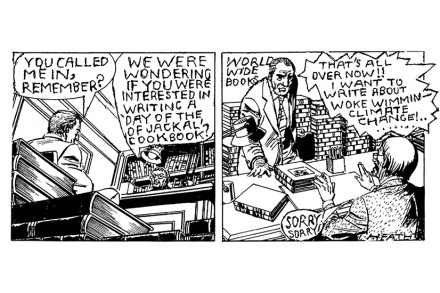
Kate Clanchy and the new censorship in publishing

From our UK edition

‘There’s more than one way to burn a book’, wrote Ray Bradbury, in a coda to the 1979 edition of his anti-censorship classic, Fahrenheit 451. The case of Kate Clanchy, the Orwell Prize-winning author, currently rewriting her book after a particularly strange fit of identitarian pique, shows us just how true that is. The story of Clanchy’s sudden fall from grace in the publishing world is utterly mad, even by today’s standards. She is an author, poet and teacher. In 2019, she published Some Kids I Taught and What They Taught Me, a memoir reflecting on her time teaching in an Oxford comprehensive, to critical acclaim.

Why I gave up writing fiction

From our UK edition

When, three years ago, I announced my retirement from writing fiction, the only thing that surprised me was the surprise it generated. I had long come to the somewhat un-arty view that writing was a job like any other (well, almost) and that nudging 80 was a good time to step back and consider a senescence involving only serious decisions like which claret to choose. No need to rabbit on and on. Apart from the lengthening shadows, there was a very practical reason. The stuff I used to write involved the unlovely side of life with some unlovely places and people. The search for authenticity required travel to find and observe them. I never felt I could trust online research to get it right. I had to go and see for myself.

Read Ray Bradbury before he’s canceled

I was 14 or 15 when I first read Ray Bradbury, which is not a bad age to enjoy the man fully. It was the short story ‘Boys! Raise Giant Mushrooms in Your Cellar’, in which a lad called Tom does just that and it doesn’t end terribly well. Superficially, it is a silly story, but what hooked me from the outset was the vague yet pervasive sense of unease running throughout this minor small-town saga, disturbing the comfortable ennui of family life. Nothing spelled out — just a deepening disquiet, the common thread in all of Bradbury’s finest little vignettes. Back then, in the 1950s, the Cold War and the possibility of nuclear annihilation were hovering in the background, just beyond the edge of our eyesight, which perhaps explains the author’s state of mind.

bradbury

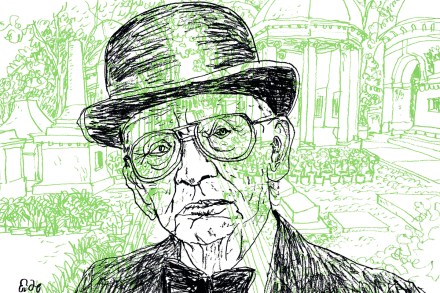
In search of Nirad Chaudhuri

The false sense of complacency in Washington DC, now restored as the imperial capital of the world, is only matched by a tone of utter bafflement. History has apparently renewed its march toward a progressive utopia, and the American cabinet seems as epidermally diverse as it is ideologically totalitarian. But there remains a sense of unease. The imperium suffered a systemic shock in 2016, one that needed and still lacks explanation. The shock was not limited to America. The Guardian struggles to comprehend that British Indians tended to support Brexit, and that members of their community such as Rishi Sunak and Priti Patel have risen to influence in the Conservative party and high office in the government.

chaudhuri

The best theatre podcasts

From our UK edition

All the world’s on stage again so where to go to for insight into what to see and why? Podcasts, of course. Lowe’s ‘luck’ is that he happens to be friends, neighbours, or have starred, with everyone he interviews Let’s start with Literally! With Rob Lowe. An hour-long conversation between the most swoonable actor in the world who we’ve all forgotten, and everyone he knows and likes, from Alec Baldwin and Oprah Winfrey to St Elmo’s Fire co-star Demi Moore. It’s a wonderful and eye-opening listen. Lowe combines the enthusiasm and curiosity of the best interviewers with a knowledge and experience that makes conversation flow until the cup spilleth over.

The rise of the ‘sensitivity reader’

From our UK edition

You probably won’t have heard about sensitivity readers, but across the pond they are already an essential part of fiction. Sensitivity readers are freelance copy editors who publishers pay to cancel-proof their new books. They read books that feature identities or experiences that are outside of the lived experience of the author. They then critique the writing through the prism of what they claim to be their own authoritative life experience to guide the author toward more authentic representation. For example, the white author Jodi Picoult used a sensitivity reader for her novel about a black nurse who cares for the children of white supremacists.

Thoughtful and impeccable: Ken Burns’s Hemingway reviewed

From our UK edition

Ken Burns made his name in 1990 with The Civil War, the justly celebrated 11-and-a-half-hour documentary series that gave America’s proudly niche PBS channel the biggest ratings in its history. Since then, he’s tackled several other big American subjects like jazz, Prohibition and Vietnam; and all without ever changing his style. In contrast to, say, Adam Curtis (another ambitious film-maker whose methods have remained unchanged for 30 years), Burns’s documentaries take an almost defiantly considered approach, forgoing anything resembling self-regarding flashiness in favour of such old-school techniques as knowledgeable talking heads, careful chronology and straightforwardly appropriate visuals.

Nina Hamnett’s art was every bit as riveting as her life

From our UK edition

Nina Hamnett is in vogue again. She is the subject of a new pocket biography, no. 7 in Eiderdown Books’s Modern Women Artists series, and her first ever retrospective is now open at Charleston Farmhouse’s gallery space. I confess I didn’t know much about her before this resurrection, but she is now one of my favourite 20th-century artists. In this bucolic gallery space, where cows can be heard bellowing, her portraits are at last hanging together, like a cocktail party finally regrouped. The colours are subtle, beautiful without being decorative; as the co-curator Alicia Foster explains, Hamnett’s use of colour is ‘meaningful, incisive’.

Is caste the American class system?

John Dollard (1900-80), trained in sociology at the University of Chicago and in psychoanalysis at the Berlin Institute, brought the sensibility of a novelist to a five-month study in Indianola, Mississippi, which he wrote up as Caste and Class in a Southern Town (1937). Dollard went south, but what he found applied in the other direction: The ‘caste line is drawn in the North as effectively, if not as formally, as in the South,’ which meant ‘We are still deliberately or unwittingly profiting by, defending, concealing or ignoring the caste system.’ Caste, Dollard argued, had far-reaching implications: ‘Our social system has come under world inspection and is literally being looked at by several billion people or their competent agents.

caste

What Meghan Markle can learn from Enid Blyton

From our UK edition

The year is 2070 and English Heritage are unveiling their latest Blue Plaque: 'The Duchess of Sussex, children’s author, lived here 2017 – 2018'. The accompanying online guide praises Meghan for her work promoting inclusion and diversity. I have no idea whether Meghan will one day be rewarded with an iconic plaque for her services to literature. But she’s certainly heading in the right direction.