Books

In praise of the Dome

From our UK edition

London’s City Hall stands empty. The bulbous, Foster + Partners-designed ‘glass testicle’ — in Ken Livingstone’s words — occupies one of the best sites in the capital: Thames-side, squaring off to the Tower of London, and overlooking Tower Bridge. But in December, its occupiers — the Mayor, the London Assembly and the Greater London Authority — deserted their glitzy £43 million headquarters for a cheaper building more than five miles east at the Royal Docks in Newham. It took them less than 20 years to outgrow their purpose-built home. According to the architectural commentator John Grindrod, City Hall is a giant glass-and-steel metaphor.

I’m a Latinx person of letters

A development has reshaped the world of letters. The literary universe is no longer a boys’ club but the playground of woke Brooklyn ladies who’ve swallowed up editorships and literary-agent gigs. The results continue to be predictable: a constant bombardment of books from elite white women about the travails of neurotic Brooklyn ladies, and victim narratives about brown suffering. The fetishization of people of color has come to define the woke relationship with so-called marginalized communities. Virtually every literary book — except for those based in Brooklyn — details the struggles of a victimized minority. The Booker Prize longlist or the National Book Award finalists will annually bombard you with weepy tales of generational POC suffering.

poc
failure

Succeeding at failing

My London agent calls to break the news gently. “Your book is dead. I can’t sell it. Sorry. But you do have the most fabulous collection of rejections from publishers I’ve ever read.” “Really? Can you get me a book deal for a book of my book rejections? Failure is a hot topic now.” “You’re funny...” “Thanks.” “...but not commercial. Still, there is some good news.” “Really?” “I’ve sold your ex-wife’s new book for a huge advance!” My ex-wife and I have the same agent so I’m well practiced in the art of the fake congratulation. It’s what we men do, our equivalent of the fake orgasm. “That’s such wonderful news!” Two weeks later, more failure.

Why don’t I come with a trigger warning?

From our UK edition

Last week brought the news that some universities have attached more ‘trigger warnings’ to certain books, concerned that students may find their contents offensive and upsetting. No, we’re not talking about Lolita, American Psycho or The 120 Days of Sodom. The works judged too disturbing for young people of a sensitive disposition include Oliver Twist, Nineteen Eighty-Four and Harry Potter and the Philosopher’s Stone. I’m not making that last one up. The English department at the University of Chester has included it as a set text on its Approaches to Literature module and cautioned students that it may ‘lead to some difficult conversations about gender, race, sexuality, class, and identity’.

Getting the jokes in Proust

Did you read Proust in lockdown? Lockdown, it seemed, offered the eons of vacancy apparently required to finally get around to À La Recherche Du Temps Perdu, aka “The Big One”: a book to be attempted only by the pretentious one percent in the discharge of their services to intellectual snobbery. I did. I read it twice. I read it because it’s always a pleasure and a novelty, and because I want to get it made as a long-form television series. Proust is perfect for TV: better than anything else, the format can show the passage of time. This is the sine qua non of any Proust reckoning, and it has defeated all attempts so far to make the book into a feature film. We are doing well.

proust
genis

Reading gaol

In my more whimsical moments, when I’m worried that I don’t have the time and opportunity that I once had to read great works of literature, I have occasionally wondered about committing a minor felony of some sort. I would then be incarcerated for a couple of months and aim to use the time as a reading retreat. All I would need was earplugs, comfy bedding and a prison library card. Now there’s precedent, too. The author Daniel Genis used his time inside jail to read more than a thousand books during his ten years’ incarceration, and this memoir, Sentence, is his account of his education inside, both literary and (un)sentimental. But by the time I finished reading it, any idea of straying from the straight and narrow had well and truly left my consciousness.

literature

The death of literature

The greatest men make the greatest mistakes. One thinks of the late John Lukacs, the Hungarian-American historian who claimed that the age of the book is at an end. That is far from being the case, the electronic book having failed to drive the print version to extinction as enthusiasts had predicted. Indeed, the continuing flood of printed and bound books remains among the greatest threat to books today — good books, that is, books worth an intelligent man’s time.

Why do British galleries shun the humane, generous art of Ruskin Spear?

From our UK edition

Where do you see paintings by Ruskin Spear (1911–90)? In the salerooms mostly, because his work in public collections is rarely on display. Until the National Portrait Gallery closed for redevelopment it was, however, possible to study Spear’s splendid portrait of ‘Citizen James’ (Sid James) peering from a black and white TV screen, and his oil sketch of Harold Wilson wreathed in pipe smoke, the epitome of political cunning. Both were strikingly more convincing than their companion array of anodyne commissioned images. Like his beloved Sickert, Spear painted commissioned portraits but also took to making enigmatic ‘unofficial’ portraits based on press photographs — or, in the case of Sid James, a snap off the telly.

Robert Harris on Boris Johnson, cancel culture and rehabilitating Chamberlain

From our UK edition

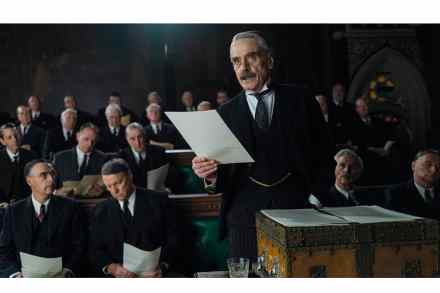
Robert Harris has long been on a one-man crusade to reverse history’s negative verdict on the architect of appeasement. He argues that it was Neville Chamberlain’s duty to go the extra mile for peace and give Britain the moral authority to fight Hitler in the second world war. ‘There seems to be a general feeling that he couldn’t have done much else. He bought us precious time.’ Now the appearance of an acclaimed Anglo-German Netflix film Munich — The Edge of War, starring Jeremy Irons as Chamberlain, and based on Harris’s 2017 novel Munich, gives him the chance to bring his quixotic campaign to a mass audience.

‘The Fifth Head of Cerberus’ at 50

Gene Wolfe’s sci-fi novella, The Fifth Head of Cerberus, was published fifty years ago this year. It is a minor masterpiece. Set in the town of Port-Mimizon on the imaginary planet of Saint Croix, the story follows a family who are descendants of French colonizers. A sister planet, Saint Anne, was also colonized by the French. The original inhabitants of both planets were shapeshifters, and one of the early questions of the novella is whether the current inhabitants of both planets are in fact French or shapeshifters who, according to one theory, killed the would-be colonizers and permanently took on their form. The story is narrated by one of two brothers, who live in a large house on 666 Saltimbanque.

Stacking up

"It feels almost like there is money in writing again.” So the historian and New York Times bestselling author Dan Jones tells me. Is he referring to increased book sales, or lucrative adaptation deals? Not this time. Instead, he’s discussing Substack, which launched in 2017. It has now become the platform of choice for writers to develop their careers on their own terms, without having to give substantial percentages away to agents, publishers and lawyers. For years, authors have felt that they have been little more than galley slaves, flogging themselves and their wares for the profit of multinational corporations. Now, finally, they have been given an opportunity to take back control of their own careers and destinies. The format is a simple one.

substack

Spare me the celebrity Christmas memoir

From our UK edition

Is there anything more dispiriting at this time of year than the dreaded 'celebrity' memoir – the publishing industry's annual two-fingered salute to all us starving mid-list authors? Last week I managed to weave my way through a heaving Waterstones, eventually arriving at one of those vast tables groaning with needy 'personalities'; there they all were, present and correct in their neat hierarchical piles (the higher the advance the bigger the stack). This year's roll call of vaguely familiar faces has been much the same as any other year.

How a small publisher survived the digital age

Godine at Fifty: A Retrospective of Five Decades in the Life of an Independent Publisher, by David R. Godine, David R. Godine, 2021 In The Truth about Publishing, Sir Stanley Unwin writes: “It is easy to become a publisher, but difficult to remain one.” David R. Godine has accomplished the difficult task of remaining one for fifty years, and in the beautifully designed and set Godine at Fifty — would we expect any less from a Godine book? — he tells the story of the company’s beginning and survival and of each book he has published over the years, chock-full of reproductions of the company’s covers, woodcuts, and illustrations. This is a book about books for book lovers. Raised in Boston, David R.

The best crime books to buy for Christmas

From our UK edition

Want to treat an avid crime fiction reader to a book or two this Christmas? Or simply want to do a bit of literary self-gifting? From a beguiling South Korean mystery to a grizzly serial killer procedural, here are six new novels to consider. Lemon by Kwon Yeo-sunPeople Like Them by Samira Sedira This pair of short books, both published in translation, are two of the finest crime novels of 2021. Firstly, Lemon, by the South Korean author Kwon Yeo-Sun takes a well-worn starting point, the murder of a beautiful female high school pupil, and spins an idiosyncratic and beguiling mystery from it. A riveting police interview kicks things off, but this is the one nod to convention.

Meet climber, photographer and filmmaker extraordinaire Jimmy Chin

From our UK edition

‘Why did you want to climb Everest?’ reporters quizzed mountaineer George Mallory in 1922. That the question even needed asking shows mountaineering is fundamentally different from other pursuits. No journalist would ever ask a footballer why they kick a ball around. But mountaineering is gruelling and you’re way more likely to perish from it than to make a fortune. So why would anyone climb any mountain, let alone Everest? Mallory’s rationale was short and sweet: ‘Because it’s there.’ And what about Jimmy Chin? Why does he climb? Chin, 48, is part Bear Grylls, part David Attenborough.

Books of the Year 2021

Matt Labash I read a lot of books. Probably well over sixty in the last year. I’m not saying that in some little-kid braggadocious way. After all, I’m fifty-one years old. Though some have said I read on a fifty-two-year-old level. In addition to the couple of books I have open at any time, a good deal of my book consumption comes via audio: I have an audiobook going in my car or on my MP3 player at all times. And at my advanced age, if I don’t dog-ear and underline a book, it’s lost down the memory hole forever, no matter how much I liked it. But one I do remember liking so much that it bears mentioning, is John Green’s The Anthropocene Reviewed: Essays on a Human-Centered Planet (Penguin, $28).

books

In Bennington it was a badge of dishonour not to have slept with your professor

From our UK edition

It is incredibly hard to convey the fleeting invincibility and passionate self-significance that we feel on the cusp of adulthood. Youth goes: the skin fades, the face slackens, the lower back begins to groan in protest. The world dims and we dim with it. Yet generally speaking, we’re as personally winded by that realisation as we are indifferent to it in others. When everyone suffers, no one cares. Why should I bother with someone else’s wasted youth? I’ve got one of my own right here. Still, I was intrigued by the appearance of Once Upon a Time at… Bennington College, an eight-part oral history of three literary superstars’ time at university together.

Fight club: when book groups turn nasty

From our UK edition

‘Small friendly village book club is looking for three or four new members.’ I was infuriated to read this in our village newsletter, an alternative to the parish magazine. I had just been ‘cancelled’ by this ‘friendly’ club from featuring at one of their evenings. A text, sent by a hitherto pleasant woman who’d liked my last book, explained: ‘There are many hurt feelings in the village. We in the book group believe that your email, put on the parish council notice board, was hurtful and upsetting. So the feeling is that at the moment it would be better to postpone your visit.’ ‘Hurt’ seems to be a current buzzword for those who don’t share others’ views.

Why we should venerate Evelyn Waugh

Evelyn Waugh is popularly known today as a comic author, despite the fact that Brideshead Revisited, made famous by the eponymous 1981 television series, is certainly not a comedy. Not everyone agrees. Years ago, a well-read friend of mine remarked to me that he was not fond of Waugh’s work. When I asked why, he replied, ‘Because I don’t think he’s that funny.’ I answered that the way to appreciate the exquisite wit of Evelyn Waugh is to approach him in the expectation of something other than humor, in which case the absurd incongruities, outrageous juxtapositions and ludicrous extremes that occur throughout the novels are in fact supremely funny. Waugh never set out to write comedic stories in the manner of P.G.

waugh

Granada’s Brideshead Revisited remains the sine qua non of mini-series

From our UK edition

It is 40 years ago today since Granada’s masterly adaptation of Evelyn Waugh’s Brideshead Revisited first beamed into British homes. This 11-part serialisation of a book originally entitled A Household of the Faith soon gathered millions of faithful householders. The autumn of 1981 was an especially cold and wet one and it was still too soon in the Thatcher premiership for her patron saint, Francis of Assisi, to have worked his magic. So while ITV was not able to deliver harmony, truth, faith or hope, it certainly provided 659 minutes of romantic escapism.