Books

The enduring wisdom of Robert Baden-Powell

From our UK edition

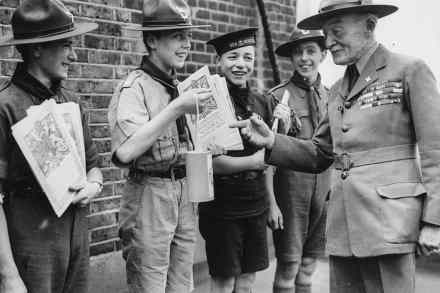
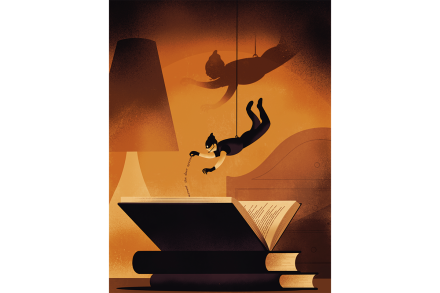
I do not yet have any children of my own, but a large extended family means plenty of young nieces and nephews to buy presents for come birthdays and Christmas. Those moments provide an opportunity to indulge in some pedagogic guidance: I’ll be damned if you're getting the latest Fifa game for the PlayStation 5 – you can have a real football to kick around outside. Ditto the inevitable requests for Nintendo virtual reality headsets and Frozen merchandise. Happily, I’ve got at least one Christmas present this year sorted already – and I’m quietly confident my nephew is going to enjoy reading it as much as I just have. Lord Robert Baden-Powell’s life-guide book Rovering to Success is a century old this year.

The books Spectator readers take on their summer holidays

From our UK edition

Recently, Spectator writers shared their all-time favourite summer holiday reads. In response, Spectator readers have been offering their own recommendations for what books to take to the beach… 'You might try Helen Thompson’s Disorder: Hard Times in the 21st Century, a history of oil politics. It starts with the simple fact that in evolving from the steam to petroleum age, the old western powers no longer had direct access to fuel and faced a growing dependency on oil from Russia, initially, and then the Middle East. The US, of course, is an exception as it has domestic resources – but foreign policy errors led to it being the guarantor of petroleum resources to the rest of Nato.

Salman Rushdie overcame his fear

From our UK edition

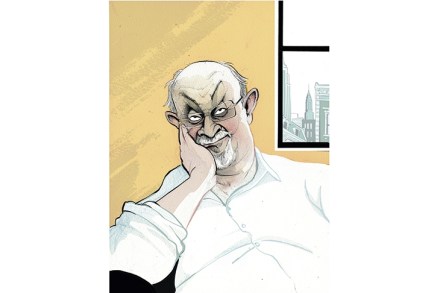
After Ayatollah Khomeini ordered Muslims to kill him for publishing The Satanic Verses in 1989, Julian Barnes gave Salman Rushdie a shrewd piece of advice. However many attempts were made on his life and the lives of his translators and publishers, however many times Special Branch moved him from safe house to safe house, he must not allow the ‘Rushdie affair’ to turn him into an obsessive. When I interviewed him ten years ago he had learned to live without fear. No shaven-headed bodyguards accompanied him as he walked into a Notting Hill restaurant. His eyes did not scour the room for signs of danger. If the other diners knew who he was, they were too well-versed in the manners of the English upper-middle class to stare at a celebrity.

Off the books: there’s more to Hay-on-Wye than the literary festival

From our UK edition

Chances are you will have heard of Hay-on-Wye. You might even have been. It’s the town on the Anglo-Welsh border where more than 30 years ago a man called Peter Florence began what has become the world’s most famous literary festival. Now some 200,000 people descend on the place each May and June, and for 11 days it feels like the centre of the literary universe, with hordes carrying tote bags traipsing hither and thither and pubs and restaurants overflowing like Venice in high summer. If that’s what floats your boat, then get stuck in. But for my money, Hay is worthy of a visit in its own right – and preferably when all those other visitors (not to mention ex-presidents and Booker prize-winners) aren’t there.

What we can all learn from Jim Corbett’s tiger tales

From our UK edition

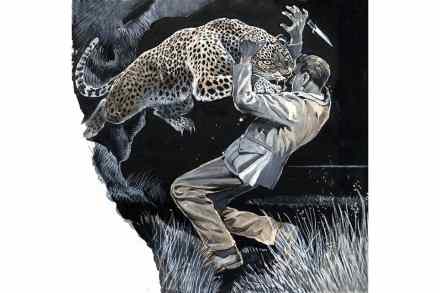
‘The word “Terror” is so generally and universally used in connection with everyday trivial matters that it is apt to fail to convey, when intended to do so, its real meaning.’ Thus begins the third chapter of The Man-Eating Leopard of Rudraprayag (1947), part of the Man-Eater series by the great Anglo-Indian hunter and naturalist Jim Corbett. I was reminded of Corbett and his wonderful books when reading last week that human-assaulting tigers are once again on the prowl in Nepal, with 104 attacks and 62 people killed in the past three years. Conservation efforts have seen tiger numbers rise three-fold since 2010, but with that good news comes the bad news of increased danger to humans.

What Spectator writers read on their summer holidays

From our UK edition

The flights are booked, the passports are dusted down and it’s time to pack. But which books deserve space in your suitcase? Here, Spectator writers share their all-time favourite summer holiday reads… Matthew Parris My all-time favourite re-read at any time of year is Thornton Wilder’s The Bridge of San Luis Rey. A very short novel with the kind of perfection a geometrical proof may command, it starts with the death of a group of travellers crossing a Peruvian rope bridge who are linked only by the fact that they were on the bridge when it snapped, and traces the life of each up until that point. Wilder’s quest is to discover whether there exists any divine plan. Toby Young For pure escapism, I Am Pilgrim by Terry Hayes is hard to beat.

Evelyn Waugh’s sincerest form of flattery

T.S. Eliot once made the significant point, in an essay on Philip Massinger, that “Immature poets imitate; mature poets steal; bad poets deface what they take, and good poets make it into something better, or at least something different.” Eliot knew exactly what he was talking about (himself). However, change “poets” to “novelists” and the same pertinence applies. In fact, this wholesale, covert purloining may be true of all artists in all ages in all the seven arts. Let’s start with some backstory. Evelyn Waugh (1903-66), as they say, needs no introduction. William Gerhardie (1895-1977) is almost wholly forgotten today, but in the 1920s he was the luminous young wunderkind of English literature — a kind of Donna Tartt or Sally Rooney of his times.

gerhardie
Gaitskill sex pill sex

Mary Gaitskill and the body electric

A man bites a woman’s breast with the aim of drawing blood, before taking a cigarette lighter to her stomach. The woman’s lack of arousal at this cruelty causes the man to enquire angrily why she lied when she told him she was “a masochist.” A young secretary is spanked by her boss for mistakes in her typing, before he masturbates over her naked behind. In a conversation between two young adulterous lovers, a woman casually admits to “flirting... like wild” with a man after she discovered he had “broke his girlfriend’s jaw.” These snapshots of masochism, warped desire and sexual depravity made Mary Gaitskill famous when her short story collection Bad Behavior first appeared in 1988.

The melancholy of Middlemarch (1872)

From our UK edition

George Eliot’s novel Middlemarch was released in eight instalments, or 'books', throughout 1871 and 1872. A century and a half later, it is heralded as one of the greatest works in the English language. The following piece was written 150 years ago, in anticipation of the release of the fifth book. The author is Richard Holt Hutton, who edited the Economist from 1857 to 1861, as well as The Spectator alongside Meredith Townsend from 1861 until his death in 1897. He oversaw the magazine's books coverage, during a period in which they and he became one of the most celebrated sources of literary criticism in the country. You can explore more of The Spectator’s archive here.

Books you should plan to read this fall

Summer has arrived in full force — at least here in southeastern Virginia, where the temperature has been creeping up towards 100 degrees — and so, too, have those lists of the best beach books, hottest summer reads, high temp tomes, etc. But fall is just around the corner, so why not take a peek at what’s in store? Here are a few forthcoming books that piqued my interest for one reason or another. This isn’t a list of the fall’s “biggest” books. Some of these might not be covered at all in the national press. But if you want a list like that, just wait. You’ll have 20 to choose from before long. Here is mine. Robert Crawford’s Eliot after The Waste Land (August 23, FSG), the second volume of his biography of T.S.

substack

Falling in line with Sinclair Lewis

In 1920 Warren G. Harding was elected president of the United States, after campaigning on a promise to the American electorate to return the country to what he called “normalcy.” Exactly one hundred years later, Joe Biden assumed the same office having offered the same thing, in different language. In July 1922 Sinclair Lewis published Babbitt, a bestselling novel about a normal middle-class American businessman living in a normal small-sized Midwestern city: the quintessential personification of “normalcy.” Around the middle of the same decade, H.L. Mencken, a good (if necessarily patient) friend of Lewis’s, predicted that America would “blow up” in a hundred years. 2022 is Babbitt’s centennial year.

babbitt

The endless tiny errors of the NHS

From our UK edition

I wrote recently elsewhere about Jeremy Hunt’s good new book examining unnecessary deaths in the NHS. Someone should write a companion volume about the other end of the scale of seriousness – the literally millions of small mistakes and obstructions effected by ‘the envy of the world’. Since 2014, I have found myself in hospitals many times, though never as a patient. Four close family relations or in-laws have died in hospital in that time, and several living members of my family have received various treatments. This has involved, I think, eight NHS hospitals and dozens of visits. In only one case has a major misdiagnosis contributed to otherwise avoidable death, but almost every encounter has been strewn with error or delay.

The perfect pairing of books and wine

From our UK edition

In the West End of London there is an alley which insinuates its way between the Charing Cross Road and St Martin’s Lane. It is called Cecil Court, and the Salisbury pub is close at hand. Those are clues. The area around Cecil Court has been owned by the Salisbury branch of the Cecil family since the 17th century. For a long period, it was not a salubrious area. At least one local was hanged. Others were transported. There may have been a whorehouse or two. The ambience resembled a cross between Fagin’s kitchen and Mistress Quickly’s Boar’s Head, with Doll tearing the sheets. Then everything changed, thanks to Victorian morality and political pressure. The Third Marquess of Salisbury was a devout churchman as well as a prime minister.

My Sally Rooney conversion

From our UK edition

I tried to dislike the writing of Sally Rooney. But I failed. I retain some resistance to Sally Rooney the cultural phenomenon, because this is largely about television adaptations of her books, which can only accentuate the negatives. I have an old-fashioned view of these things: only literature can represent a glamorous world with nuance, real satire, barbed detachment; the interiority of writer and reader is a counterweight to the allure of worldly things.  The adaptation of her first novel, Conversations With Friends, which begins this weekend, is unlikely to challenge my view. It might, for example, attempt to show that Nick is vain and selfish as well as handsome and amazing at sex, but handsome and amazing at sex will win.

‘I came, I saw, I scribbled’: Shane MacGowan on Bob Dylan, angels and his lifelong love of art

From our UK edition

We join Shane MacGowan, much like a character from one of his songs, in a world where prosaic, often harsh realities vie with feverish flights of fancy. The former Pogue conducts this interview remotely, ‘sitting on a vastly uncomfortable lime green leather chair, within reach of a grey bucket, in a small but surprisingly unspeakable room. In a corner, Jimi Hendrix is repairing some broken guitar strings, while in the kitchen behind me, Bono is loading the dishwasher and a leprechaun with a gold earring is rolling what he says is a cigarette. On the walls are a selection of my wife’s multidimensional angel paintings and one or two of my drawings. Clint Eastwood is on the telly and Maggie Barry is on the record player.

The chief characteristic so far has been nervousness: Chivalry reviewed

From our UK edition

Chivalry – written by and starring Sarah Solemani and Steve Coogan – is a comedy drama about post-#MeToo Hollywood life. It’s perhaps not surprising, then, that the show’s chief characteristic so far has been nervousness. Somewhere inside it, you feel, lurks an impulse to really let rip. But if so, Thursday’s first two episodes successfully resisted it. Now and again, we did get some jokes that might just frighten the admittedly neurotic horses of the new Moral Majority. The overall effect, though, was of a game of How Far Can You Go? in which the contestants’ answer was a firm ‘not very’. Still, even this level of unorthodoxy seemed unlikely when the programme began.

A wonderfully unguarded podcast about the last bohemians

From our UK edition

Ordinarily, if a podcast purports to be revelatory, you can assume it is anything but. There’s a glut of programmes at the moment featuring interviewer and interviewee locked in passionate heart-to-hearts in which a few, carefully selected beans are spilled to no real consequence or effect. The Last Bohemians makes no claim to shatter the earth with secrets, but the guests are so unguarded that the episodes possess that longed-for bite. Maggi Hambling reels off a to-do list she made at art school while she was seeking to lose her virginity: ‘Older man, younger man, black man, woman’. Dana Gillespie, singer and former flame of David Bowie, describes undoing her top button to be photographed in the cleavage-obsessed press of her youth.

The cult of sensitivity

From our UK edition

I was extra pleased to have swerved the modern curse that is Wordle when I read that ‘sensitive’ words have been removed from it. A spokesman proclaimed: ‘In an effort to make the puzzle more accessible, we are reviewing the solutions and removing obscure or potentially insensitive words over time. HARRY is an example of an obscure word.’ Other more obviously ‘insensitive’ words had already been removed, such as ‘sluts,’ ‘bitch’ and ‘whore’, and though I’m the most rad of femmes, I do wish they’d stayed. Removing ribaldry makes the language increasingly bland. ‘Sensitivity’ is one of those words that’s changed its meaning. It was once used mostly to refer to sore teeth and gums.

Et in Arcadia ego

"Oxford I do not enjoy,” wrote T.S. Eliot to Conrad Aiken in February 1915. “The food and the climate are execrable, I suffer indigestion, constipation, and colds constantly.” The poet was clearly having one of his bad days. Since arriving at the university the previous October, he had found himself in and out of love with the place, which was hardly surprising, given the timing. Most of the undergraduates at Oxford had either left or were on the verge of leaving to fight for their country, meaning that the lecture and tutorial rooms were almost empty, the sports fields green through lack of use, and the centuries-old traditions stalling like motor cars on the long stretch of the High.

Oxford
Rowling

Standing with J.K. Rowling

When Roland Barthes wrote his 1967 essay “The Death of the Author,” he probably didn’t intend that, fifty-five years later, a major American news outlet would be provocatively suggesting that the world’s bestselling author should be de-personed, de-platformed or de-materialized from history. And yet that is exactly what has happened with the New York Times. They recently ran a series of advertisements on the subway featuring a reader named “Lianna” who is, as much of their subscriber base now are, “breaking the binary,” experiencing “queer love in color” and meditating on “heritage in rich cues.” So far, so predictable. But the ads took a grimmer turn when one suggested that Lianna was “imagining Harry Potter without its creator.