Book review

Even worms and vampire bats do it

From our UK edition

I used to think we had five senses — sight, hearing, taste, smell and touch. And I used to think I knew how they worked. Using specialised instruments, such as eyes, ears and fingertips, they gave us information about the outside world. I imagined that the eye saw things, and then told the brain what those things looked like. I imagined that the fingertips touched things, and then told the brain what those things felt like. But now, every time I look at a book on neuroscience, I see that this nice cosy picture is absolutely wrong. Before I continue with this line of thought, let me say that this book is about the sense of touch, it’s by a professor of neuroscience at the Johns Hopkins School of Medicine, and it’s excellent.

Scabrous lyricism

From our UK edition

Irvine Welsh, I think it’s safe to say, is not a writer who’s mellowing with age. His latest book sees the return of ‘Juice’ Terry Lawson from the novel Glue and the short story ‘I Am Miami’ — now an Edinburgh taxi-driver in his mid-forties but still, in the face of some competition, possibly the most priapic character Welsh has ever created. With a penis he understandably nicknames ‘Auld Faithful’ and an unshakeable faith in the power of porridge (‘Complex carbs: set ye up fir a day’s shaggin’), Terry begins his latest adventures by pulling a grieving relative at a funeral — and, on the way home afterwards, two young American tourists.

Daring to be a Daniel

From our UK edition

As I swink in the field of Thatcher studies, this book brings refreshment. It is a welcome and rare. Far too many writers attitudinise about Margaret Thatcher (for and against) rather than studying her. I doubt the author likes Thatcher much, but all the more credit to her that she makes a fair-minded effort to understand what she believed about God, and how she succeeded and failed in applying her beliefs. Not all who knew Mrs Thatcher agree that she was religious. In a way, they are right. She was not churchy or denominational, which is good. She was not sacramental (she once told me that her twins were baptised but ‘didn’t have the water’) or spiritual, which is not so good. But Denis thought she had a serious Christian faith, and I think he would know.

Early Christian alms race

From our UK edition

Peter Brown’s explorations of the mindsets of late antiquity have been educating us for nearly half a century, ever since his great life of St Augustine in 1967. His latest book, relatively short in volume but very wide in scope, explores Christian attitudes to the afterlife, from the time of Cyprian of Carthage (martyred in 258) to that of Julian, Bishop of Toledo in the late seventh century. Julian put together an anthology called the Prognosticon Futuri Saeculi. He viewed his book as a compilation of the shared wisdom of Christianity. What in fact he demonstrated, in this ‘futurology of the Christian soul’ as Brown calls it, was the extreme variety of viewpoints over the previous 400-odd years. One would expect a difference over nearly half a millennium.

Some watcher of the skies

From our UK edition

We live in an age of astronomical marvels. Last year Europe’s Rosetta spacecraft made a daring rendezvous with the comet Churyumov-Gerasimenko, revealing a bizarre double-lobed mountain of ice and rock with landscapes of vertiginous crags and ashen scree slopes. In our image-saturated age it’s easy to forget that such views are only possible through the intermediary of sophisticated technology: cameras and computers and the spacecraft that carry them halfway across the solar system. And yet this is nothing new. Ever since the Italian mathematician Galileo Galilei first turned his telescope to the heavens in the autumn of 1609, advances in technology and great strides in knowledge have gone hand in hand.

That unmistakable touch of Glass

From our UK edition

Philip Glass is by now surely up there in the Telemann class among the most prolific composers in history. There must be an explanation, preferably a non-defamatory one, for how his technique has enabled him to produce such an enormous quantity of music. A glance at my iPod shows that Varese’s collected works are over in 150 minutes: Berg, Ravel and Debussy each managed to produce between ten and 15 hours of music at most. Glass’s style, which has been called ‘minimalist’, though he doesn’t accept the label, works on a bigger scale. He has written 25 operas, some, like Einstein on the Beach, as long as Die Meistersinger. He owns up to 30 film scores, although the internet movie database connects him with more than a hundred different films.

The self-taught maritime artist who transcends ‘naïve’ cliché

From our UK edition

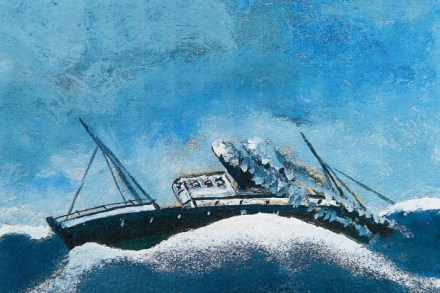
In the manner of Richard Holmes’s Footsteps, Julia Blackburn’s story of John Craske is as much autobiography as biography, as much about the hunt for information as the processed results of the search. The facts of John Craske’s life are briefly told: born in Norfolk in 1881 into a fishing family, he suffered some sort of mental and physical breakdown while training with the army in 1917 and for the remaining 25 or so years of his life dodged in and out of invalidism, sometimes bedridden for long periods, sometimes out fishing with his brothers, sometimes working as a fish merchant and perpetually supported and nursed by his devoted wife, Laura.

Melissa Kite comes out fighting. Again

From our UK edition

Madison Flight is a divorce lawyer, nicknamed ‘the Chair-Scraper’ for the number of times she leaps to her feet arguing in court. She has been contrary since birth, putting her mother through six days of labour before eventually being pulled out by forceps. ‘Is she saying no?’ asks the doctor, perplexed by the distinctive ‘Naaaaaaaaah!’ sound of her new-born wail. Madison’s life begins with her voicing dissent and argument fills every moment of her adult life.

The secret life of the short story

From our UK edition

The short story likes to play the underdog. Famously unfavoured by publishers, it has none of the commercial clout of the novel. Denying itself the luxury of length, it is a martyr to the cause of shortness. When the short story writer Alice Munro was awarded the 2013 Nobel prize for literature, she seemed to personify the supposed modesty of her craft. With the blessing of the Swedish Academy, the short story had finally gained the status of a standalone art form: no longer, to quote Munro, ‘just something you played around with until you got a novel’. All this modesty seems at odds with the idea of an ‘epiphany’ — a device associated with the stories of Joyce, and the hallmark of two new collections by D.J. Taylor and Salley Vickers.

Brian Sewell does some donkey work: how Britain’s best-known art critic put his ass on the line

From our UK edition

I suppose all children’s authors write the stories they would have liked to read as children. But in the case of this novella about a sensitive man called Mr B who rescues a donkey in Peshawar, names her Pavlova after the ballerina, and brings her overland all the way back home to Wimbledon to meet his dogs named after women painters of the 20th century, this feeling that the target reader is the childhood author himself is overwhelming. You learn more about the young, sweet, aesthetically precocious Brian Sewell while reading it than you do even about Persian carpets and the dusty towns on the old Silk Route. This is the old Brian Sewell telling a story to the young Brian Sewell. Both are soppy about four-footed animals, so the bringing-a-donkey-home storyline is ideal.

When Rex met Edith: a meeting of minds in interwar England

From our UK edition

Rex Whistler — this book’s ‘bright young thing’ — was an artist of the 1920s and 1930s, and Edith Olivier, the ‘bluestocking’, was a novelist. They both deserve to be more famous than they are, and Anna Thomasson’s absorbing joint biography will doubtless make them so. They met through Stephen Tennant in 1924, when Olivier was 51 and Whistler was a 19-year-old student at what he called ‘the darling Slade’. She was snobbish and he was talented; liking one another from the start, they bonded over hair. Once Rex persuaded Edith to exchange her spinsterish bun for a ‘bingle’ — a daring combination of a shingle and a bob — she never looked back. Suitably attired, Olivier invited Whistler to her home, the Daye House in the grounds of Wilton.

The other trenches: the Dardanelles, 100 years on

From our UK edition

In August 1915, in his tent at GHQ on the Aegean island of Imbros, General Sir Ian Hamilton, commander-in-chief of the Gallipoli expedition, woke from a dream in which someone was attempting to drown him in the Hellespont. ‘For hours afterwards,’ he wrote in his diary, ‘I was haunted by the thought that the Dardanelles were fatal: that something sinister was afoot: that we, all of us, were pre-doomed.’ This was not how it had seemed when what had been confidently designated ‘the Constantinople expedition’ set out for the distant and largely unknown Turkish peninsula.

Things fall apart in Denis Johnson’s latest novel of madness and anarchy in Sierra Leone

From our UK edition

‘I’ve come back because I love the mess. Anarchy. Madness. Things falling apart.’ The lines belong to Roland Nair, one of the morally bankrupt spies who careers around Africa in Denis Johnson’s tenth novel, but they might equally well describe Johnson himself, a writer always happiest in his work when the wheels come off and the world breaks down. His novels vary in setting (Prohibition America in Train Dreams, the Vietnam war in Tree of Smoke, a future post-apocalypse in Fiskadoro) but they share a mixture of gravitas and derangement, sarcasm and lyricism, comic danger and dangerous comedy that makes them reliably fascinating — and reliably peculiar. You certainly wouldn’t confuse Johnson’s dialogue with anyone else’s.

Lesley Blanch: a true original on the wilder shores of exoticism

From our UK edition

Lesley Blanch (1904–2007) will be remembered chiefly for her gloriously extravagant The Wilder Shores of Love, the story of four upper-class European ladies who abandoned their natural habitat to seek and find romance in the Middle East. If one had to pick only one of Blanch’s books to read there could be no better choice than this; but, as this exotic potpourri reminds one, she was incapable of writing boringly or badly. The most substantial part of Lesley Blanch: On the Wilder Shores of Love (a title which seems designed to deceive putative readers into thinking that they have read it all before) is Blanch’s record of her youth — the opening chapters of a book which she did not live to complete.

A mad menage — and menagerie – in Mexico: the life of Leonora Carrington in fictional form

From our UK edition

Leonora Carrington is one of those jack-in-the-boxes who languish forgotten in the cultural toy cupboard and then pop up every few years to a small flurry of excitement. Born in 1917, the child of a rich Lancastrian industrialist, she ran away to Paris to paint and there became the lover of Max Ernst. She lived at the heart of the Surrealist group, fleeing war-torn Europe with a gaggle of artists to sail to New York, where she kept company with Peggy Guggenheim, Dalí, André Breton, Marcel Duchamp et al. Raven-haired and chain-smoking, she spent time in a Spanish lunatic asylum, married a Mexican, painted and wrote. There were lovers, a second husband — this one a Hungarian photographer — children and a menagerie of animals.

Dominic Cummings (who ought to know) is not impressed by Michael Barber, Tony Blair’s former adviser and self-styled ‘delivery man’

From our UK edition

In 2001, Tony Blair took Sir Michael Barber from his perch as special adviser in the Department for Education and brought him into Downing Street. Once there Barber set up Blair’s ‘Delivery Unit’ and oversaw his attempts to reform public services. He then moved to the McKinsey consultancy where he cloned his unit for governments around the world. He has now written a book, How to Run a Government, about what he calls ‘deliverology’ — an ‘emerging science of delivery’. It is part memoir and part a ‘how to’ manual describing ‘a set of processes that enables governments to deliver ambitious goals’.

Baiting the trap with CHEESE: how we fooled the Germans in the second world war

From our UK edition

Second world war deception operations are now widely known, particularly those which misled the Germans into thinking that the D-Day Normandy landings were merely a diversion. Great use was made of captured German agents in Britain who sent disinformation about invented army divisions and ships allocated to the supposedly ‘real’ landings still to come. Much less well known, though of arguably equal consequence, was a similar deception operation in the Middle East, based on an MI6 agent known as CHEESE.