Art

Lust for life | 3 December 2011

Seduced by the hayseed hair and the Yorkshire accent it’s tempting to see the young David Hockney as the Freddie Flintoff of the painting world: lovable, simple, brilliant, undoubtedly a hero, and delightfully free of angst. In this enjoyable book, which sets out to to ‘conjure up the man he is and in doing so to put his paintings and drawings in the context of his extraordinary life’, Christopher Simon Sykes provides us, naturally, with a more complex story. Hockney is a hero if course — not least to homosexuals, for blazing a stylish and courageous trail to emancipation in the 1960s, and more recently to beleaguered smokers in his

Art Books: A sumptuous tour

In 1930 Evelyn Waugh, already at 27 a famous novelist, spent two days in Barcelona. He came upon one of the art nouveau houses designed by Antonio Gaudí, who had died four years earlier. Waugh was captivated by the swooshing ‘whiplash’ lines of the building. He hired a taxi and asked the driver to take him to any other buildings in the same style. So he saw a number of Gaudí’s fantastical creations, including his church (often mistakenly called a cathedral), La Sagrada Familia. It took an extra-ordinary leap of taste for Waugh to admire this flamboyant architecture at the height of the Modern Movement, with its insistence on ‘clean

William Nicholson: Catalogue Raisonné of the Oil Paintings by Patricia Reed

A pleasingly tactile canvas-like cover adorns this heavy book and proclaims its purpose; the boldly brushed illustration is a detail from ‘Mauve Primulas on a Table’ painted in January 1928 when the artist was in his mid-fifties. He wrote of a ‘painting orgy’ and how he suffered ‘tennis-elbow from holding my brush for 8 hours solid’. Patricia Reed’s catalogue note adds, ‘the work is a synthesis of the motifs that interested him at this moment: a tilted picture plane, textured cloth, penumbrated shadows, a cropped bowl and a pair of open scissors’. It is pertinent to follow with a quote from Merlin James’s introductory essay on Nicholson’s ‘Painting and Experience’,

A Bigger Message: Conversations with David Hockney by Martin Gayford

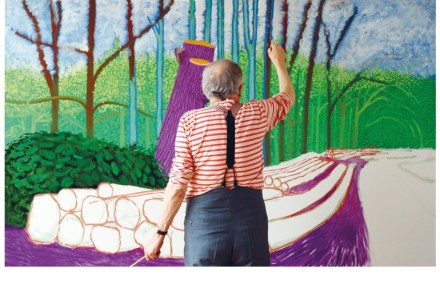
Like his contemporary and fellow Yorkshireman, Alan Bennett, whom he slightly resembles physically, David Hockney has been loved and admired throughout his lifetime. He painted one of his greatest works, ‘A Grand Procession of Dignitaries in the Semi-Egyptian Style’ in 1961 while still at the Royal College of Art. He has dazzled, surprised and often upset the world of art ever since. Picasso aside, he is the wittiest modern painter, in the sense not just of being funny, but intelligent; a whole history of Western art is both contained and extended by his originality. For example, it was both funny, and in the 1960s brave, to apply Boucher’s soft pornography

In New York, the whole world remembers

New York There’s an eerie mood in New York right now, as the city prepares to commemorate the tenth anniversary of the September 11 attacks. Al-Qaeda, or what’s left of it, likes anniversaries. The police have been on overdrive ever since a “credible” tip-off about an attempted truck bomb. Officers are everywhere. Armed guards patrol landmarks and cars from bridges and tunnels are being pulled over and checked. All this reinforces the sense of something alien to New Yorkers (and almost all Americans) until ten years ago: the threat of attack. A common threat has solicited a rather wonderful common response. Shop windows have displays of commemoration; companies take adverts

Art for ransom

These two books make mutually illuminating and surprisingly contrasting companions, given the similarity of their subjects. Both are written by those with hands-on experience in the field of art preservation and security. Sandy Nairne was Director of Programmes at the Tate Gallery in 1994 when two important paintings by J.M.W. Turner were stolen while on loan to an exhibition in Frankfurt, and was a key player in their eventual recovery. When Anthony Amore became Security Director at the Isabella Stewart Gardner Museum in Boston in 2005, he immediately picked up the threads of the investigation into the theft of three Rembrandts and other works which had been stolen from the

Poetry in paint

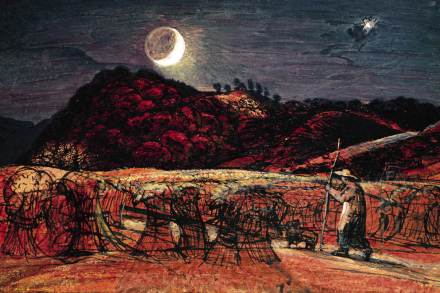
At the age of just 21, Samuel Palmer produced one of British art’s greatest self-portraits. At the age of just 21, Samuel Palmer produced one of British art’s greatest self-portraits. Although he is wearing the clothes of the period (1826), the face that surmounts the casually fastened soft high collar is both Romantic and modern, instantly and thrillingly bridging the gap between his century and our own. As Rachel Campbell-Johnston notes in her welcome biography, Palmer’s hair is unbrushed and he seems not to have bothered to shave: ‘It’s hardly the image you would expect from an upcoming artist at that time. He does not strike the pose of the

The English El Greco

Talk about ‘enemies of promise’. Talk about ‘enemies of promise’. In the March 1942 number of Horizon magazine there appeared what could be a heartfelt illustration of the whinger’s conceit propagated by Horizon’s editor, Cyril Connolly, to the effect that life stifles artistic ambitions. Plate 2, ‘Dreamer in Landscape’ by John Craxton, is a pen-and-wash drawing of horny plants breathing down the neck of a dozing boy. How very Craxton. Not yet 20 and already well-versed in overgrown styling and poetic self-pity. For decades Craxton lived with the fact that early promise guarantees nothing. What in his salad days denoted a growing confidence — the tidied airs, the recurrence of

1951 and all that

The author of this book and I both visited the 1951 Festival of Britain on London’s South Bank as schoolboys. The author of this book and I both visited the 1951 Festival of Britain on London’s South Bank as schoolboys. He was 13, I was 11. We were both old enough to remember the war. We were both enduring the post-war austerity. Much was still rationed. Everywhere there were bombsites. From his generally commendable account, I know we both had a similar reaction to the Dome of Discovery, the Skylon and all the other attractions: there was a sense of renewal, lightness, colour, modernity and excess, in contrast to the

Religious doubt

No description of Eric Gill is ever without the words ‘devout Catholic’, and Eric Gill: Lust for Letter & Line (British Museum Press, £9.99), while short, provides evidence to both confirm and confound that assessment. One can follow the three-year journey of Gill’s celebrated Stations of the Cross for Westminster Cathedral from preparatory drawing to finished sculpture. Or one can study ‘Girl in bath’, a wood engraving of the artist’s daughter Petra, impossible to contemplate without bearing in mind his sexual abuse of his children. Limiting themselves almost entirely to works owned by the museum, authors Ruth Cribb and Joe Cribb handily distil the career of a restlessly prolific artist

The Midas touch

Now that we can read on Kindle and some people fear that paper-and-ink books will become extinct, one’s first impulse might be to say hurrah for this mighty production. Now that we can read on Kindle and some people fear that paper-and-ink books will become extinct, one’s first impulse might be to say hurrah for this mighty production. But then doubts creep in: isn’t it a bit OTT? It is by far the largest book I have ever reviewed, or indeed handled. A monster of a book, a juggernaut, a Leviathan. And it has a whopping price to match: 400 smackers. I had the sneaking thought: do the publishers, Reel

Fish and chaps

This is the ultimate ‘niche’ book. This is the ultimate ‘niche’ book. It focuses on that singular decade between the years of rockers and punks, when toffs, freed from school or army uniforms, and toughs, discarding skinhead aggression, found a sartorial meeting point. This new style, the cool child of late Fifties mods, had been given a huge public oomph by the Beatles and ‘their silly little suits’ as David Bailey (who has stated that he, along with myself, was the unwitting originator of the look) succinctly puts it. It was sharper, leaner and hinted at androgeny. Its creators were no longer found in caverns down Carnaby Street, nor high

Never the same | 12 February 2011

There is a saying that art in restaurants is like to food in museums. You know the feeling: the attendant monstrosity on the wall peers over your shoulder, wrecking your appetite. But times are changing. Independent galleries have faded under recent financial strain, and the upward pressure on shop rents continues. Denied their premises, dealers are using new spaces and have reached new markets in the process. This is what brings Thomas Ostenberg’s Equilibrium to the Mint Leaf Lounge, 12 Angel Court, London EC2 (until 27 February). Ostenberg is a former vice-president of Citibank who had a Damascene moment in the Rodin Museum and vowed to become a sculptor. Plenty

Enlightened patronage

Alberto Della Ragione (1892–1973) was a naval engineer from Genoa with a passion for music, poetry and the visual arts; he also had the collecting bug. Alberto Della Ragione (1892–1973) was a naval engineer from Genoa with a passion for music, poetry and the visual arts; he also had the collecting bug. Towards the end of the 1920s, he sold his earlier accumulation of 19th-century paintings and began to acquire modern art, concentrating on works with a figurative bias, but by some of the most adventurous spirits then active in Italy. He became friendly with the second generation Futurists — Fillia, Enrico Prampolini and Fortunato Depero — and bought their

In from the cold | 12 February 2011

Philip Ziegler puts the case for Terence Rattigan, whose centenary is celebrated with numerous revivals of his work After decades in the doldrums, Terence Rattigan seems once more to be returning to popular and critical favour. Last year After the Dance was one of the National Theatre’s more emphatic successes, and the centenary of Rattigan’s birth is being celebrated by productions of his plays at the Old Vic, the Jermyn Street Theatre and in Northampton, West Yorkshire and Chichester. There is to be a Rattigan season at the British Film Institute, and a new screen adaptation of The Deep Blue Sea. Rattigan, it seems, is back. Of course, he never

Hungry for novelty

My first — and so far only — proper job in journalism was, many years ago, as a staff writer on a kids’ computer-games magazine. My first — and so far only — proper job in journalism was, many years ago, as a staff writer on a kids’ computer-games magazine. We were pretty good for what we were, but if we had a flaw it was that we were obsessed, absurdly and often fruitlessly, with being the first magazine to feature some new game that absolutely no one was talking about, usually because they hadn’t finished writing it yet. It was my introduction to a particular kind of journalistic mindset:

Creative protesting

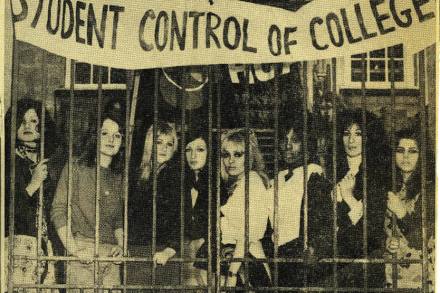
It’s time to heed the complaints and free art schools from the constraints of the university system, says Niru Ratnam The Turner Prize award ceremony always attracts protest — usually in the shape of the Stuckists, a group of bedraggled, eccentric-looking artists who gather outside Tate Britain in funny hats and bemoan the death of representational painting. But this year they were upstaged by around 200 art students, who entered the museum in the afternoon and refused to leave, staging what was described as a ‘teach-in’. In addition to wearing their own humorous hats, the students made speeches, marched round and chanted. The ‘teach-in’ was a protest against proposals unveiled

Best in show | 15 January 2011

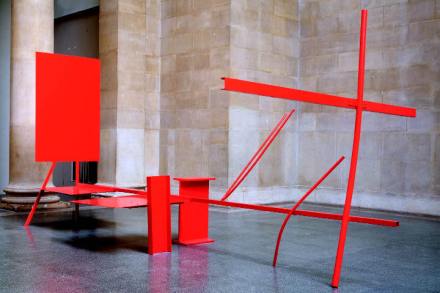
Penelope Curtis, director of Tate Britain, talks to Ariane Bankes about the planned revamp of the museum and 100 different ways of showing sculpture The evening after first meeting Penelope Curtis, director of Tate Britain, I bumped into a mutual friend who told me, only half-joking, that she could be frightening. Fair enough, I thought: to become the first woman director of one of Britain’s pre-eminent public galleries you have to frighten a few people along the way. As it happened, I hadn’t found her alarming at all at the press briefing that morning: direct, brisk, purposeful — she was, after all, embarking on a wholesale top-to-toe redesign and rehang

Never the same

Simon Starling’s art often involves some form of recycling — his controversial ‘Shedboatshed’ won the 2005 Turner Prize – and his ‘new’ exhibition at Camden Arts Centre (until 20 February) is no different. Simon Starling’s art often involves some form of recycling — his controversial ‘Shedboatshed’ won the 2005 Turner Prize – and his ‘new’ exhibition at Camden Arts Centre (until 20 February) is no different. Never The Same River (Possible Futures, Probable Pasts) is Starling’s selection of 30 artists’ works exhibited at the centre over the past 50 years, installed in the same positions they originally occupied, juxtaposed with three new pieces referencing time by Sean Lynch, Jeremy Millar

More real art, please

Although I am an admirer of Dulwich Picture Gallery, and like to support its generally rewarding exhibition programme, I will not be making the pilgrimage to see its latest show, Norman Rockwell’s America. Although I am an admirer of Dulwich Picture Gallery, and like to support its generally rewarding exhibition programme, I will not be making the pilgrimage to see its latest show, Norman Rockwell’s America. This is not just because it’s quite a hike to Dulwich for me, involving a bus, a train, another bus and another train (anything in excess of three hours from door to door), but also because I don’t think the trip will be worth