More from Arts

Dedicated follower of fascism?

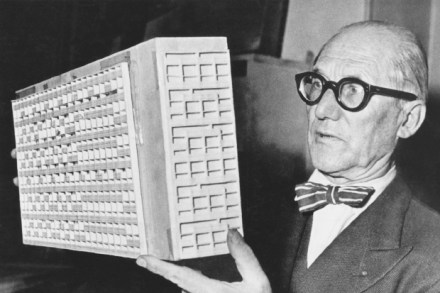
The ‘revelations’, 50 years after he drowned, that Le Corbusier was a ‘fascist’ and an anti-Semite are neither fresh nor startling. Indeed they’re old hat. And it defies credibility that the authors of three recent books about this tainted genius were ignorant of what anyone with even the frailest interest in architects’ foibles and tastes has been aware of for years. Not that this has deterred them; nor has it deterred newspapers from filleting the books for supposedly sensational titbits. What next? The hot news that the cuckold Carlo Gesualdo murdered his wife and her lover? That Jean Genet has been discovered to have been, you know, on the light-fingered side?

Moving pictures | 21 May 2015

About six years ago the first section of the now celebrated High Line was opened in New York and made a palpable hit both locally and internationally. Locally it revealed what one might have guessed, that the inhabitants of Manhattan’s downtown suffered a severe lack of amenity. Every place to walk or run or ride a bike, every place to exercise the dog, is valuable and well used. This new and unusual park, restoring and converting the tracks of a disused overhead railway, was reserved neither for running nor biking nor walking the dog, but rather for strolling, sitting and sunbathing, and for the novelty of looking in on buildings old and new, from unusual angles and with an unusual degree of impertinence.

Woolf haul

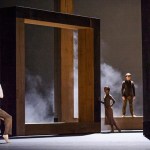
People have been saying that Wayne McGregor’s new Woolf Works has reinvented the three-act ballet, but not so. William Forsythe reinvented the three-act ballet 20 years ago with Eidos: Telos, a mesmerising masterpiece that I found myself recalling as I watched the McGregor. There are many formal similarities: the search for sense through words, the woman facing darkness and death, the central act in period costume, spectacular light, video, ambitious structures on stage, and so on. You get the picture. McGregor’s work isn’t reinventing the wheel — it just reinflates it with a jet of new hot air. Since last week’s première, every possible view has been taken about Royal Ballet’s Woolf Works, from rapture to loathing.

Shakespeare’s duds

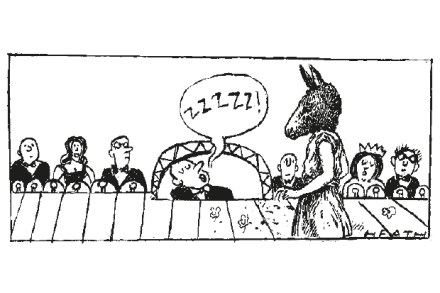
I love Shakespeare. But when he pulls on his wellies and hikes into the forest I yearn for the exit. A Midsummer Night’s Dream has a moonlit, sylvan location populated by a syrupy crew of hectic fairies, humourless bumpkins, panting maidens and swooning aristocrats in disguise. Shakespeare wrote it during his apprenticeship and he had yet to learn that several romances are far less interesting than just one. The result is a cloying, over-busy fantasy whose highlight is a love potion that makes a sprite called Titania fall in love with a donkey called Bottom. If you find the passion that flowers between a Sloane-y dryad and a pack animal hilarious then poor you.

Boys on the march

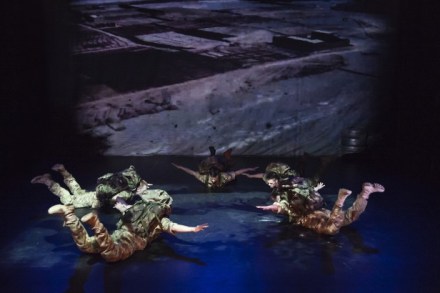
In dance, it’s usually the moment the boys start fighting that challenges your suspension of disbelief. Synchronised fencing (MacMillan’s Romeo and Juliet), unison goosestepping (Grigorovich’s Spartacus), even the Sharks and Jets in Robbins’s West Side Story, are formation set-pieces designed to arouse us. Last year there was a bunch of ballets made by British choreographers to mark the first world war centenary, which artfully focused on sorrow. But high tension, apprehensiveness, emotional denial — what’s really in the fighter’s head — these are physically antipathetic to dance’s expansive language. This is why Rosie Kay’s 5 Soldiers: The Body is the Frontline is so powerfully striking and bold a dance work.

The rudeness of John Eliot Gardiner

Sir John Eliot Gardiner is talented almost beyond measure. His Monteverdi Choir, English Baroque Soloists and stupidly named Orchestre Révolutionnaire et Romantique have notched up one triumph after another over the decades: benchmark recordings of the Monteverdi Vespers and Bach B minor Mass, the finest period-instrument Beethoven symphony cycle and a cantata pilgrimage of live performances of all the Bach sacred cantatas. His recordings of Mozart operas are dazzling. At 72, Gardiner is at his artistic peak. His live re-recordings of the Beethoven Fifth, Seventh and Missa Solemnis eclipse their predecessors and in its second account of the Bach motets the Monteverdi Choir sings with such eerie precision, infused with the spirit of dance, that its rivals must despair.

Curators

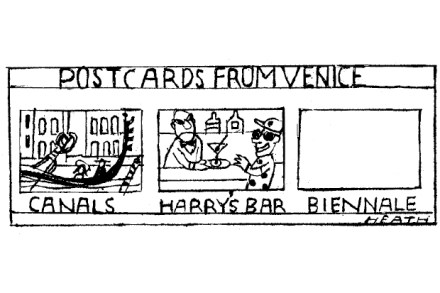
As a purveyor of lairy souvenirs Venice outdoes even Lourdes. The scores of shops and booths that peddle this lagoonal kitsch are manned by graduates of hard-sell whose market-barker schtick does not need to include descriptions as their goods are self-explanatory. Every other year they coexist with a different sort of operation: the galleries, ateliers, showrooms and studios of the Biennale. And with them an ever-burgeoning cadre of soft-sell operatives, who compose the hieratic order of the curatocracy. There is no piece of approximate art or workshopped event that cannot be curated just as there is no foodstuff that cannot be sourced. At a recent ‘ideas festival’, I was enjoined to participate in a curated walk round a small town.

Lethal weapon

The current talking-point at the Royal Ballet is the Russians milling around. One can sound unfortunately as if one’s starting a Ukip conversation here, but the Royal Ballet never used to be short of half a dozen home principals, any one of whom could be looked on as sufficiently glittery to attract the opening-night audience. Right now, though, the recent loss of a wonderful generation of artists — Cojocaru, Kobborg, Rojo, Benjamin, Polunin — has left the top rank rather thinned of true star quality, especially among the women. Hence the excitement at the recruiting to the Royal of Natalia Osipova from the Mikhailovsky and Bolshoi, Vadim Muntagirov from English National Ballet, and the guests Iana Salenko and Evgenia Obraztsova recently in Swan Lake.

James Bond

For fans of the franchise who remain unconvinced by Daniel Craig’s time on her majesty’s secret service, the stories leaking from the production of the latest film Spectre are further evidence that the time has come to hand 007 a glass of scotch and a revolver. Craig’s Bond always had less of an air of an expense-account gentleman spy and more the demeanour of a spornosexual plumber. This is a Bond who’d sooner take photographs of his abs in the bathroom mirror than go bird-watching. Stumbling after the surefooted remake of Casino Royale, there is no disguising the tedious drivel that was Quantum of Solace, nor that Skyfall borrowed heavily from the Home Alone franchise.

Crossing cultures

For an Indian woman to make a dancework about La Bayadère is a promising prospect. This classical ballet of 1877 by Russia’s French-born genius Marius Petipa tells the simple story of an Indian temple dancer — essentially a religious sex slave — whose potential salvation by an amorous young soldier is dashed when he expediently marries the rajah’s daughter. Death and transfiguration ensue in some addictively gorgeous balletic poetry, along with all sorts of improbable exotica to please the tsar’s eye. Londoner Shobana Jeyasingh, born in India, trained as a traditional Bharatanatyam dancer, and is a contemporary dance choreographer of keen intelligence, if sometimes letting her brain get the better of her choreographic imagination.

The Heckler: down with the actor-commentariat!

I’ve never been terribly keen on actors. I prefer hairdressers and accountants. And teachers and builders and lawyers. I may even prefer politicians and footballers to actors. It’s a modesty thing. No profession demands more attention. And no attention is less warranted. Everywhere you look, there they are pouting and grimacing on billboards and TV screens, like oversized teenagers. How have we come to this? These people dress up and pretend to be other people — for a living! It wouldn’t be quite so bad if that were all they did. But these days actors are taking over our public space in a way that is unsettling and impossible to ignore.

Birmingham Royal Ballet review: A Father Ted Carmina Burana

We ballet-goers may be the most self-deceiving audiences in theatre. Put a ‘new work’ in front of us and half of us go into conniptions because the classical palace is being brought down and the other half into raptures at not having to sit through some old-hat ballet-ballet. Twenty years ago, David Bintley was appointed artistic director at Birmingham Royal Ballet. For his debut creation there, having defined himself at Covent Garden as a well house-trained classical choreographer, he picked on Carl Orff’s bold, brash choral work about naughty medieval priests, Carmina Burana. The London critics’ reception was broadly (if I remember rightly — I was one of them) sniffy.

Is this the greatest sculpted version of the Easter story? It’s certainly the strangest

In April 1501, about the time Michelangelo was returning from Rome to Florence to compete for the commission to carve a giant marble David, a very different sculptor named Tilman Riemenschneider agreed to make an altarpiece in the small German town of Rothenburg ob der Tauber. Since then, things have not changed much in Rothenburg. Though battered during the war, it has been restored to postcard perfection (or rather turned into a perfect place for tourists to take selfies of themselves against a Disneyesque medieval background). And the Altar of the Holy Blood is still there, in the place for which it was made, at the west end of the church of St James or Jakobskirche. This is a sculpted version of the Easter story both great and strange.

50 shades of beige: English National Ballet’s Modern Masters at Sadler’s Wells, reviewed

My moment of the week was stumbling into the shocking, fantastical Cabinet of Curiosities in the Alexander McQueen show at the V&A. On the walls were tier upon tier of dresses, shoes and headdresses, feathered, leathered, beaded, painted, razored, or tenderly embroidered with a fairy needle. Rotating at the centre of the room was the Spray Paint Dress that a dazed Shalom Harlow wore while robots ejaculated paint over her in 1998. What could be more sinisterly resonant of classical ballet’s erotic world? McQueen made his one and only ballet working with Sylvie Guillem 18 months before his suicide — remember her as the cross-gender Chevalier d’Eon in Eonnagata? But fashion was a vastly more permissive (and richly resourced) playpen for his darkling artistry.

The Heckler: Why I’m allergic to Stephen Sondheim

I came out in a rash when I heard that Emma Thompson was to star in Stephen Sondheim’s Sweeney Todd at the Coliseum. Sondheim has that effect on me. And it’s an allergy I bear with pride. I’ve been the victim of a Sondheim evening only once in my life and I emerged feeling as if I’d been shrieked at for three hours by a gorilla with rabies. The show, Sunday in the Park with George, was conceived as an exercise in ‘musical pointillism’ to honour the painter Georges Seurat. Musical pointillism? Come on. Sondheim has supporters that I admire, like Michael Grandage, and I would put the following questions to these deluded fanatics.

The Heckler: Tate Britain is a mess. Its director Penelope Curtis must go

Things have not been happy at Tate Britain for some time. Last year Waldemar Januszczak wrote an article culminating with this cri de coeur: ‘Curtis has to go. She really does.’ The meat of the argument against Tate Britain’s director was that she had presided over a run of misconceived exhibitions disliked as much by critics and scholars as by the public. In her defence, these were not the blockbuster shows but the low-cost fillers that UK museums must put on when the coffers are low. As such they tend to be long on ideas and short on jaw-dropping loans. It is not much of a defence. The massive unseen collections of the Tate present plenty of opportunity to mount extraordinary exhibitions. Now, however, she has presided over a stinker of a blockbuster.

The dos and don’ts of the Russian art scene

They’re doing fantastic deals on five-star hotels in St Petersburg the weekend the Francis Bacon exhibition opens at the Hermitage. With tensions between Russia and the west at their highest since the Cold War, ‘no one’, I’m told, wants to come here. No one, that is, except large numbers of elderly but well-heeled people from the Norwich area, many of them trustees and friends of the University of East Anglia’s Sainsbury Centre for Visual Arts — co-organisers of the exhibition — who have flown out here for the gala opening. If 2014’s UK-Russia Year of Culture passed virtually unnoticed for political reasons, the western visitor won’t experience the slightest sense of tension on the placid streets of St Petersburg.

A legendary piece of iconoclastic dance returns. Does the piece still stand up?

Funny how things turn upside-down with time. A work of contemporary dance that made an iconoclastic splash decades ago is revived today, exactly as it was, as if it were a museum piece. Yet more long-standing dance traditions — such as flamenco and circus — are constantly being remodelled. The contemporary work is that legendary 1987 invention of Eurocrash by the Belgian dance-inventor Wim Vandekeybus, What the Body Does Not Remember. The icons it trashed included rules about the place of grace in dancing, even the place of knowledge — Vandekeybus was a photographer and experimental theatre performer when he made this, his first dance piece, never bettered. Those icons have had boots in their faces for a generation since, so does this piece stand up?

The Heckler: how funny really was Spitting Image?

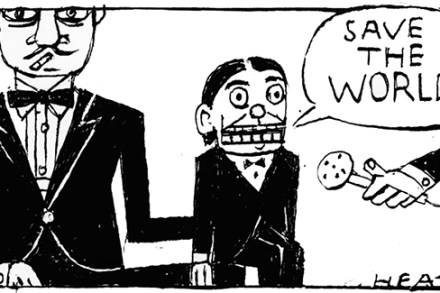
Hold the front page! Spitting Image is back! Well, sort of. A new six-part series, from (some of) the team behind Fluck and Law’s puppetry satire show, will be broadcast on ITV this spring. Called Newzoids, it promises to provide a ‘biting look at the world of politics and celebrity’. Cue ecstatic reports in all the papers about how hilarious the original was, and how much we’ve all missed it. There’s only one problem with this analysis. Whisper it on Wardour Street, but Spitting Image wasn’t actually all that funny.

The Associates at Sadler’s Wells reviewed: another acutely inventive work from Crystal Pite

The prodigious streetdancer Tommy Franzén pops up everywhere from family-friendly hip-hop shows by ZooNation, Boy Blue and Bounce to serious contemporary ballet by Russell Maliphant and Kim Brandstrup, but he’s a bit of a Macavity. He ought to be recognised as a star, but he effaces himself award-winningly in others’ work. That chameleon quality is a problem with his venture into the solo limelight, a Charlie Chaplin tribute, SMILE, on the Sadler’s Wells triple bill of associate choreographers last week. Franzén’s mercurial moves are always thrilling to watch, and his creative extension of Chaplinesque capering into some acrobatic popping and b-boying does OK in making the Little Tramp a street brother of hip-hop’s outsiders.