More from Arts

Gutted!

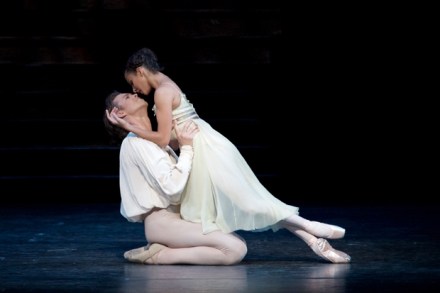
There was blood on the walls and floor at the birth of Kenneth MacMillan’s Romeo and Juliet in 1965. The violence of the subject was matched by the goings-on in the wings, the scrap over the first-night casting, in which the original Juliet, the young Lynn Seymour, found herself relegated down the list having had

Fighting talk | 17 September 2015

If there’s one thing scarcer than hen’s teeth in serious choreography nowadays, it’s a light heart. When was the last time we had something jolly created in the artform that brought us La Fille mal gardée, Coppélia and Les biches? Still, the first week of the start of the dance year was all good stuff,

Press night

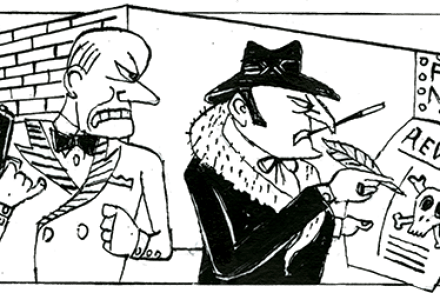
Sam Mendes once said there is no such thing as the history of British theatre, only the history of British press nights. That observation takes us closer to understanding the taboo that constrains journalists from reviewing the opening performance of a West End play. A dozen or so previews take place before the critics are

Martian moves

Every August when London dims, Edinburgh calls, promising nothing less than ‘the greats of the arts’ at the International Festival. As if this beautiful, haunting city wasn’t enough enticement, I always pack high expectations for the EdFest, which in the past has delivered some staggeringly good international dance events that commercially biased London could not

Ai Weiwei

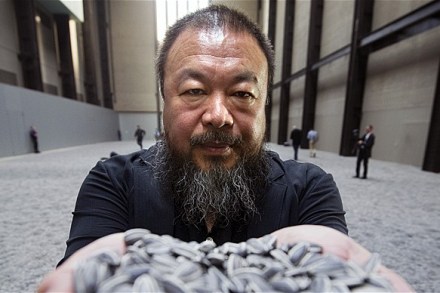
In September, the Royal Academy of Arts will present a solo exhibition of works by the Chinese artist Ai Weiwei. This follows his installation of porcelain sunflower seeds in Tate Modern’s Turbine Hall, a solo show at Blenheim Palace and two solo exhibitions at the Lisson Gallery (which represents him). Peculiarly, the Royal Academy’s press

Afterthoughts

The blackness that sweeps along the stage behind Sylvie Guillem’s disappearing figure in the Russell Maliphant piece on her farewell tour is an astonishing moment. One flinches. An eclipse has happened and the light has just run away with her. All gone. Michael Hulls’s momentous lighting states Guillem’s intentions as clearly as Elias Benxon’s filmwork

Portrait or landscape?

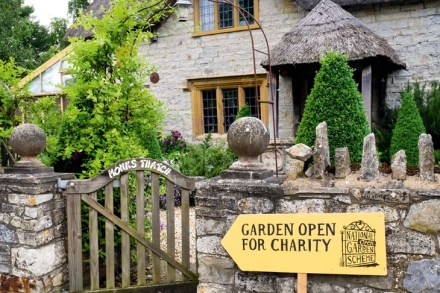
One of the default settings of garden journalists is the adjective ‘painterly’ — applied to careful colour harmonies within a border (or equally considered clashes) and long, swooping vistas. It evokes soft sfumato smudges of pink and green, much as I imagine the interior of the late Queen Mother’s wardrobe must have looked. But it’s

Zaha Hadid

Zaha Hadid is the most famous woman architect in the world. Would women or, indeed, architecture, be better off without her pushily hard-won, global celebrity? She established her studio in London in 1980. For nearly 14 years Hadid, absurdly, became famous for not having built anything. Her reputation was boosted by a clique of fawning

Pulp fiction

Hot, languorous, sizzling… I was thinking what an ideal show Matthew Bourne’s noir comedy is to watch on a summer’s evening in T-shirt and shorts as you sip a cold beer in a plastic cup and feel all toasty while the garage mechanics are bumping and grinding away at Dino’s Diner. Then the rain started

All you need is love | 16 July 2015

What could induce a grown-up, rational, childless person to go to see the ballet of Cinderella? You’ll expect to cringe at the panto comedy; on the other hand, you do not want to see verismo child-abuse and uglies-baiting. So what’s left for modern eyes? Two things: the Prokofiev score — as magical a charmer as

Dying of the light

It’s a comfort that the creation of a new ballet inspired by French court entertainment can still happen in the amnesiac ballet country that Britain has become. The idea of making a modern-day meditation on the first ballet — Louis XIV’s 12-hour epic Le Ballet de la nuit (1653) — is as intellectual as Wayne

Walking with cadence

I often regret that I’m writing in the past tense here, but never more than about milonga. It is such a smash show in every way that by rights it would be having a six-month run where everyone can see it, rather than five measly days at the elite Sadler’s Wells dance theatre where people

Dietrich Fischer-Dieskau

For anyone who has been interested in classical vocal music since the middle of the last century, whether choral, operatic or solo, there has been one inescapable name and voice: Dietrich Fischer-Dieskau. His repertoire was gigantic, surely larger than that of any singer ever. He began public concerts and recordings in the late 1940s and

The long goodbye

There’s been a clutch of middle-aged danseuses taking leave of life in one way or another recently. We’ve seen the abject (Mariinsky star Diana Vishneva’s solo show at the Coliseum) and the magnetic (Alessandra Ferri mournfully channelling Virginia Woolf at the Royal Ballet). A fortnight ago, the Paris Opéra’s aristocratic Aurélie Dupont retired from the

Dedicated follower of fascism?

The ‘revelations’, 50 years after he drowned, that Le Corbusier was a ‘fascist’ and an anti-Semite are neither fresh nor startling. Indeed they’re old hat. And it defies credibility that the authors of three recent books about this tainted genius were ignorant of what anyone with even the frailest interest in architects’ foibles and tastes

Moving pictures | 21 May 2015

About six years ago the first section of the now celebrated High Line was opened in New York and made a palpable hit both locally and internationally. Locally it revealed what one might have guessed, that the inhabitants of Manhattan’s downtown suffered a severe lack of amenity. Every place to walk or run or ride

Woolf haul

People have been saying that Wayne McGregor’s new Woolf Works has reinvented the three-act ballet, but not so. William Forsythe reinvented the three-act ballet 20 years ago with Eidos: Telos, a mesmerising masterpiece that I found myself recalling as I watched the McGregor. There are many formal similarities: the search for sense through words, the

Shakespeare’s duds

I love Shakespeare. But when he pulls on his wellies and hikes into the forest I yearn for the exit. A Midsummer Night’s Dream has a moonlit, sylvan location populated by a syrupy crew of hectic fairies, humourless bumpkins, panting maidens and swooning aristocrats in disguise. Shakespeare wrote it during his apprenticeship and he had

Boys on the march

In dance, it’s usually the moment the boys start fighting that challenges your suspension of disbelief. Synchronised fencing (MacMillan’s Romeo and Juliet), unison goosestepping (Grigorovich’s Spartacus), even the Sharks and Jets in Robbins’s West Side Story, are formation set-pieces designed to arouse us. Last year there was a bunch of ballets made by British choreographers

The rudeness of John Eliot Gardiner

Sir John Eliot Gardiner is talented almost beyond measure. His Monteverdi Choir, English Baroque Soloists and stupidly named Orchestre Révolutionnaire et Romantique have notched up one triumph after another over the decades: benchmark recordings of the Monteverdi Vespers and Bach B minor Mass, the finest period-instrument Beethoven symphony cycle and a cantata pilgrimage of live