More from Arts

Jay-Z: 4.44

Grade: B – All criticism is pointless, I suppose, given the sheer magnitude of the Shawn Corey Carter machine — his billions of dollars, his millions of sales, his ubiquity. This is the rapper even whitey can git down to, big pal of the Obamas, bad-ass Bedford-Stuyvesant gangsta made good. But even when Jay-Z and the genre have been comprehensively subsumed by the mainstream, there is still stuff about it that grates. Not the familiar homophobia or the championing of criminality. Not even the misogyny — hell, if it’s misogyny you’re after, check out The Eagles. Crackers do misogyny just as vigorously. It’s the relentless, self-obsessed, cock-clutching braggadocio — and, when it’s not braggadocio, whining.

Gustav Mahler

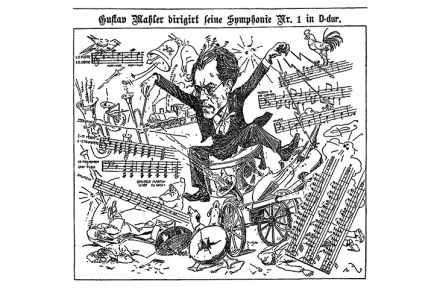
When I began listening to music seriously, in about 1950, I had read about Mahler but wasn’t able to hear any — almost none of his works was available on 78s, apart from the celebrated pre-war recordings of the Ninth Symphony and Das Lied von der Erde, under Bruno Walter, and they were way beyond a teenager’s pocket. Reading about his symphonies — vast, anguished, tormented, ecstatic — I was desperate, and when I finally managed to hear that recording of the Ninth I was suitably overwhelmed, as I still am. During the 1950s I was able, slowly, to hear, though not to get to know, the rest of his output, and responded with prepackaged ecstasy.

Match made in heaven | 6 July 2017

Tennis is best played with a wooden racket on a shady lawn somewhere close to Dorking. There is no need for trainers, an umpire, or a scoreboard. No need for rules at all. After Wimbledon, the tea-and-jam, grass-stained, Sunday-afternoon scenario from A Room with a View is the only one to emulate. In 1908, when E.M. Forster published his novel, lawn tennis was not yet 50 years old. Although the origins of the game reach back to the 12th century, the version played by Miss Honeychurch and Reverend Beebe and most of us today was said to have been pioneered on a croquet lawn in Edgbaston in 1859.

Beth Ditto: Fake Sugar

Boy is she fat, and getting fatter. I realise this is something we’re not meant to mention when talking about Beth — but it’s kinda the elephant in the room. Literally. And I worry about the lass. These days she makes Mama Cass look like Edie Sedgwick. Of course, we should accept her as she is — a lesbian-identifying, very hefty babe from good ol’ down-home Ar-kin-saw. Her difference, then, is part of the schtick, breaking the mould, etc. — and that’s just fine and (Jim) dandy, providing something palpably ‘different’ actually emanates from the stuff she does. That the proud revelling in difference is not merely a cosmetic exercise designed to shift units. And while perhaps once she could claim this, not any more.

Council of despair

Amid the general political turmoil, a flutter of hope has greeted the arrival of Sir Nicholas Serota as chairman of Arts Council England, an organisation of fading relevance. Sir Nick, grand impresario of the Tate galleries, started life as an Arts Council gofer in 1969, taught to hang pictures by the flamboyant David Sylvester, friend of Lucian Freud, Bacon and Giacometti. Sylvester was one of many outsized brains that fuelled the quango in its heyday. Think Stuart Hampshire, Alan Bullock, Marghanita Laski, Richard Hoggart. No one like that left now. Might Serota signal a revival? The omens are not auspicious. In the past 20 years, the Arts Council has shed most of its ethos. The rot began in 1997 when the incoming Blair regime demanded social reform in exchange for state cash.

Peter Perrett: How The West Was Won

Much though I loved it at the time, not a great deal of lasting worth came out of that fervid punk upheaval between 1976 and 1978. In terms of bands you would voluntarily listen to again, there was just The Clash and The Only Ones, in my book. The latter enjoyed no commercial success, despite leaving behind two of the best British albums of the decade and a single — ‘Another Girl, Another Planet’ — which has been called the finest three minutes of rock music ever, ever. Problem was they were too musicianly and literate for a time which exulted in bellowing, grunting, spitting and staccato stabs of noise. The band’s lead singer and songwriter, Peter Perrett, has just released his debut solo album.

Tall story

‘Everything is slow in Romania,’ said our driver Pavel resignedly, and, as it turned out, he was not exaggerating. He was taking us on a trip of about 150 miles, from Sibiu to Targu Jiu, to see the sculptures of Constantin Brancusi. Taking the faster route, we set off a little after 9 a.m. and arrived at about 2 p.m., stiffer, wearier and more comprehending of the reasons why, although Brancusi’s ‘Endless Column’ is among the most celebrated works of modernism, almost nobody — in the London art world, at least — has seen it. My inquiries suggested that an intrepid Tate curator had made it, but that was more than a decade ago.

Triple thrill | 8 June 2017

Thrilling debuts, starry guests and a tear-stained farewell at Covent Garden this week as the Royal Ballet closed the season with a triple bill of works by Sir Frederick Ashton. The company’s founder choreographer could often be spotted lurking at the back of the house during Marius Petipa’s Sleeping Beauty enjoying ‘a private lesson’. Today’s would-be narrative dancemakers could gain similar benefits from The Dream, which distils Shakespeare’s five acts into 55 minutes of witty, characterful dance. Steven McRae’s Oberon made short work of Mendelssohn’s Scherzo with icy pirouettes melting into deep penchées and turns chained so tight and fast he should wear asbestos slippers.

Snoop Dogg: Neva Left

The problem Calvin Broadus has is persuading the rest of us that he still a baaaad muthafucka. Snoop is now 45 and a rather avuncular figure in the US, with his own reality TV show in which he comes across as, God help us, likeable. Those days of running with the Crips in Los Angeles are long behind him, a testament to the redemptive power of huge amounts of money. Is he still of the streets? Neva Left is the defiant response, his best collection for many years. Snoop has immersed himself in a studio with a collection of artists who broke through at about the same time as he did. So this is kinda trad rap, much as Kenny Ball used to dotrad jazz. But none the worse for it — the album is richly melodic (Snoop always had an ear for a good tune) and the rhythms hugely sophisticated.

National Army Museum

I used to love the National Army Museum in Royal Hospital Road, Chelsea, which was crammed with the memorabilia of four centuries of the British Army. I even visited it on the morning of my wedding. It taught you about the history of the British Army in a completely non-political way, allowing the objects — which were carefully factually annotated — to speak for themselves. It was housed in a hideous 1971 building, but the artefacts inside were superb.

Scarlet women

A Covent Garden barfly was scanning her programme during the first interval: ‘Oh yes, the one about the gynaecologist.’ She meant Strapless, of course, an attempt to tell the back story to John Singer Sargent’s ‘Portrait of Madame X’, which scandalised the Paris Salon of 1884. ‘Madame X’ was Amélie Gautreau, a Creole beauty who became the trophy wife of a Paris banker (and bat-guano importer). Impressed by Sargent’s striking portrait of her lover, the surgeon and saloniste Samuel-Jean Pozzi, Mme Gautreau agreed to let the fashionable young artist immortalise her own cadaverous allure. Bad idea. Her brazen pose and the fallen strap of her low-cut gown caused lasting damage to her reputation.

PWR BTTM: Pageant

How about some queercore garage punk? PWR BTTM — the name means something empowering to do with buggery — are a young, gay, two-piece band from New York State who live apparently hectic lives. Their new album, Pageant, was released last week and a couple of days later they were kicked off their record label and current tour after allegations of sexual predation were made against the pantomimely camp singer, Ben Hopkins. The greatest surprise was that the complaints came from a woman. Their career is now in limbo. Hopkins denies the allegations, of course, claiming that he is a consensual and democratic kind of chap. But it’s all rather a shame because Pageant is a thrilling album: tuneful, frenetic and funny. Forget the garage punk tag.

A method to his madness

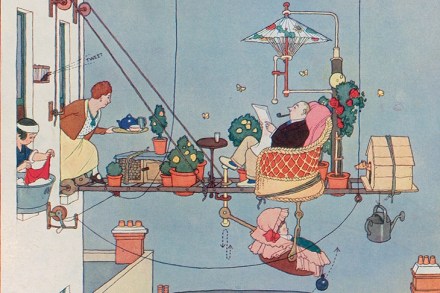
I first came across the extraordinary creations of the artist and illustrator William Heath Robinson at least 60 years ago. I loved them, even though I may not have understood every nuance. When I look once more at old favourites such as the machine for conveying peas to the mouth I often spot in the corner some little twist or joke that I had not seen before. What also wasn’t clear at the time is how prescient some of his contraptions were — in one illustration you can see a prototype selfie stick; in another he invents the silent disco. Many of his madcap solutions were semi-serious responses to societal problems. Some weren’t far off what serious inventors were coming up with themselves.

The play’s the thing | 18 May 2017

Donald Winnicott once told a colleague that Tolstoy had been perversely wrong to write that happy families were all alike while every unhappy family was unhappy in its own way. It is illness, Winnicott said, that could be dull and repetitive, while in health there is infinite variety. Winnicott was reared in an environment of plain-speaking west-country Methodism. He was a people’s doctor who earned his spurs in the crowded children’s wards of east London’s wartime hospitals, allergic to dogma and fearless of being labelled a heretic. He believed that mothers did not need experts to tell them how to care for their own babies and, equally, that artists didn’t need to be justified or understood by psychoanalysts.

An artist of the quickening world

What is it about Yorkshire, particularly Leeds, that it has bred or trained such a succession of famous modern sculptors? Moore, Hepworth, Armitage and, although it stretches the point, Hirst. All attended Leeds art schools and Armitage was born there on 18 July 1916. Everyone knows Moore, Hepworth, Hirst. But Armitage? How many under 60 remember him? Conventional opinion confines his relevance to the 1950s. The Kenneth Armitage Foundation (of which I was a trustee) has marked his centenary with an overdue restoration. There have been two books — Kenneth Armitage Sculptor, edited by Ann Elliott, and The Sculpture of Kenneth Armitage by James Scott — and three exhibitions.

Roving eye

Photography has many genres, even more than painting, and most photographers achieve fame by focusing on one of them. There are technical reasons for this. Armed only with a bunch of brushes and a palette of colours, a painter can achieve a variety of effects — close-up, distance, soft or sharp focus, motion — for which a photographer needs a battery of cameras and associated paraphernalia in the form of lenses, films, lights and filters, and the technical know-how to get the best out of each. There is also professional snobbery. Jobbing photographers who work across genres for magazine assignments are less likely to be taken seriously as artists. The distinction may be artificial (pun intended) but it exists, and it explains why New York photographer Marvin E.

Blondie: Pollinator

Ah, Blondie. Those happy days of glorious power pop, chilly disco and rich, fruity vocals — Debbie Harry yearning away like a very bad alleycat on heat. ‘X Offender’, ‘In the Flesh’, ‘Picture This’ and that one where she’s in the phone booth, apparently gagging for it. People knock it, but the late 1970s wasn’t a bad time to be a teenager. And while Blondie may have been a rather calculating act, cleverly positioned on the fringe of punk and the fringe of pop and the fringe of disco and later even rap, they were at least likeable and the tunes were, largely, effortlessly and simplistically terrific. And then there was Debbie.

Remembrance of things past | 11 May 2017

If you want to appreciate why the return of Twin Peaks is so significant, then you need to know something of the background. And, no, not the background of the show itself, which rose and fell through two series before coming to a stop on 10 June 1991. Nor the background of its story, which began with the sodden corpse of Laura Palmer and concluded with the FBI agent Dale Cooper — or was it? — smashing his head into a mirror. But the background of the world into which Twin Peaks is returning. The terrible here and now. This is a time when pop culture is being overrun by nostalgia for the 1990s.

The unhappy Prince

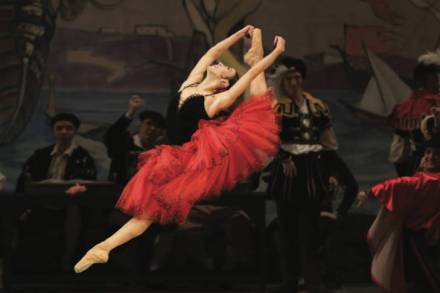
A tragic flaw is one thing — every hero should have one — but Mayerling’s Rudolf, a syphilitic drug addict with a mother fixation and a death wish, is a very hard man to love. Kenneth MacMillan’s 1978 ballet, currently being revived at Covent Garden, tells the complex tale of the Crown Prince of Austria-Hungary and his 1889 suicide pact with his teenage mistress. The narrative unfolds in flashback with cinematic sweep to a cunning patchwork of 30 Franz Liszt compositions invisibly mended by John Lanchbery. The grandeur of the Viennese court is deftly sketched by designer Nicholas Georgiadis. Vast interiors are evoked with a swath of fabric and the women’s gowns suggest the bulk of bustles without cramping MacMillan’s style.

Ray Davies: Americana

There is some surprise that after all these years Ray Davies has turned his attention to America. He is the most quintessentially English of pop musicians, a witty and acute observer of the British way of life whose best tunes were drawn from music hall and calypso — even while, with his brother Dave, he was inventing that most doggedly, turgidly, horribly English of genres, heavy metal. And yet The Kinks most famous hit, ‘Lola’, had a real American swagger about it, in the wonderful rolling rhythm, as Davies expressed his profound confusion at meeting a transgendered lady in a Soho bar. It was the first record I ever bought, at the age of ten, much to my parents’ disgust and consternation.