Lead book review

Darius III: Alexander’s stooge

In 1891, George Nathaniel Curzon, ‘the very superior person’ of the mocking Balliol rhyme, and future viceroy of India, arrived at Persepolis. Torched in 330 BC by Alexander the Great, it had once been the nerve-centre of an empire that stretched from the Aegean to the Hindu Kush. For Curzon, whose tour of Iran had

The forgotten flowering of the medieval mind

For those who imagine the medieval period along the lines of Monty Python and the Holy Grail — knights, castles, fair maidens, filthy peasants and buckets of blood and gore (you know, all the fun stuff) — Johannes Fried’s version may come as something of an aesthetic shock. His interests lie in the more rarefied

A window on Chaucer’s cramped, scary, smelly world

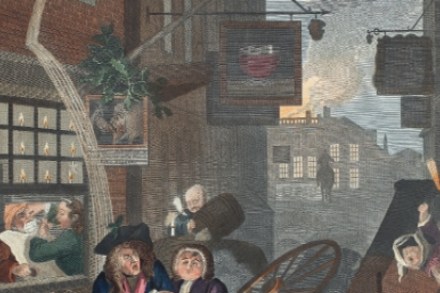
Proust had his cork-lined bedroom; Emily Dickinson her Amherst hidey-hole; Mark Twain a gazebo with magnificent views of New York City. Where, then, did the father of English poetry do his work? From 1374 till 1386, while employed supervising the collection of wool-duties, Chaucer was billeted in a grace-and-favour bachelor pad in the tower directly

Mecca: from shrine to shopping mall

Mecca is the greatest paradox of the Islamic world. Home to the Kaaba, a pagan-era cube of black granite said to have been built by Abraham and his son Ishmael, it is the lodestar to which 1.6 billion Muslims direct their five daily prayers. Mecca is the single point on the planet around which Muslims

Eugene O’Neill: the dark genius of American theatre

George Bernard Shaw called him a ‘Yankee Shakespeare peopling his isle with Calibans’. He was dubbed ‘a fighting Tolstoy’ and ‘the great American blues man of the theatre’. Before he was 35, Eugene O’Neill had emerged as the first real titan of American theatre, a preeminence he has never lost. When Sinclair Lewis was awarded

The Edge of the World: deep subject, shallow history

The Mediterranean glows in our conception of the Continent, the warm source of everything that is best in us, the seat of civilisation, from which one delicious wave after another has washed up on our shores. But what about the Mediterranean’s twin, the other great lobe of the Atlantic which defines the northern edge of

Does Boris Johnson really expect us to think he’s Churchill?

As you would expect, it’s impossible to read this book without drawing fairly direct comparisons between its author and its subject. In promotional exchanges, with the well-worn practice of self-deprecation, its author will of course insist that there is no comparison between the great man and the present humble supplicant. The readership will, with tolerant

My mad gay grandfather and me

Family history is all the rage at the moment — finding out about one’s ancestors, digging back into one’s roots. Sofka Zinovieff has written the strange, and strangely moving, tale of her family’s unorthodox relationships. By turns comical, tragicomical and melodramatic, her book often reads much like fiction, and she recounts it like a novel.

How Hitler’s dreams came true in 1946

I should begin this review, in the spirit of full disclosure, by admitting that I know the author very slightly. Something close to 14 years ago, we were on the same press freebie: a slap-up lunch in Paris courtesy of — was it? — LBC radio. Who knows? The ignominious occasion of our acquaintance isn’t

Nabokov’s love letters are some of the most rapturous ever written

After the publication of The Original of Laura, Nabokov’s last and most disappointing novel in a very sketchy draft, you might have been forgiven for thinking there wasn’t much left to discover in the great novelist’s writings. If the posthumous fiction has been mostly fairly thin, this extraordinary and wonderful collection of letters to his

Going for a Song, by Bevis Hillier – extract

  On the Bust of Helen by Canova In this beloved marble view, Above the works and thought of man What nature could and would not, do, And beauty and Canova can! Beyond imagination’s power Beyond the Bard’s defeated art, With immortality her dower Behold the Helen of the heart! — George Gordon, Lord Byron