Features

From snowball fights to delivering birthday cards: Britain’s 136,000 lockdown penalty charges

While Boris Johnson and Keir Starmer await the police’s judgment, there has been no end to the fines issued to others caught by their lockdown rules. At last count, some 136,000 fixed penalty notices had been issued in Britain. Durham police – a fairly easygoing force by Covid standards – have handed out just 1,090. Is it a bit mean to fine someone for having had a glass of wine or a beer at work? Perhaps. But no more so than the fines still being issued under the lockdown rules that Johnson and Starmer both voted through. A student in Leeds was fined £10,000 for organising a snowball fight. A beggar was fined £434 for having his cap out at King’s Cross station.

The culture wars have crept into Oxbridge admissions

The characters in Sarah Vaughan’s thriller Anatomy of a Scandal include rich Oxford undergraduates from Eton whose main preoccupations are drinking and trashing rooms. They are what it is fashionable to call ‘privileged white males’; while the typical female Oxbridge student is ‘slim, tall, well dressed. Entitled… they knew they belonged there’. The truth, however, is that although Eton is one of the top academic schools in the country, its ‘beaks’ are puzzled by the sharp reduction in the number of their brightest pupils gaining places at Oxbridge. The number of offers has halved between 2014 and 2021.

Fraud victim? Don’t bank on getting your money back

Lloyds Bank has been running a new advertising campaign which updates its long-standing black horse corporate branding. The horses no longer thunder along a beach, but interact with people who we assume are actual or potential customers. The soothing payoff slogan goes: ‘Lloyds Bank. By your side.’ The latest episode features a girl who slightly puts me in mind of our 17-year-old daughter. She happens to bank with Lloyds, but there the happy parallel ends. On a Saturday afternoon in March, a person unknown withdrew £440 from our daughter’s account via an ATM. At that precise time, our daughter was playing her clarinet during an audition for a London orchestra.

What the new GCSE in global warming should teach

For years, environmentalists have campaigned for children to study global warming as a subject rather than simply as a part of geography. Their wish has now been granted in England with a new GCSE in natural history, starting from 2025. We know nothing yet about the syllabus but it’s quite the opportunity to ask what our planet’s problems really are, and how effective the net-zero agenda is as a solution. Rather than be scared to death about the future of the planet, pupils should instead be encouraged to take a rationalist approach. They might ask whether the obsession with climate change in recent decades has taken attention away from the many other major problems facing the planet.

The march of the ‘menosplainers’

I think we’ve reached peak menopause. You simply can’t switch on the radio, open a newspaper or watch telly without some fiftysomething media babe banging on about her hot flushes, sudden rages and the feeling of going mad. Davina McCall has just made a whole TV show about it (Sex, Mind and the Menopause), and her book Menopausing is out this month. McCall has likened her symptoms to those felt by people with a brain tumour. Clearly, she has never known anyone with a brain tumour, because those symptoms are a little more significant than simply forgetting where you left your keys, or feeling suddenly hot. I’m not saying there isn’t a place in women’s magazines or in the health section of newspapers for features about ‘My menopause hell’.

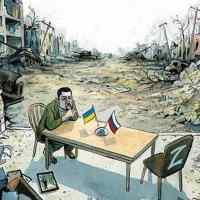
The new White Russians: the fate of émigrés fleeing Putin

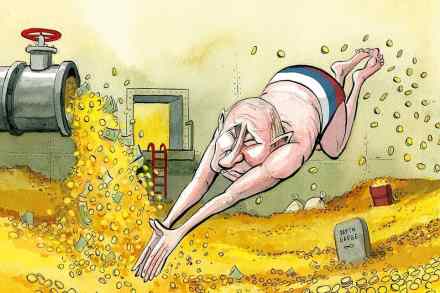
It’s spring in Tbilisi. The fruit trees are in full blossom, the nights are warm. The Purpur restaurant near the Gudiashvili Gardens and Vinzavod No. 1 on Rustaveli Avenue – favourites of visiting Moscow hipsters and creatives for years – buzz with Russian conversation. ‘Everyone I know is here now,’ says Katya, 43, a museum curator visiting from Moscow. ‘It’s like Kvartira 44 [a Moscow café popular with the intelligentsia] on an outing.’ But instead of excitement, the mood among the thousands of Russians who have fled their country for the Georgian capital since the beginning of the war is one of anxiety and barely suppressed desperation.

The monarchy’s real race problem

The monarchy has a race problem. And it has much more to do with Theresa May and Boris Johnson than the hazy accusations of the Sussexes. Two royal tours on the trot have now been upstaged by accusations of ‘colonialism’. First, the Cambridges took the Queen’s Jubilee message to three of her Caribbean realms. Then the Wessexes visited three more. On both tours, local politicians took the opportunity to lecture their royal guests on historic evils done in the name of the Crown. This was swiftly followed back home by a virtuous pile-on on Twitter and elsewhere. LBC’s James O’Brien berated the ‘absurd’ Wessexes for giving their hosts framed photographs. Some urged ‘independence’ for nations like St Lucia.

Why Sinn Fein holds sway on both sides of the border

If Sinn Fein emerges with the most seats in the Northern Ireland Assembly elections this week, it will not be because the party has grown in popularity since the last vote in 2017. It will be because support for the DUP is at its lowest in more than two decades. The DUP has suffered because of its failure to prevent Boris Johnson from agreeing the protocol that left Northern Ireland subject to EU single-market and customs rules. Sinn Fein, meanwhile, has benefited from Brexit and the Conservatives’ assertion of a muscular form of Unionism, both of which have added legitimacy to calls for a border poll on Irish unity.

‘Whitehall was horrified by Brexit’: an interview with Australia’s departing high commissioner

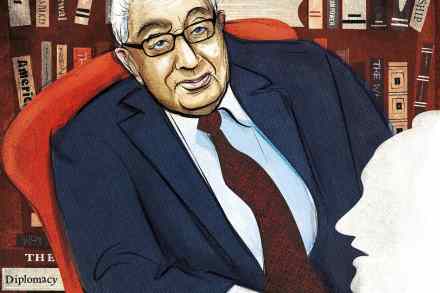
When Britain voted for Brexit, Tony Abbott, the former prime minister of Australia, had an idea. How about striking a new free trade deal between Australia and the UK to celebrate escaping the statism and bureaucracy of Brussels? The deal needed to be only one page long, he argued, because the two countries were already so similar. ‘If a car is fit to be sold in Britain, it’s fit to be sold in Australia,’ he said. ‘If a doctor is fit to practise in Australia, he or she is fit to practise in the UK.’ In the end, things proved more complicated. An agreement was eventually signed last December, but it ran to 430 pages. Free trade was to be phased in very slowly – over 15 years in all – on the grounds that British farmers needed time to adjust.

The strange return of the Philippines’ brutal Marcos dynasty

For Ferdinand ‘Bongbong’ Marcos Jr, the frontrunner for Monday’s Philippine presidential election, a reframing of the country’s past has been crucial to securing his future. Last week, he reminded a television audience what a ‘political genius’ his late father, the dictator Ferdinand Marcos Sr, was. Bongbong’s revisionist history has infuriated many Filipinos but, it seems, resonated with many more. Polls show that he has a 30-point lead over his closest rival, the current vice-president Leni Robredo, though she has drawn massive crowds and expects a late surge of support.

Chump or champ? Why Ben Wallace could be the next PM

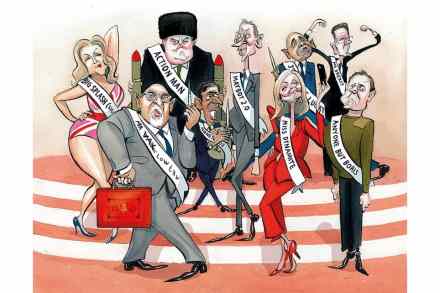
During the Afghanistan crisis last summer, Ben Wallace decided that he had what it took to be prime minister. He had suspected it before then, according to friends, but during the evacuation of Kabul the Defence Secretary came to a definitive conclusion. His prediction that the Taliban would take Kabul had been proved correct, when other senior ministers involved had failed to see it coming. And as the desperate situation played out following the US withdrawal, he hit his stride. His row with the then foreign secretary Dominic Raab over the fall of Kabul was a turning point for the way he saw himself, insiders say. Raab was caught off guard, on holiday.

Boris’s plans for a new Brexit clash

In next week’s Queen’s Speech, a remarkably controversial bill will be announced in the most anodyne language. The government will legislate to protect the Belfast Good Friday agreement in its entirety. These words will be a coded threat to the European Union that the UK is prepared to unilaterally tear up parts of the Brexit deal relating to Northern Ireland. The EU has previously said that if this happens, the whole deal could fall. To which the Prime Minister may well respond: so be it. Northern Ireland was the great compromise of Brexit. Boris Johnson got his deal against all expectations because he agreed to what is, in effect, a regulatory border in the Irish Sea.

Disney vs DeSantis

Bob Chapek, Disney’s CEO, was paid $32.5 million last year. It’s hard to feel sorry for someone on that sort of money. Poor Bob, though. He’s caught in the middle of a vicious fight between Florida’s conservative governor Ron DeSantis and Disney’s LGBTQ+ activists and he’s being pummelled from both sides. It’s nasty. Children probably shouldn’t watch. The story begins with DeSantis’s Florida Parental Rights in Education Act, which passed in March and banned Floridian schoolteachers from discussing sexuality and mutable gender-identities with very young children. America’s progressives despise DeSantis and, it seems, the notion that parents should have more control over what their sprogs are told about sex.

My stock has soared since I’ve taken in two Ukrainians

I have temporarily taken in two Ukrainian refugees and suddenly find that, for very little sacrifice, my stock has soared. People who have regarded me as a hard-nosed, right-wing bastard are suddenly confused and struggling to readjust. A woke young relative who has despaired of my ignorant, reactionary views on Black Lives Matter, climate change, gender and so on suddenly sees a halo above my head. My mother-in-law on the Costa Brava reports mentioning that her daughter and son-in-law have Ukrainian refugees is like being sprinkled with gold dust. Her social circle is in awe. Never have I received so much praise for doing hardly anything at all.

Fractured: can the West fix itself?

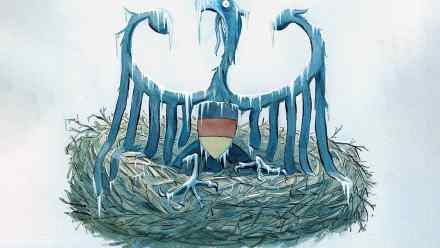
There are many ways to fracture a people. But one of the best is to destroy all the remaining ties that bind them. To persuade them that to the extent they have anything of their own, it is not very special, and in the final analysis, hardly worth preserving. This is a process that has gone on across the western world for over a generation: a remorseless, daily assault on everything that most of us were brought up to believe was good about ourselves. Take our national heroes – the people who used to form the epicentre of our feelings of national pride. Twenty years ago, Winston Churchill easily won the BBC’s competition to find out who the nation thought to be the Greatest Briton.

In defence of staring

Like many people, I enjoy watching people. There’s a great pleasure in sitting in a café or on a park bench on a sunny afternoon and just watching people pass by. But increasingly, people-watching is becoming suspect, and even criminalised. The latest and most worrying example is Transport for London’s campaign against what it calls ‘intrusive staring’. Posters all over the Tube now warn us: ‘Intrusive staring is a form of sexual harassment and will not be tolerated.’ Last month a man was sentenced to 22 weeks in prison after a woman reported him for ‘continuously staring’ at her on a train in Berkshire.

Can Mélenchon unite the French left?

Paris Shortly before the first round of the French presidential election I was handed a campaign flyer by one of Jean-Luc Mélenchon’s activists. On one side was his photo and on the reverse the headline: ‘With Jean-Luc Mélenchon another world is possible.’ What sort of world? A leftist utopia in which the minimum wage would be raised from its current €1,302 to €1,400 net per month, new hospitals would be built, the retirement age would be lowered to 60, and there would be a fixed price for petrol, food and energy prices. Oh, and there would also be a Sixth Republic.