Features

Battle begins: inside Rishi Sunak’s plan to take on Labour

When David Laws moved in as chief secretary to the Treasury in 2010, he found a note from his predecessor Liam Byrne saying: ‘I’m afraid there is no money.’ It was the most famous parting gift in British political history. What was meant as a joke (Byrne had thought his friend Philip Hammond would get the job) quickly became the coalition government’s most effective weapon against the opposition: proof that Labour could not be trusted with the public finances. Today, Labour wants to level the same accusation against the Conservatives. ‘On the first day [in power], we need to land the message very quickly that the finances are in a very bad state and it is all because of the Tories,’ says one Keir Starmer aide. ‘We would need to make them wear it.

The new age of gullibility

Is the Loch Ness Monster real? Many thousands of people think so. ‘Existence “plausible” after plesiosaur discovery,’ the BBC reported. ‘Hundreds join huge search for Loch Ness Monster.’ Not only that. The Beeb had live coverage of congressional hearings about possible UFO sightings in July. It ran a series on the yeti the previous month asking: ‘Is something out there in the Himalayas?’ Last year, an Autumnwatch presenter took seriously the possibility that large cats are roaming the countryside. What’s coming back next? Poltergeists, Ouija boards, the Bermuda Triangle, crop circles? Have we been time-ported back to the 1970s?

What really motivates the ‘new progressives’

Kemi Badenoch is right to say that Britain is not a racist country. The data simply does not support the claim that black and ethnic minority (BME) people in the UK are generally disadvantaged because of the racial prejudice of white Britons – that ‘systemic racism’ is the cause of the problem. It also suggests that some ethnic minorities tend to perform better than others because of internal cultural factors – not least, strong families and high educational aspirations. By the same token, the cause of relative disadvantage often lies in culture, not racism.

Why are House of Lords clerics so anti-Tory?

The bishops can smell blood in the water. Sensing how badly the Conservatives are doing in the polls, the two archbishops and 24 bishops of the Church of England in the House of Lords appear to have thrown aside any pretence of political objectivity and impartiality and have pitched themselves all-out against the government. This has been building up since the advent of the Tory-Lib Dem coalition in 2010, but the way that the bishops have taken their gloves off in the present session of parliament is shocking. Anglican bishops occasionally argue that they opposed the last Labour and coalition governments just as much as they do the present Conservative one, but consider these statistics. In 1999-2000 they opposed Tony Blair in 27.

Judgment call: the case for leaving the ECHR

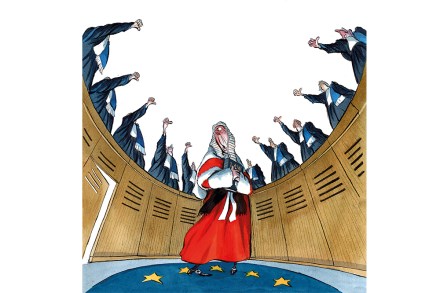
The debate about the European Convention on Human Rights is in danger of being diverted into irrelevant byways. Hostility to the convention has become a trademark of the right wing of the Conservative party, which invites unnecessary partisanship. This is unfortunate, because the United Kingdom’s adherence to the convention raises a major constitutional issue which ought to concern people all across the political spectrum. It is far more important than Suella Braverman’s battles with boat people and ‘lefty lawyers’. Yet so far, the debate has rarely risen above the level of empty slogans, meaningless mantras and misleading claims.

Could I find a girlfriend on a Guardian Blind Date?

Free grub, free booze and the chance to fall in love. That’s the deal offered by Blind Date, a matchmaking strand in the Guardian that brings together lonely hearts and asks them to spill the beans. When I applied for this enticing freebie I had no expectation of being chosen, but my email was answered within hours. Amazing. Randy singletons are in short supply among Guardian readers. I was asked to describe my ‘interests’, which are rather limited. I tend to avoid travel, sport, art, museums, cars, planes, movies, pubs, music, parties, dancing, eating out or holidays. I’m never invited to dinner by anyone or ‘for the weekend’, thank God. I avoid TV, and my idea of hell is ‘a walk in the countryside’.

Should Ukraine hold a general election next year?

In the months before Russia invaded Ukraine last year, Volodymyr Zelensky was fighting for his political life. The former comedian was elected in 2019 on a pledge to end the war in Donbas by an electorate exasperated with its political class. Zelensky initially set out to negotiate with Vladimir Putin – but achieved nothing. He appeared naive and out of his depth. However, Zelensky’s transformation into a wartime leader captured the world’s imagination and rallied his allies. Yet some of those allies are beginning to ask whether, if this war is really about the free world versus autocracy, as Zelensky claims, Ukraine should hold a general election next year.

Meet the Aboriginal politician leading the charge against Australia’s Voice referendum

Sydney Every so often, in the life of nations, there comes a moment when a new political force articulates a sense of frustration at the old orthodoxies, or a yearning for something new. Sometimes, such a force turns into a momentous presence that transforms the national landscape. Australia has reached such a moment in the person of a 42-year-old Aboriginal mother of four. A conservative legislator for little more than a year, Jacinta Nampijinpa Price, the shadow chancellor for indigenous affairs, has challenged the old, failed narratives which argue that systemic racism is responsible for indigenous woes and that a policy of welfarism and separatism is the answer. As a result, she has changed the nature of our national debate surrounding our Aboriginal population.

Why we hate surge pricing – but love happy hour

A Dominican and a Jesuit were chain smokers. Both were eager to be allowed to smoke while performing their devotions, but needed to gain permission from a higher authority. ‘I tried asking the Prior, but he was dead against it,’ said the Dominican. ‘What did you ask, precisely?’ enquired the Jesuit. ‘Well, I asked him whether it was acceptable to smoke while I was praying.’ ‘Wrong question,’ replied the Jesuit. ‘I asked my Abbot whether I could pray while I was smoking. Permission granted.’ To economists, price is a number. To everyone else, price is a feeling This is called a framing effect and is one of the best attested findings in the psychological sciences.

The simplicity and joy of recorded conversations

Recently I stumbled across a file of conversations I’d recorded with my seven-year-old son Frank back when he was four. Topics include his travels through wormholes, why he finds planet Earth ‘boring’, the tragic story of how his ‘first family’ died and how he got his ‘laser eyes’. It was only by listening to these voice notes three years later that I understood just how precious audio recordings are, and also how under-used. The conversations I taped illustrate the nuances of Frank’s four-year-old self more vividly than any photo or video could. Anyone attempting to write fiction should take note of the power of audio – conversation and voice are how character is built. A physical description tells you relatively little.

Parent trap: the relentless rise of children’s speaker Yoto

If you want a handy metaphor for contemporary childrearing, it’s a colourful plastic box with big red buttons on it. Yoto is the name, and before long, you’ll be seeing it where you already see children using screens – so pretty much everywhere. One in 50 British homes with a child under 12 is said to have one. It’s like a CD player-cum-iPad with ambitions to run your child’s life. The essential bits of it are plastic cards that you or the child – the idea is that the child has agency here – slot into the player to listen to a story, but there’s a whole range of other options – radio, podcasts, night lights, sound effects.

The enormity of the migrant crisis will upend European politics

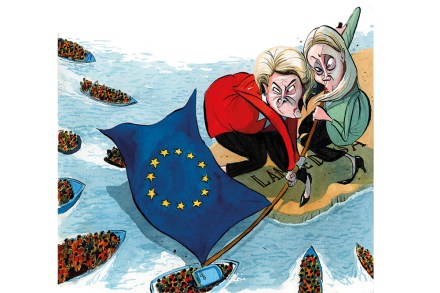
When hundreds of mostly African migrants escaped from the transfer centre in Porto Empedocle, Sicily, last weekend and began roaming the town’s bakeries and shops begging for food, the mayor took to social media to explain. There were 2,000 migrants squeezed into a facility meant for 250, he told terrified locals. The conditions were inhumane. The repeated attempts to escape were inevitable. On the island of Lampedusa, 11,000 migrants had arrived in the space of five days. There were 6,000 migrants in a facility meant for 600. The Sub-Saharan Africans were fighting with the North Africans. ‘To get food is a problem,’ one migrant told a television interviewer. ‘If you don’t fight, you don’t have food.

Inside the fastest growing – and shrinking – churches in the UK

The Pentecostal preacher is in full flow – his voice raised to near-deafening volume, his gestures expansive but exact, the congregation murmuring back a chorus of ‘Amens’ – when he receives an unexpected interruption. ‘A woman asked me at the barbecue last week,’ he is telling us, ‘“Pastor, if I won the Lottery…”’  A voice somewhere to his right intervenes. ‘A-MEN!’ A wave of laughter from the congregation. The preacher rides it. ‘No! Don’t Amen that! We don’t believe in lotteries, we believe in work. Hard work. So, she asked me, “Pastor, if I won the Lottery, and I gave the money to the church repair fund, would you accept it?” And I said…’   The congregation is quiet again. We’re in the realm of moral theology.

The exiled activists who dream of dismantling the Russian empire

There is a dream called the Republic of Ingermanlandia. This republic’s values will be European, its borders will be open and it will prosper like its neighbour Estonia on the back of a booming digital economy. For the moment Ingermanlandia is better known as Russia’s Leningrad Region, and its capital as St Petersburg. But soon, promises Maxim Kuzakhmetov, a leader of the Ingria Without Borders independence movement, Russia will suffer ‘catastrophic defeat in Ukraine and will collapse like the USSR, or like all the empires who lost the first world war’ and disintegrate into its constituent regions. This week in London and Paris, exiled activists from more than 40 regions of Russia will gather for the Free Nations of Post-Russia Forum.

How an animal psychic helped find a missing dog

It was more in a spirit of desperation that I decided to contact an animal psychic after my friends’ terrier Lark disappeared. Lark vanished one evening from their house. She was chipped, and her collar had their number on it, but as the days went by no one called. Lark’s photo was put on Facebook and on posters near her home. Had she been stolen, or hit by a car? We searched for her body but found nothing. Was she stuck down a rabbit hole? Five days after her disappearance, my friends went on a prearranged holiday and left me in charge of the mystery. Becky mentioned birds of prey, and people living off the land. It seemed a litany of clichés I put dog food outside Lark’s home. What if she returned and, like Peter Pan, couldn’t get in?

Why aren’t we giving Ukraine what it needs?

When you visit the rehabilitation centres for those Ukrainian soldiers who have received life-changing injuries, you swiftly learn how to deal with the shock of what you see. You don’t flinch or look away; of course not. You learn the habit of the skilled doctors and nurses and physiotherapists – of concentrating not on the wounds but on the individuals, on the men; and though many women have been killed or injured in this beastly conflict, I must have seen over a hundred badly injured soldiers in Kyiv and Lviv, in three different hospitals, and they all were men. Do not believe for one second that these Ukrainian soldiers could be persuaded to lay down their weapons You notice some remarkable qualities in these patients. They are not by any means all young, far from it.

How I got to know Westminster’s ‘Chinese agent’

On Monday, I was surprised to discover a photo of myself in the papers next to a parliamentary researcher who had been arrested on suspicion of being a ‘Chinese agent’. The photo was taken in February at a panel in parliament entitled ‘Defeating the dictators’. The man and I are both twentysomething China watchers who work in Westminster. I’d got to know him in a professional capacity, but every so often, we had a drink together or hung out at a friend’s flat. It was only when I saw reports of his arrest that I realised I hadn’t heard from him since an evening six months ago when we teamed up to play Codenames, the board game in which rival spymasters race to rendezvous with their agents. We smashed the other team.