Features

How an animal psychic helped find a missing dog

It was more in a spirit of desperation that I decided to contact an animal psychic after my friends’ terrier Lark disappeared. Lark vanished one evening from their house. She was chipped, and her collar had their number on it, but as the days went by no one called. Lark’s photo was put on Facebook and on posters near her home. Had she been stolen, or hit by a car? We searched for her body but found nothing. Was she stuck down a rabbit hole? Five days after her disappearance, my friends went on a prearranged holiday and left me in charge of the mystery. Becky mentioned birds of prey, and people living off the land. It seemed a litany of clichés I put dog food outside Lark’s home. What if she returned and, like Peter Pan, couldn’t get in?

Why aren’t we giving Ukraine what it needs?

When you visit the rehabilitation centres for those Ukrainian soldiers who have received life-changing injuries, you swiftly learn how to deal with the shock of what you see. You don’t flinch or look away; of course not. You learn the habit of the skilled doctors and nurses and physiotherapists – of concentrating not on the wounds but on the individuals, on the men; and though many women have been killed or injured in this beastly conflict, I must have seen over a hundred badly injured soldiers in Kyiv and Lviv, in three different hospitals, and they all were men. Do not believe for one second that these Ukrainian soldiers could be persuaded to lay down their weapons You notice some remarkable qualities in these patients. They are not by any means all young, far from it.

How I got to know Westminster’s ‘Chinese agent’

On Monday, I was surprised to discover a photo of myself in the papers next to a parliamentary researcher who had been arrested on suspicion of being a ‘Chinese agent’. The photo was taken in February at a panel in parliament entitled ‘Defeating the dictators’. The man and I are both twentysomething China watchers who work in Westminster. I’d got to know him in a professional capacity, but every so often, we had a drink together or hung out at a friend’s flat. It was only when I saw reports of his arrest that I realised I hadn’t heard from him since an evening six months ago when we teamed up to play Codenames, the board game in which rival spymasters race to rendezvous with their agents. We smashed the other team.

How ITN used NDAs to silence staff

One of the aims of journalism is to identify injustice and hold the powerful to account, so it’s odd that ITN – which makes news for Channel 4, Channel 5 and ITV – remains so unwilling to examine its own wrongdoing. Women who work for ITN have tried to report harassment and discrimination, but soon after doing so found themselves suddenly out of a job and bound by non-disclosure agreements. I spent seven years in Channel 4 News as a journalist and commissioning editor. It was my perfect job. Colleagues felt like family and we forged strong bonds. After the Black Lives Matter movement started, Anna Mallett, then ITN chief executive, had a message for staff: ‘The time for change is now,’ she said. Anyone suffering discrimination must report it, for the good of us all.

Why won’t Greenpeace admit that wind turbines may be killing whales?

Who cares about whales? Whales might be dying because of sonar surveying, but Greenpeace simply ignores the science that doesn’t suit it. So far last year, 71 whales have washed up dead on the shores of New England and neighbouring states. The rate seems to have risen in recent years along with a growth in the number of offshore wind turbines. A small group of concerned citizens have started to campaign against the turbines on behalf of the whales, and the journalist Michael Shellenberger has made a short film about their efforts called Thrown to the Wind. The evidence gathered by the scientists in the film is far from conclusive: it’s a correlation that could be a coincidence. But it’s not a mad idea that wind farms threaten whales.

‘We’ve cut carbon emissions by decimating working-class communities’: the leader of the GMB union on the folly of net zero

Last week there should have been a great victory for the British turbine industry. Auctions were held for offshore wind power, asking companies to bid for the right to supply electricity at £44 per megawatt hour – a third of the price offered eight years ago. The government and the renewables lobby hoped that a successful auction would show that wind power could compete with fossil fuels. Instead, developers worried that they couldn’t turn a profit on the amount they would be paid for energy. There wasn’t a single bid. ‘Communities up and down the east coast can see wind farms, but they can’t point to the jobs’ ‘It was very embarrassing,’ says Gary Smith, leader of the GMB union. ‘Whitehall told us wind was getting cheaper and cheaper.

Our prisons are in crisis

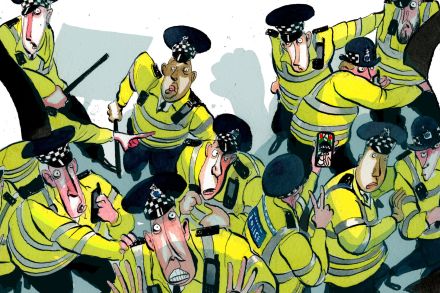
Just as the drama of the escape and recapture of Daniel Khalife settled down, HMP Wandsworth returned to more routine problems. On Sunday, another prisoner was hospitalised, having been stabbed by a fellow inmate. Quality of staff is critical. The best officers have an intuitive sense that something is going on This sort of violence is all too common, especially in the overcrowded Victorian local prisons that hold often volatile remand prisoners. In the past year there have been 1,878 serious assaults on prisoners, an increase of 32 per cent on the previous 12 months. The cause is usually a score being settled between gangs or the failure to pay a debt.

Britain is now a nation of shoplifters

I was a teenage shoplifter. I had a good run at it, from 12 to 14, and found it as addictive as any drug: the anticipation, the antsiness, the sharp stab of joy on completion. But all it took was getting caught, spending an hour in a police cell before being grimly collected and yelled at by my dad, to make sure I never went looking for a five-finger discount again. Shoplifting used to be something which, with the help of stern parents and the police, people grew out of. No longer. Now we are in a world of, as the Gail’s Bakery boss Luke Johnson has put it, ‘widespread, really widespread aggression, abuse and shoplifting’. Asda chairman Stuart Rose says that shoplifting has effectively been decriminalised due to lack of police action.

Click bait: confessions of a Lego addict

The empire of Lego has many dominions and protectorates, with every year, it seems, new territories to conquer. There are theme parks; there are films of excruciatingly ironic sophistication; there are competitions to make bizarre tableaux that grip nations; there are highly controlled TV documentaries about life at the heart of Lego in Denmark. I don’t feel my life will be complete until I’ve spent a week constructing Hagia Sophia out of plastic bricks It is an astonishingly powerful brand and its growth has been extraordinary to watch. Many years ago, it was just one building toy among many, like Meccano or Fischer Technik. Now, it is supreme. Some tremors were, however, observed last week when a plunge in profits was reported.

Is your pet killing the planet?

As a travel writer, I used to joke about the so-called ‘downsides of the job’. The stupidly complex shower-fixture in the five-star Maldivian Paradise. The unexpected commission to go to Denmark in winter. The vague but real sting of disappointment upon realising that the free hotel pillow-chocolate is actually a mint. But in recent years a genuine and troubling downside has arisen. When I meet someone and tell them what I do, the listener often winces, perhaps with a hint of moral superiority, and says something like: ‘Don’t you feel guilty about your carbon footprint? You’re killing the planet!

TikTok is giving our children Tourette’s

Shortly after the first Covid lockdown ended, doctors began to notice something so strange that at first they struggled to explain it. There appeared to be a sudden rise in the number of children being referred with Tourette’s syndrome. Tourette’s is a rare neurodevelopmental disorder characterised by repetitive, involuntary movements or sounds called ‘tics’. While mild tics are relatively common in children, specialists suddenly started seeing large numbers of children displaying complex and debilitating symptoms. Dr Alasdair Parker, president of the British Paediatric Neurology Association, said in 2021: ‘The most severe tics disorders I have seen over the past 20 years have all presented in the last five months to my practice.

Broken Britain: what went wrong?

Did Gillian Keegan need to apologise? The Education Secretary thought her ITV interview had ended and she could speak frankly. She insisted the schools’ concrete crisis was down to ‘everyone else’ who had ‘sat on their arse’. It was a fair point, inelegantly expressed. It’s been almost 25 years since the order first went out from Whitehall to inspect schools and hospitals for crumbling reinforced autoclaved aerated concrete (Raac). When a roof eventually collapsed at the Singlewell Primary school in Kent in 2018, the government sent out surveys to inquire about building material – but that was largely it. Like lazy homeowners, or dodgy landlords, successive administrations assumed the problem would be dealt with by somebody else at a later date.

Why we need an Elizabeth and Philip museum

Driving up Royal Deeside last weekend, I spotted a harvest under way on that magical Hobbit-esque green/gold/purple hillscape. It all came flooding back. One year on from the death of Elizabeth II, it’s the sight of the tractors lined up next to the A93 which remains among the most enduring images. It wasn’t just that they all had their shovels dipped in tribute, like the dockers’ cranes saluting the Havengore as it carried Churchill down the Thames in 1965. It was the fact that they were all spotless. At the busiest time of the year in this lush agricultural belt of Aberdeenshire, farmers had paused their harvesting, taken their machines out of the fields and given them a very thorough hosing down before lining up for hours to salute the late Queen.

How Africa fell out of love with France

On Wednesday last week, a new Gabonese military junta installed itself, having ousted President Ali Bongo, whose family have ruled the country since 1967. Just two days earlier, the French President Emmanuel Macron gave a speech to his ambassadors in which he spoke of an ‘epidemic of putschs’ in what was formerly France’s greatest sphere of post-colonial influence. Although most of these states have been independent for decades, Paris kept them firmly in the French orbit There have now been six coups d’état in francophone sub-Saharan Africa in three years – Mali, Chad, Guinea, Burkina Faso, Niger and now the small but wealthy nation of Gabon.

‘We need to start the road to rejoin’: Gina Miller on Brexit, farmers and her ambitious plans for Epsom

Gina Miller is trying to convince me that she understands why I voted Brexit. The woman who went to the High Court in 2016 to effectively try to cancel my vote by insisting the EU referendum result be referred back to a Remain-dominated parliament, plunging Brexit into years of legal and parliamentary wrangling, says she feels my pain and always has. How can this be? Well, maybe it’s just the magic of politics. ‘My case was not to do with Brexit. It was to do with parliament’ Ms Miller is attempting to turn her single-issue, referendum-wrecking fame into a broader platform, by standing in leafy Epsom and Ewell as one of nine general election candidates for her True and Fair party.

Britain should not be nervous of India

For a disconcertingly large constituency in Britain, Indian history ends in 1947.The two centuries leading up to that bloody year – when British rule formally ended, India gained independence and Pakistan was conjured into existence – were replete with books, articles, pamphlets, lectures and debates on India. What unites this body of work, apart from colonial condescension, is an effort to comprehend India. That impulse faded once India attained freedom. After independence, India surged forward; Britain’s idea of India, however, remained captive to the past Britain’s sins in India – racism, carnage, plunder – are a matter for British consciences.

India’s century: Sunak’s plan for a new Indo-Pacific alliance

When Rishi Sunak became Prime Minister, India’s press was thrilled. ‘From Age of Empire to Rishi Raj’ declared the Times of India: another headline hailed the ‘Browning Street’ phenomenon. ‘Indian son rises over Empire’, proclaimed the New Delhi TV channel, a play on the colonial-era adage that the sun never sets on Britain’s empire. When Sunak visits New Delhi for the G20 next week, it will be quite a moment. Two Hindu heads of government will meet – the old power and the new. Sunak’s agenda is to bind Britain closer to a growing Asian economic powerhouse – which last week completed its first successful moon landing – while containing China by bolstering its rivals.

Thankfully, Tony Blair was nowhere near my Sicilian holiday

Sicily is far removed from the gracious suavities of Tuscany. With the souk-like atmosphere of its markets and obscure exuberance of life in the old Cosa Nostra towns, the Mediterranean island is halfway to Muslim Tunisia. The British Tuscanites who descend on the hills around Florence during the summer holidays as part of their ‘Toujours Tuscany’ dream – Tony Blair, Sting, David Cameron – are thankfully nowhere in evidence. In our post-Godfather world no history of Sicily would be complete without mention of the Mafia. The word is said to derive from the Arabic mahyas, meaning ‘aggressive boasting’: for almost three centuries until the Norman Conquest of 1061, Sicily was an Islamic emirate.

Why the US will decide Ukraine’s fate

As Ukraine marked its 32nd national holiday since independence, news from the front lines and the wider world appeared better than perhaps in any week since the recapture of Kherson in November. In Zaporizhzhia, the hard-fought front lines moved a few miles forward. In Crimea, a missile strike took out a Russian S-400 anti-aircraft complex and a team of Ukrainian commandos briefly raised their yellow-and-blue flag on the peninsula for the first time since Russia’s 2014 annexation. A Russian Mi-8 helicopter pilot defected to Ukraine with a load of jet engine parts. Near-nightly waves of drone strikes deep inside Russia blew up two Tu-22M long-range bombers, four Il-78 transport aircraft and repeatedly struck central Moscow.