Features

A beginner’s guide to witchcraft

Next year, Exeter University will offer an MA in Magic and Occult Science: the first of its kind in a British university. The new course has led to newspaper headlines about a ‘real-life Hogwarts’ and questions as to whether magic is as worth studying as say, economics. The course director, Professor Emily Selove, refused my request for an interview – with polite apologies, although one could hardly expect the convenor of Exeter’s Centre for Magic and Esotericism to be anything but esoteric. A similar tension, it turns out, is at the heart of the debate about the degree. For all the media snideness, the most serious objections come from Britain’s growing magical community.

The sad death of the pony ride

Pony rides were once a staple of every village, church and primary-school fête. A brusque, horsey mother would swing you up into the saddle, and the patient pony would trudge up and down while you clung to its mane, before it was the turn of the next child in the queue. No one ever plonked a hard hat on your head. There were certainly none of those restrictive body protectors that children are encased in now, bundled up like scarab beetles. These days, I am that horsey mother. When we moved to the country from London after the lockdowns, ponies were top of my shopping list – above a replacement for the wheezy boiler and a fancy range cooker. We now have a miniature Shetland pony called Ollie and a donkey called Mouse.

How the BBC scapegoated Martin Bashir

I have become rather obsessed with Martin Bashir and his downfall. Three years ago, I began researching for a play based around his infamous 1995 Panorama interview with Diana, Princess of Wales, which he secured by forging bank statements and reinforcing her belief that there was an Establishment conspiracy against her. When I started writing I thought I would soon understand him. But he still baffles me. When we corresponded recently via email, he suggested playing himself on stage or, failing that, what about Idris Elba? I couldn’t tell if he was joking.   I knew Bashir pretty well back in the day. We were fellow reporters at the BBC and ITV for 13 years. He even joined my covers band Surf’n’Turf on percussion, and very good he was too.

Mind games: why AI must be regulated

During my time in No. 10 as one of Dominic Cummings’s ‘weirdos and misfits’, my team would often speak with frontline artificial intelligence researchers. We grew increasingly concerned about what we heard. Researchers at tech companies believed they were much closer to creating superintelligent AIs than was being publicly discussed. Some were frightened by the technology they were unleashing. They didn’t know how to control it; their AI systems were doing things they couldn’t understand or predict; they realised they could be producing something very dangerous.

Political Islam now commands the Middle East

No sane American president takes office hoping for war. Woodrow Wilson, a 56-year-old Princeton academic, said it would be ‘the irony of fate’ if his presidency came to be dominated by foreign affairs. He spoke in 1913. Joe Biden came to office in 2021 promising to end the ‘forever wars’ of Iraq and Afghanistan. But as he boarded Air Force One on Tuesday, another irony of fate was in evidence: the American-enforced world order is crumbling, and the results are now becoming clear. Iran, far from being neutered by US sanctions, was able to start a war using its Hamas proxies and their Hezbollah allies to attack Israel. At a stroke, the Arab-Israeli rapprochement America had wanted to nurture has been put on ice.

Netanyahu has failed Israel

Jerusalem Israel’s war with Hamas in Gaza is rapidly evolving into a war with all of Iran’s proxies on its borders, including Islamic Jihad and Hezbollah. Its outcome will determine the country’s future for a generation, perhaps longer. The conflict is not even in its third week, and as I write these words the inevitable ground invasion of Gaza has still not begun, and yet this is already proving to be an epochal episode in the country’s history.  The Hamas terror attack on 7 October not only revealed a conceptual flaw in Israel’s regional strategy, exposed glaring problems within its celebrated intelligence services and caused the terrible deaths of some 1,400 Israelis. It also shook the self-confidence of Israelis to their core.

Europe needs to step up on Ukraine

Vasyl, a burly, tattooed infantry commander who lost a leg to a Russian mine on the eastern front, sits swinging his remaining leg on the edge of the treatment table in the ‘Unbroken’ rehabilitation clinic in Lviv. He’s been inside the Russian trenches 50 times, he tells me. His stories are reminiscent of the first world war. I ask him what Ukraine needs for victory. Answer: ‘Motivated people.’ His T-shirt proclaims ‘no sacrifice, no victory’. After we shake hands and I wish him luck, he suddenly jumps off the table and starts skipping at amazing speed, his blue skipping rope whizzing around under his one foot, while he looks at me with a broad grin, as if to say ‘Here’s your answer’.

Ukraine’s fight has been eclipsed by the ‘Other War’

The first indication that this was a literary festival like no other came with the request to provide ‘proof of life’ questions in case of kidnap. I’ve been to some unusual festivals – earlier this year I found myself discussing war-rape, ancient and modern, with the classicist Mary Beard on a barefoot island in the Maldives – and had some unusual festival encounters, such as the woman who asked me to sign a book to her dead husband, adding that he was reading it when he died. This, however, was my first in a war zone. There was a polite warning from the Lviv Book Forum organisers: ‘If there is an airstrike, we will interrupt the event.’ It’s all part of the resilience of Ukrainians, determined in the face of Russian aggression that life must go on.

The World at War is the greatest documentary series ever made

To present a TV history documentary these days, one must first have access to the full Angels and Bermans dressing-up box – everything from britches to bonnets. The past must be experienced as pantalooned immersion: throw in some CGI cavalry charges or naval battles, plus artfully dressed period locations, back-alley washing-lines fluttering with greying rags, and you are just about ready to go. This is not necessarily to complain. Every generation finds its own way of exploring complex historical questions. Nothing dates faster than history. Yet The World At War retains a freshness and a capacity for surprise But there is one television series that stands as a monument to the virtues of focused seriousness, and that is still being streamed today.

How to win four Nobel Prizes in literature

‘Hi Jacques,’ I say as the publisher of Fitzcarraldo Editions appears on my Zoom screen with his Franz Hals facial hair. ‘Thanks for making the time.’ I explain, apologetically but cheerily, that I’m going to be asking him to give his basic ‘how I keep winning Nobel Prizes’ spiel – at which, I say, he’s probably by now well practised. ‘Hm,’ he says, ‘I’m not sure about that. I’ll do my best.’ Though he’s grateful for what it’s done for his tiny publishing company, you sense that Jacques Testard probably finds it a bit irksome that it takes the ephemeral showbiz razzle of the Swedish academy to bring the experimental writing he publishes anything much in the way of public attention. But there again, the Nobel thing is hard to ignore.

Can Israel’s hostages be saved?

The last message that Shaked Haran saw from her father was just after 7.30 a.m. on the Saturday of the Hamas attacks in Israel. Her parents were in the safe room of their house in Kibbutz Be’eri, just outside the Gaza Strip. The message said that ‘masked terrorists’ were ‘swarming’ everywhere. ‘We don’t think we’ll make it out alive.’ Then nothing. When Israeli soldiers finally arrived, the house was a smoking ruin. But there was no sign of her parents, nor of her sister, her sister’s husband, their daughter aged three and son aged eight, nor of an aunt and her 12-year-old daughter, nor of another aunt and an uncle. Ten members of the family were gone. Hours later, one of her father’s friends got through to his mobile.

What Iran gains from the conflict in Israel

A little more than a week before Hamas carried out its Operation Al-Aqsa Flood, the US National Security Advisor, Jake Sullivan, said: ‘The Middle East region is quieter today than it has been in two decades.’ Sullivan was expressing a consensus view, one apparently shared by the Israeli government. Then came the attacks of last weekend and, as the Israeli President, Isaac Herzog, said, ‘Not since the Holocaust have so many Jews been killed in one day.’ The surprise attacks have been called Israel’s 9/11, its Pearl Harbor, and so the question Israelis are asking is: how could this happen? And of more consequence, perhaps: who was really behind it? The sheer scale of the attack may not have been planned.

What going blind taught me about humanity

Twenty-one years ago, when I was a young Labour MP, I wrote a piece in these pages about going blind. I described a rare degenerative eye condition called choroideremia, which shrinks and darkens one’s vision until eventually there’s nothing left. I started to see less in my late teens; by the time I wrote the piece in 2002 I was 33 and perhaps half-blind, but could still manage to do most things pretty well.  The daily differences were such, though, that people could tell there was something not quite right. I would do things – such as failing to see, and therefore to shake, an outstretched hand – which just seemed odd. I worried that my bumping into and tripping over things all the time would make people think I was drunk.

Britain must stand up against those who support Hamas

It was 7 a.m. when the ‘peace rave’ outside of Re’im was reaching its peak. Outside the kibbutz, five miles from the Gaza border, the participants of the dance festival were ‘coming up’ at just the moment that the terrorists of Hamas started to come down. They arrived on motorised paragliders, with machine-guns in position, like something from Mad Max. They came by motorbike and in trucks bearing the marks of Hamas. Rockets had already started firing across Israel from Gaza, but here the twenty- and thirty-something rave attendees were soon running in every direction across the Negev desert – hunted down. At the time of writing, 260 bodies have been recovered from the site. This is just one of the many simultaneous massacres across Israel in the areas nearest to Gaza.

War at close quarters: a report from the Kfar Aza kibbutz

When faced with a tragedy on the scale of Saturday morning’s attack by Hamas terrorists on Israeli communities near Gaza, it’s natural to look to history for comparisons. Many did that over this week. The event that was mentioned most often was Israel’s previous intelligence failure at the start of the Yom -Kippur War, exactly 50 years ago. Other military debacles that came up were Pearl Harbor, 9/11 and the 1968 Tet Offensive in Vietnam. Israel has tried for so many years to pretend that the Gazans don’t actually live right alongside it All had many points in common that are worth considering, but there is one major difference between those historic episodes and what happened on the Israel/Gaza border.

‘Weaponising Jewish people is wrong’: Sadiq Khan on anti-Semitism, Ulez and the upcoming electoral battle

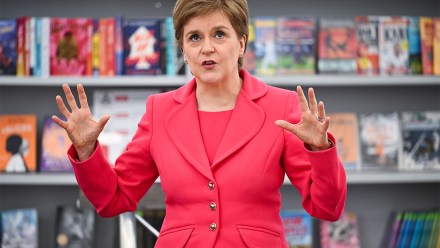
For most of this year it was widely accepted that the Tories had given up on London. Sadiq Khan seemed unbeatable and the party’s hunt for a mayoral candidate to run against him became a farce as various ‘big names’ refused to run. Then Daniel Korski, the frontrunner for the candidacy, had to drop out over a #MeToo row and it fell to Susan Hall to lead the charge. And yet, despite the political drama, the Tories are within touching distance of victory at City Hall – just a couple of points behind Labour in the polls. London looks winnable. ‘Nobody likes to be unpopular, but you’ve got to have your moral compass’ When I meet Khan for an interview in front of an audience at Labour party conference, he tells me he’s taking nothing for granted.

Scattering my father’s ashes in Santiago de Compostela

We are in the holy city of Santiago de Compostela to scatter our father’s ashes. He and my youngest sister had planned to walk the Camino, which finishes here at the resting place of Saint James, to mark the start of her adulthood and the beginning of his retirement. Instead, my two sisters have been walking the ancient pilgrims’ route for the past few weeks. I’ve flown into the city to meet them at the end. Most of Dad’s ashes went into a smart Regency tea caddy. The funeral directors had offered us a standard-issue urn but we decided he’d prefer something jolly and Georgian. The lacquered box didn’t quite hold all of his remains so the youngest put the rest in a Tupperware tub and brought him here to Spain.

The full English: how to fall in love with this country

My nine-year-old half-Russian daughter has arrived in England for the first time since she was a baby. As she knows almost nothing about British culture apart from Peppa Pig and Willy Wonka, my job is to put together a week-long programme before she goes back to Italy, where she currently lives with her mother, my ex-partner. They were living in Russia but left following Vladimir Putin’s invasion of Ukraine. Ideally, my daughter will go home enthused about all things English and wanting a lifetime more. But where do I start? Peppermint Aeros and Crunchie bars are the things I want to pass on, far more than the music of Elgar First, there’s the question of food.