Features

Why are students steered towards duff A-levels?

‘Women are more religious because they are socialised to be obedient and passive.’ ‘In Latin America, men often spend 20-40 per cent of the household’s income on alcohol, as well as further spending on tobacco, gambling and prostitutes.’ ‘The Challenger space shuttle disaster in 1986 is an example of state-initiated corporate crime.’ All examples taken verbatim from the most common sociology A-level course book (by Napier Press) used by students for the AQA syllabus, the most commonly used exam board. They lack any qualifying language or citation but are presented as fact.

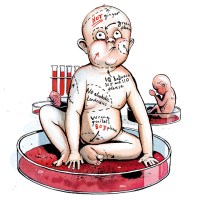
The quiet return of eugenics

Here follows a non-exhaustive list of my genetic flaws. I am short-sighted, more so as I age. I have bunions, dodgy knees and even dodgier shoulders. I have asthma. My skin blisters easily. My hair started going grey when I was in my late teens. I have zero talent for foreign languages, running or music. I am prone to nightmares, as well as to depression and anxiety. Relatively mild flaws, as they go. But still, these aren’t traits I’m eager to pass on. Our three-year-old already shows a tendency for nightmares that sometimes makes me wince with guilt. Not that it’s my fault, of course. We don’t get to choose which of our genes we pass on. Every conception is a roll of the dice.

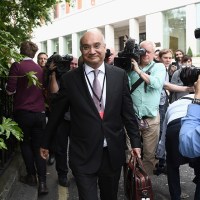
The unlikely political resurrection of Keith Vaz

When Keith Vaz announced his ambition to stand as an independent for Leicester East in the general election, no one in my hometown was surprised. Vaz may be a joke nationally, known for a fondness for rent boys. But in Leicester East, he remains something of a local hero. It may seem astonishing to the rest of the country, but it’s quite possible that despite everything, come July, Vaz will make a triumphant return. An elderly woman lights upat the mention of his name: ‘He wanted to take my picture!’ Leicester was one of the first British cities to have a majority non-white population and its British Indians are a highly prized voting bloc. They are the country’s largest immigrant group: young, fast-growing and aspirational.

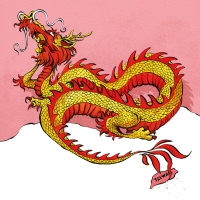
China’s ‘soft siege’ of Taiwan

‘There is only one China in the world,’ Wang Wenbin, the spokesman for China’s foreign ministry, declared at a press conference late last month. ‘Taiwan is an inalienable part of China’s territory.’ The previous day, on 23 May, Beijing carried out major military exercises around the island under the title ‘Joint-Sword 2024A.’ The Chinese Communist party (CCP) said it wanted to practise how to ‘seize power’ in Taiwan, and to ‘punish’ its new leader, Lai Ching-te, and his supporters in the US. J-16 aircraft and Type 052D destroyers – some of China’s best military assets – led the exercises, surrounding Taiwan and practising bombing runs.

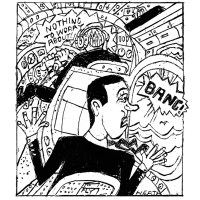
My brush with doom in Tangier

I wait till early summer to spring-clean so I’m moving my study, a stirring-up that invariably releases powerful methane from its swamp. Every meaningful valueless thing I own has been sorted through and removed from the pretty, bright room next to ours, with the garden below and the custard-cream scent of blooming wisteria, to a dark, unlovely corner of the top floor. It’s a study, not a viewing platform. I tell myself. A while ago, we put a single bed in the corner of our room to tempt our youngest son from climbing into our bed when he came in at 2 o’clock every morning. And it has worked only too magnificently. Two years on, there are now three of us in this marriage.

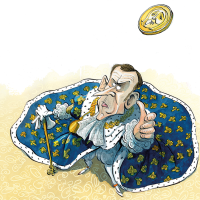
Can Macron still outplay Le Pen?

Petulance, panic and performance. President Macron’s broadcast following the evisceration of his party in last weekend’s elections for the European parliament had elements of all three. Wearing a black tie as if in mourning, he looked shocked, exhausted and angry. ‘The rise of the nationalists and demagogues,’ he said, ‘is a threat not only to our nation but also to our Europe and to France’s place in Europe and in the world… The extreme right is both the impoverishment of the French people and the downfall of our country. So at the end of this day, I can’t pretend that nothing has happened. I decided to give you the choice. Therefore, I will dissolve the Assemblée nationale tonight.

The truth about Paul Hollywood

My husband and I are in New York, where everyone is talking about the approaching Trump-Biden debate. Well, I’ll be astonished if it deserves the name. True debate seems to be a thing of the past in the US as much as in the UK, with both sides of any argument (assisted dying, the Israel/Gaza war, immigration) shouting loudly but not listening. Civilised friends of ours tell us their university-student children refuse to engage in debate about gender identity. It’s ‘You’re just wrong, Dad. You don’t get it. That’s all.

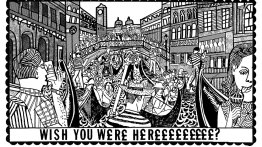
Tourists are the new pariahs

Think of Majorca and what do you picture? Maybe it is elegant tapas bars in the Gothic quarter of Palma, full of yachties and foodies from across the world. Maybe it is literary pilgrims trekking to the house of Robert Graves or noisy parties of Brits and Germans, squabbling over sunbeds in Magaluf. In one Japanese town, residents have erected a screen to block a much-prized view of Mount Fuji Any which way, what you picture is tourists. Lots of tourists. So many tourists that the reality of Majorca as an authentic place is quite obscured, invisible under the weight of visitors. And if you think that sounds bad, so do the Majorcans, which is why they are finally – perhaps belatedly – rebelling.

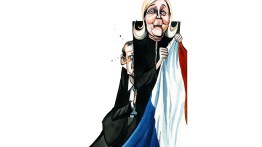
Marine Le Pen and Jordan Bardella are slowly conquering France

Marine Le Pen’s National Rally – formerly the National Front – is expected to triumph for a third time running in the European elections this weekend. The party topped the poll last time, in 2019, and in 2014. But its principal candidate, five years ago and today, is not the 55-year-old Le Pen but the youthful Jordan Bardella, whose story tells us a lot about the changing nature of the French right. The son of Italian immigrants, Bardella, 28, grew up on a housing estate in Seine-Saint-Denis, an impoverished area north of Paris. While Le Pen appeals to the middle-aged electorate, Bardella is the star attraction for younger voters. French politics is dominated by the bourgeoisie and Bardella is unusual in that he is working class.

Scotland’s religious collapse

Last week, I had a drink with a Catholic priest friend who works with young people in custody. Inevitably, our talk turned to how radically unchurched they are – not badly disposed to Christianity, just unfamiliar with much of the doctrine and almost all the forms of worship, even though many had a Catholic granny or a non-practising parent. He mused over the startling speed of the secularisation of society. ‘Protestantism has collapsed,’ he said, and not in any triumphalist spirit. ‘Most people believe in or at least want to believe in some form of afterlife’ And so it has turned out in Scotland. The latest census, published last month, shows that for the first time a majority of Scots identify as ‘no religion’ whatsoever.

Would you dare to wear a Rolex?

‘London has become a jungle, right? Anyone with anything nice risks having it taken.’ Bobby, the manager of one of Hatton Garden’s watch shops, does business in a windowless room as far from the street as possible, watched over by a thickset guard and a couple security cameras. ‘I’m a paranoid person,’ he says, and he’s right to be. While the level of general theft in London is going down, more and more luxury watches are stolen every year – tens of millions of pounds’ worth. There’s no sophistication to stealing a watch. Gangs smash into shops with machetes or rip them from wearers’ wrists. Last week, Oliver White, a watch broker in south-west London, had £3 million worth of watches stolen.

Have you had the school gate VAT chat?

Another day closer to the general election and I’m at my daughter’s prep school in Oxfordshire. As has come to be the norm, I’m having a ‘VAT chat’ with a fellow mother. Of course, we’ve known about Labour’s plan for months. It will lead to a likely 20 per cent rise in private-school fees. Recently, however, these VAT chats have intensified and become louder. ‘To think that other parents would vote Labour given what’s coming enrages me,’ a friend says I begin with my usual opening gambit. ‘Isn’t it awful?’ I say, trying to convey my real sense of desperation that I will have to take my daughter out of the school that she loves, that our way of life is for the chopping block.

Can the Tories survive Nigel Farage?

Nigel Farage had given less than a day’s notice, yet hundreds stood ready to welcome him on Tuesday morning on the pier of Clacton-on-Sea. There was a woman with Union Jack sunglasses and a man wearing an ‘I love gas and oil’ T-shirt. More stood on the bridge above, peering down. Everyone wanted to catch sight of their would-be MP. ‘I’m here to blow him a kiss and say thank you, thank you Nigel,’ explains Yvonne, in her sixties. ‘He 100 per cent has my vote.’ This is a Tory seat now but it was once a Ukip seat and these voters may well send Farage to parliament as the new leader of Reform UK. ‘Nigel is a breath of fresh air. We need the government shaken up big time.

I’m a lifelong Tory. Should I vote Reform?

For more than 30 years, I have knocked on doors and dutifully recorded voting intentions. I’m sure every party has their own abbreviations but during my Tory canvassing career, ‘U’ stood for undecided. I often wondered at – and, in part, admired – those people who were genuinely open to any party. It was an affliction that I did not suffer from, but I could see its merits. If people like me don’t vote Tory, Keir Starmer will, of course, have an even bigger majority Now that Nigel Farage has entered the race for a Reform party whose agenda is very close to the principles I’ve always believed in, I am, for the first time, a ‘U’. I live in the constituency of Boston and Skegness. My Conservative candidate, Matt Warman, is defending a 25,000 majority.

The moon matters to China

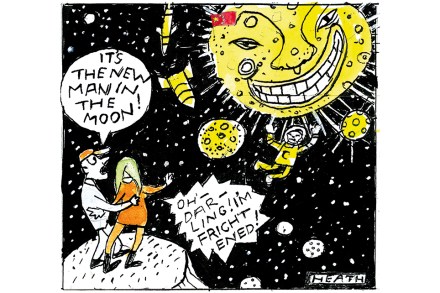
China’s Chang’e-6 moon mission was launched on 3 May. It reached lunar orbit a few days later and began waiting for sunrise over its landing site on the moon’s far side. Chang’e-6 is named after the Chinese goddess of the moon and it will land on Sunday in a crater called Apollo – an ancient double-ringed walled plain caused by an asteroid smashing into the young moon. Apollo has been heavily damaged by subsequent impacts and in many places covered with lava flows and sprinkled with particles from newer impacts. It is as Buzz Aldrin said, a magnificent desolation. It is a region of great geological significance, since it contains rocks from the moon’s lower crust and the deeper mantle – a treasure trove of planetary history.

Hell is a rented garden

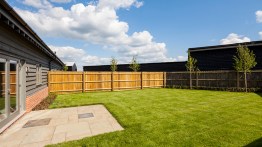
For the past few years, I have been a joyful Chelsea Flower Show attendee. Every May, my phone’s photo album usually becomes stuffed with pictures of plants: variegated borders in shades of white and purple, hostas bursting from decorative pots, cornus trees providing shade over ground cover of miniature geraniums. I obsess over dahlias, clematis and roses, not to mention the mini greenhouses, chic she-sheds and pretty pergolas. A couple of years ago, I had recently acquired for the first time my own garden and was embarking on filling it with gusto. I was drunk on possibility when it came to what I could fill my little patch with. Climbing roses! Strawberry beds! A fig tree! I spent accordingly. It was impossible to pass a garden centre without dropping a ton every time.

Can the Tories avoid the fate of Canada’s Conservatives?

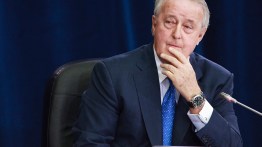
As the Conservatives edge closer to disaster in the general election, the hunt is on for a historical comparison. Tony Blair’s dispatching of John Major in 1997 was mild compared with what polls say could be in store. Those wondering how bad it could get should look to Canada in 1993, when a Conservative-majority government showed the world just how far it is possible to fall. The similarities are clear. Brian Mulroney, the prime minister, had seemed to usher in a new conservative era when he was elected in 1984 with an unlikely coalition of voters. He had managed to cross Canada’s equivalent of a Red Wall by winning support in his native Quebec (French Canada had traditionally been the turf of the Liberals). But not enough was done to keep the voters on board.

The heyday of the gay guardsmen

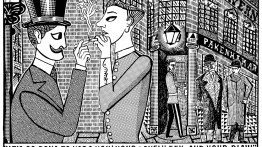
In 1943 the music critic Desmond Shawe-Taylor placed an advertisement in Exchange & Mart offering a pair of trooper’s breeches for sale. A number of men replied, one asking ‘Have they been worn by a trooper or just yourself?’, while another observed: ‘It is always good to see the boys pulling themselves into tight troopers and then admire the “smashing finish”.’ Members of the Household Division of the British Army, in their figure-hugging breeches and scarlet coats, had always held a particular appeal for homosexual men. It was therefore fortunate that, though the military authorities publicly denied it, there was a long tradition in Guards regiments of combining ceremonial duties with casual prostitution.