Features

The worst-written memoir by a serious politician

It is bizarre. As he often demonstrated in the House of Commons, Tony Blair knows how to use words. He could also have mobilised a team to help him write his memoirs. Instead, it is all his own work, and the words mutinied. This book is not just badly written. It is atrociously written. For almost 700 pages, Tony Blair stumbles between mawkishness and banality. Prime ministers send soldiers into combat. Some of those soldiers are killed. That is a subject which would lead the least sensitive of men to reach into their souls and craft language out of emotional depth. This is Mr Blair’s version. ‘The anguish remains. The principal part of that is not selfish. Some of it is, to be sure.

Rites and wrongs

As Pope Benedict’s visit approaches, Katie Grant, a cradle Catholic, feels torn between her loyalty to the Church and anger at its callous insensitivity In 2005, shortly after Cardinal Ratzinger became Pope Benedict XVI, my then 19-year-old daughter and I walked into St Peter’s in Rome. I don’t like St Peter’s, so superior and crushing, though the dead popes with their paper skin and velvet slippers offer a chilly thrill. I spied a confessional box in the dim distance and after I’d recited a dull list of sins, a young voice — urgent, American — asked, ‘Do you ever gossip?’ ‘Good Lord!’ I said. ‘I’ve got five sisters, and that’s what sisters do.’ Silence.

Have pity on Pakistan

Cricket is often said to be a game of inches. An inch is the difference between a fatal edge to the slips and a safe play-and-miss; an inch is the difference between being clean bowled and a mere dot ball; only an inch separates a no-ball from a legitimate delivery that could take a wicket. But for Mohammad Amir, just a few inches have taken on a far greater significance than the question of winning or losing. It is alleged that the 18-year-old Pakistani prodigy bowled deliberate no-balls so that illegal gamblers could manipulate ‘spot’ betting. Had Amir’s foot stayed behind the line, we would still regard him as the most exciting fast bowler in the world. Instead, a photograph of his boot looks set to cast a shadow over his whole career.

Trouble in paradise

Joan Collins says that St Tropez’s unique beach culture is in danger from the local council. Taki wonders if the changes will see off the disgusting super-rich When people think about St Tropez, they visualise miles of golden sand and dozens of wonderful beach bars, shacks and restaurants catering to an eclectic clientele. But that could all be about to change. Those beaches belong to Pampelonne, which is part of the city of Ramatuelle, and the bars and restaurants face demolition if local council plans are given the go-ahead on 16 September. The council authorities say that the restaurants and huts pose an environmental hazard — they damage plant species, erode sand dunes and accelerate the encroachment of the ocean on the land. Nobody wants that to happen, of course.

Jealous of the gypsies

There’s nothing new about this summer’s outbreak of gypsy-bashing, writes Clover Stroud, who puts it down to our secret wish to enjoy the same freedoms they do It has not been a good summer for gypsies. In France, President Sarkozy has begun his purge: nearly a thousand Roma have been flown back to Bucharest, hundreds of their camps have been dismantled by police and one poor gypsy was shot dead during a car chase in Saint-Aignan. The caustic wind of gypsy hatred wafted across the Channel to Britain as well.

We are being engulfed by the moronic inferno of the internet

Well, thank the Lord there were no cctv cameras around when I caught Mr Tibbles in my garden a few weeks back, before the whole furore began. Luckily, I read about Mary Bale and surreptitiously took down the mini-gibbet and buried the remains in a small trench behind the pond, before the Facebook maniacs had a chance to get on the case. The cat had been doing its usual stuff — crapping on the lawn, eating wild animals, urinating in my daughter’s sandpit — before it was unfortunately snagged in the wooden peg and wire snare I had laid by the hedge.

An apology to Professor John Moore

The Spectator apologises to Professor Moore for certain postings by contributors using pseudonyms "CWBPI" and "Michael" under our "Questioning the Aids Consensus" blog in October 2009. The comments were removed following a complaint by Professor Moore. We are happy to accept that these comments were both abusive and untrue. The Spectator has agreed to make a donation to a HIV/AIDS charity.

Islam Expo: Apology

Stephen Pollard and the Spectator apologise for the unintended and false suggestion in a blog published on 15 July 2008 that Islam Expo Limited is a fascist party dedicated to genocide which organised a conference with a racist and genocidal programme. We accept that Islam Expo's purpose is to provide a neutral and broad-based platform for debate on issues relating to Muslims and Islam.

Revealed: the secret war over England’s schools

Having lost the battle over Michael Gove’s Academies Act, the enemies of school reform have switched to guerrilla tactics. Fraser Nelson and Ed Howker on the methods which may yet kill off the flagship Tory agenda Any head teacher of a school trying to free itself from state control will have had no summer holiday this year. In the weeks since Michael Gove introduced a law allowing top-rated schools to break free from local authority control, trade unions have been on the hunt for anyone daring to express interest in this offer. Heads have been sent letters, demanding they reveal their intentions. Those who do not reply are told they had better prepare for a battle. A secret war which will decide the future of English education is underway.

An answer to the A-level debacle — and Gary Lineker

As soon as Charterhouse found a credible way out of the A-level stranglehold we took it. Two years later, we are celebrating the achievements of the first cohort to sit the Cambridge International Board’s Pre-U (Pre-University) examination. Here are syllabuses that engage and stretch sixth-formers. They require deep delving, rigorous research and wider reading. Pupils are encouraged to take intellectual risks by developing their own ideas and arguments, and are rewarded for academic flair. All this will ring bells with those of us who sat A-levels 30 or 40 years ago, but not with those who sat today’s A-levels, with their ‘accessible’, prescriptive and frankly boring curricula, and examinations in which everyone has to do well.

‘I see myself as a Cameron figure’

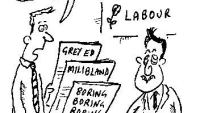
James Forsyth meets Ed, the ‘normal’ Miliband, who says that the conventional political wisdom about Middle England is all wrong When you walk into Ed Miliband’s office in the House of Commons, the first thing you’re struck by is that he has not had time to unpack since Labour lost power. It is bare except for a couple of generic-looking paintings. When I ask him what they are of, he stares at them quizzically for a second before an aide reminds him that they were left there by the previous occupant. But the second thing that hits you is that Ed is normal, surprisingly so. As we exchange pleasantries, he doesn’t engage in any of the psychological tricks so beloved of some politicians; there’s no attempt to establish alpha-male status.

Don’t police the beach

You might not have been to Freshwater West, on the remote western shores of Pembrokeshire, but you’ve probably seen it before — on the big screen. Because the bay is so untouched by man, it can stand in for pretty much any period in history. It’s just starred as the medieval beach in Russell Crowe’s Robin Hood, and as the seaside home to the shell house in the latest Harry Potter film. These days, it couldn’t stand in for much, except perhaps a Welsh version of Baywatch — Boyowatch, perhaps? Because, as of this year, between 26 June and 5 September, the beach has been destroyed by the Royal National Lifeboat Institution. Every day this summer, the RNLI has erected a beach hut — the only man-made structure on the beach. Every day, between 10 a.m.

Waste not, want not: join the new food revolution

‘Are you saving that, Clarke?’ they ask, sniggering. ‘Are you saving that, Clarke?’ they ask, sniggering. ‘Is there enough room in the fridge, what with all the other leftovers?’ Then they giggle, and turn on EastEnders. They mock me but I am resilient, and full of resolve. I have no time for soaps and mindless television because I am a food waste-buster: one of a growing group who can’t bear the amount of food people throw away. I have no time for TV — I have cupboards to organise, soups and stocks to concoct, chutneys to make, tomatoes to bottle and jams to set. There are many of us out there, a hidden army.

How to deal with hecklers

It began like any other Edinburgh gig. A cellar bar at midnight. An Australian compère warming up the crowd. ‘Anybody here from overseas?’ A voice shouted ‘I’m from Amsterdam!’ in a gnarled Glaswegian accent. It was supposed to be funny but no one laughed. The compère, sensing a challenge in the man’s voice, delivered an instant put-down. ‘So you’re homeless. And you’re a drug addict. Keep your troubles to yourself, mate.’ This got a big laugh, though on the page it doesn’t even look like a joke. Translation: Amsterdam equals drug addict. Glasgow equals homeless. The combination equals big fat loser. With the room jeering at him, the Glaswegian fell silent.

Palin is beyond a joke

Sarah Palin was once a contender: a no-nonsense mom and a serious politician. Now she’s just a greedy celebrity with a grasping family, says Alexander Chancellor Sarah Palin’s ignorance and inarticulacy are so constantly on display that she can’t just be simulating them to strengthen her popular appeal. They are also attributes in which she takes pride. As Jacob Weisberg writes in the introduction to his new anthology, Palinisms: The Accidental Wit and Wisdom of Sarah Palin: ‘Palin’s exuberant incoherence testifies to an unusually wide gulf between confidence and ability. She is proud of what she doesn’t know and contemptuous of those “experts” and “elitists” who are too knowledgeable to be trusted.

Why the coalition’s police reforms will fail

The Home Office has radical plans, but they won’t come to much, says Alasdair Palmer. Less money and fewer paid officers will inevitably mean more crime Last month when Theresa May, the Home Secretary, launched the coalition’s consultation document on the police, ‘reconnecting police with the people’, she said it would ‘herald the most radical reform of policing in this country for 50 years’. Unusually for a politician, that was probably an understatement.

Mr Powell’s ‘talking cure’

I’m beginning to wonder where I can go this summer to get away from Jonathan Powell. Suddenly Tony Blair’s curly-haired former chief of staff is everywhere, bursting out of newspapers and Radio 4 programmes, relentlessly repeating the message that it’s good to talk to terrorists. Or, to be more specific, that it was jolly good to talk to Messrs Adams and McGuinness of the IRA — which he and Tony did during the heady days of the Northern Ireland ‘peace process’ — and that now he thinks it would also be good to talk to the Taleban one day, and even perhaps Osama bin Laden himself.

A council-funded visit to a whore in Amsterdam? Yes please

Under guidelines introduced by the last government, dis-abled people are now allowed to decide the kind of services they want from local authorities. This is called ‘empowerment’ and ‘devolving services to people in the front line’, and it is a good thing, apparently. But it has had certain unexpected consequences. Bizarrely, it seems that in many cases dis-abled people do not want to sit in a frowsy community centre which smells of stale flatus making raffia baskets for begonias, fortified by the occasional cup of tea and a pat on the shoulder and so on, as was previously assumed. What they actually want, it transpires, is a bloody good seeing to. With a congenial and well-lubricated whore. Preferably somewhere abroad.