Irwin Stelzer

Of course these peace talks would fail

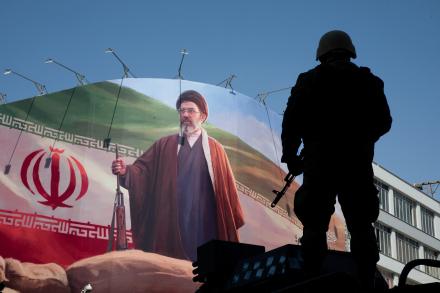
The US and Iran have failed to reach an agreement after 21 hours of talks in Pakistan. No surprise. After all, we didn’t have to wait for the negotiations to finish to make an informed guess of the outcome. America and Iran agreed on a ceasefire conditional on the Islamic Republic’s complete opening of the Strait of Hormuz. It has so far refused to honour that condition. Earlier this week, President Trump responded with fulminations: Iran ‘better stop now’ if it’s charging tankers to pass through. But, in practice, all he has done is applied more pressure on Nato allies and sent Vice-President J.D. Vance to head the delegation in Islamabad. The ceasefire agreement did not include Lebanon – where Israel is battling to destroy or at least neuter Hezbollah.
This is what Trump means by ‘victory’ in Iran

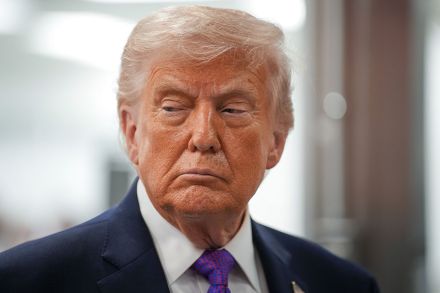
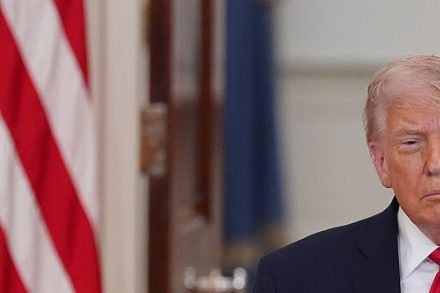
President Trump has now told us something very important about the war with Iran. Ponder his address to the nation last night and you discover how he defines victory. Nothing that happens from here on out will change that. As Trump sees it, he is the winner, having achieved all his goals. He has accomplished regime change in Iran by eliminating the men who led the regime when the war started. America has so damaged the country’s military infrastructure that it will not be able to produce or deliver a nuclear weapon for at least a decade, by which time it will be up to a future American president to take the needed action. So, no need to cart away or destroy Iran’s enriched uranium.

Will Nato regret snubbing Donald Trump?

On April 4, Nato will be 77 years old. The chance that America will be counted among the celebrants when the birthday celebrations roll around is somewhere between nil and zero. President Trump had long predicted that if America needed help, Nato would not come to its aid, even though, as he sees it, the United States has spent billions of dollars over decades defending Europe from Russian aggression. And when America did need help in the war against Iran – a few mine sweepers, please, sirs – the answer ‘no’ came back in several languages.

Can the peace in Gaza last?

From our UK edition

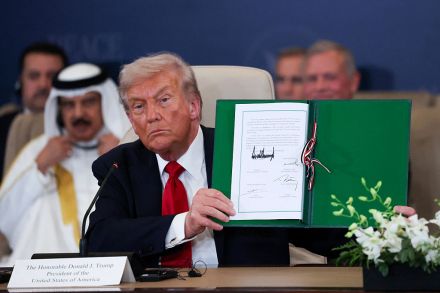
He came, he saw, he conquered. That just about describes President Trump’s 12,000-mile round trip from Washington, D.C. to Israel and Egypt. He addressed Israel’s Knesset in Jerusalem, greeted the hostages and their families, hopped on Air Force One for a flight to Sharm el-Sheikh, signed the first phase of a Gaza peace deal, delivered a moving speech, met with the leaders of 27 countries to push the next phases of his 20-point peace plan forward and take a well-earned victory lap, and returned to Washington after what most people would consider a full day.

What the army parade says about America

From our UK edition

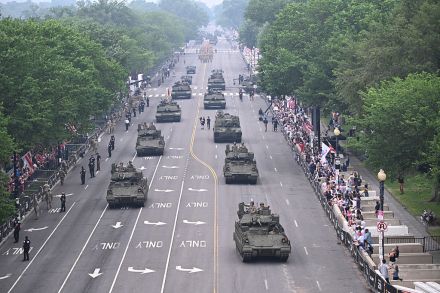
​So the celebration of the 250th anniversary of the US Army will not be a day that will live infamy. Nor will it be one many Americans will recall with pleasure, in part because it coincided with the birthday of President Trump, a man who generates some sort of veneration from his MAGA supporters and a reaction known as TDS, Trump Derangement Syndrome, from others. No vaccination is known that will prevent the onset of either disease, leaving those immune to both looking for a candidate. The President’s decision to order out this parade enabled him to join the rather exclusive club of Xi Jinping, Vladimir Putin and Kim Jong Un, men he says he ‘respects’, ‘likes’ and calls ‘a great leader’, respectively.

Trump is tearing up the Old World Order – as promised

From our UK edition

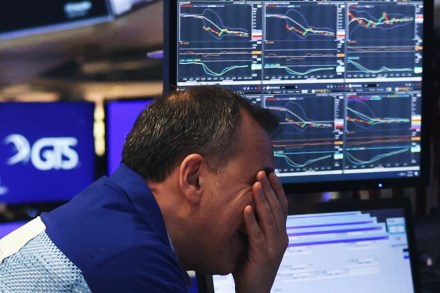
Seems there is a bit of ruckus on the stock markets of the largest capitalist country in the world, the one with deepest of all capital markets. Donald Trump has decided to lay waste to the globalised, market-based world trading order, and return to the protectionist state of affairs that served the nation so well in the 1930s. It would be foolish of me to join the army of talented prognosticators predicting a recession, unless it doesn’t happen, and the even braver ones who can see just how much each company’s earnings will be affected by the New World Trading Order, if the earnings indeed are affected.

How the Democrats fell into Trump’s trap

From our UK edition

Fox News’s Brit Hume, one of America’s most respected political analysts, and a man more given to wry scepticism than to partisanship or hyperbole, described Donald Trump’s speech to Congress as: ‘the most boisterous, the longest, the most partisan speech I’ve heard a President give… to a joint session of congress… and I go back maybe about 50 years on this. I also think it may have been the most effective. If you ever doubted that Donald Trump is the colossus of our time and our nation, this night and this speech should have put that to rest…’ There is no quarrelling with Hume about length. At one hour and 40 minutes, Trump’s speech broke Bill Clinton’s record of one hour, 28 minutes and 40 seconds. Or about partisanship.

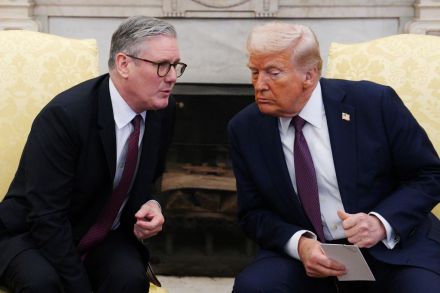
The big mistake Keir Starmer made with Donald Trump

From our UK edition

Keir Starmer did almost everything right. He headed for lunch with the President, leaving the British Embassy’s Jaguars and Land Rovers in the garage. Instead, he relied on a made-in-America (probably) Chevy Suburban, presumably part of the Secret Service’s fleet of bullet-proof gas guzzlers. That might take Trump’s mind off the fact that the UK exports £8 billion worth of cars to the US every year, making America the main destination of UK car exports. But it won’t change Trump’s mind that reciprocity is the cornerstone of his tariff policy. America taxes imported cars at a 2.5 per cent rate; the UK imposes a 10 per cent import duty and 20 per cent VAT on imports of American cars.

Does Trump really need Starmer’s bridge to Europe?

From our UK edition

This week, British Prime Minister Keir Starmer is heading to Washington to establish himself as a ‘bridge’ between the US and the EU, and to breathe new life into the Anglo-American Special Relationship. There is much to discuss between the historic allies. Starmer has announced that a ‘security guarantee’ from America is the only way there can be ‘a lasting peace agreement … the only way to effectively deter Russia from attacking Ukraine again.’ Trump is negotiating an agreement with Putin, and leaving it to the Europeans to defend the continent while America attends to other business in the Pacific, Greenland, Panama, the Middle East and any other places Trump feels it is in the interest of America to assert its presence.

Europe and the death of Pax Americana

From our UK edition

If you are still reeling from the shock and awe created by Donald Trump’s foreign policy since taking office, ‘You ain’t seen nothing yet,’ as Ronald Reagan once put it. Trump doesn’t just want to reset trading relations with every country in the world. He wants the world to change its foreign policies to suit the end of Pax Americana – and its replacement with a muscular foreign policy that relies very little, if at all, on the kindness of strangers. It is not Trump who is surrendering to Putin, but Europe Start with the war in Ukraine.

Don’t listen to Obama – real Americans want Brexit

From our UK edition

Because Americans love Britain, and because we are a presumptuous lot, we often advise the United Kingdom on its foreign policy. And not only the UK, but Europe. Successive US administrations have urged European nations to form a United States of Europe as an answer to the question attributed to Henry Kissinger: ‘Who do I call if I want to call Europe?’ The latest such unrequested advice was offered to your Prime Minister by no less a foreign-policy maven — see his successes in Libya, Middle East, China, Crimea — than Barack Obama. The outgoing president informed David Cameron that his administration wants to see ‘a strong United Kingdom in a strong European Union’.

Americans for Brexit

From our UK edition

Because Americans love Britain, and because we are a presumptuous lot, we often advise the United Kingdom on its foreign policy. And not only the UK, but Europe. Successive US administrations have urged European nations to form a United States of Europe as an answer to the question attributed to Henry Kissinger: ‘Who do I call if I want to call Europe?’ The latest such unrequested advice was offered to your Prime Minister by no less a foreign-policy maven — see his successes in Libya, Middle East, China, Crimea — than Barack Obama. The outgoing president informed David Cameron that his administration wants to see ‘a strong United Kingdom in a strong European Union’.

Do not resuscitate

From our UK edition

No one can fault the doctors: they are using every tool available to them to save their very ill patient. But they will probably fail in their efforts to save the euro in its current form. And this will be because the regimen they originally prescribed did more harm than good. Economists were almost unanimous in warning that it is beyond the wisdom of man to set an interest rate that suits 16 countries without also unifying fiscal policy, creating income transfer mechanisms, and a common language to reduce barriers to labour mobility. So we have Ireland, a country that devised a low-tax path to prosperity. Rather than raising interest rates to cool its overheating economy, the European Central Bank kept area-wide interest rates low to suit Germany.

Picking losers

From our UK edition

So we are to have a new industrial policy, this one courtesy of the coalition government and, more specifically, George Osborne and Philip Hammond, the Chancellor of the Exchequer and the Transport Secretary. Both are economically literate, professing faith in markets as allocators of resources; but they have found the lure of shaping the economy in their image irresistible. The goals of the new industrial policy are two: to reduce the relative importance of financial services, and to disperse economic activity more widely throughout the nation.

What Washington thought of Cameron: smooth, genial, evasive — and tough

From our UK edition

He came, he saw and, to the surprise of many in Washington, David Cameron conquered. Those who have been exposed to his personal charm were less surprised. For them, the surprise — perhaps they should have known better than to be surprised —- came from his willingness to resort to evasion. Faced with a specific question about his attitude towards Israel, the Prime Minister gave the usual answer about a two-state solution, the need for negotiations, etc. A few days later, before a Muslim rather than an American audience, he decided that Gaza is a prison, without mentioning that Hamas is the jailer, and that there are few prisons in which the inmates launch rockets at neighbouring countries.

Requiem for a heavyweight

From our UK edition

It’s a dirty business. When you’re on top, everyone wants something from you; when you’re not, well, as Billie Holiday says, ‘God bless the child that’s got his own.’ It is a business of sharp elbows, few loyalties, and one in which winning is all that matters. That’s how Rod Serling describes the boxing racket in his Requiem for a Heavyweight. He could just as well have been describing politics. Tony Blair might have been the Labour party’s meal ticket (as Margaret Thatcher was the Tories’) through three general elections, just as Serling’s boxer was the meal ticket for his managers and entourage.

Who would lend to a bankrupt Britain?

From our UK edition

Alistair Darling’s budget forecasts assume that Britain can keep borrowing all it wants for the foreseeable future.We may not be so lucky, says Irwin Stelzer Federico Sturzenegger and Jeromin Zettelmeyer are not exactly household names. They are, respectively, professor at the Universidad Torcuato di Tella, and an adviser to the International Monetary Fund. Some months ago, as I watched Britain roll up debts that would have been unthinkable only a few years ago, I moved their book, published in 2006, from a back shelf to the top of my desk. Where it sat, unmolested, until two things happened. First, rating agencies got nervous about the quality of the sovereign debt issued by the UK.

Tips for the new US ambassador

From our UK edition

Obama’s man in London needs to stop bashing Bush, immerse himself in domestic political discourse, and get out and meet some true Brits, says Irwin Stelzer ‘He is not even a diplomat,’ sniffed BBC News when Louis Susman took up his post as America’s ambassador to the Court of St James. An Obama Chicago crony, the Guardian’s Ewen MacAskill rushed to point out from his perch in Washington — ‘a little bit of Chicago’s ruthless and combative political machine is soon to descend on the decorous calm of the Court of St James’.

This shotgun marriage of minds between Labour and the Tories won’t last

From our UK edition

It just might be that out of the shouting at Prime Minister’s Questions, the sallies and charges, a set of sensible fiscal and financial policies is emerging. The leader of the opposition is right: Labour is planning to cut capital spending in half in the next few years. The Prime Minister is also right: the cuts result from a decision to bring forward into these recession years spending that had been planned for what policymakers call ‘the out years’. That decision inflates spending this year, but will reduce it in later years, unless when the time comes Brown can’t bring himself to ‘cut’, which might be the reason he has cancelled next year’s comprehensive spending review.

No more consensus: this time there is a choice

From our UK edition

The next election will present voters with two distinct futures, says Irwin Stelzer: Labour’s rising taxes and love of the EU, or the Tories’ spending cuts and plans for the ‘broken society’ Where is the clear blue water? MPs in both the Labour and the Tory parties have engaged in behaviour that is illegal, or tawdry, or both. Both parties are responsible for the dire financial condition in which the country finds itself, Labour by spending and spending during the fat years, the Tories by promising to spend just as much if given the chance, instead of calling for restraint.