Features

Mother Theresa

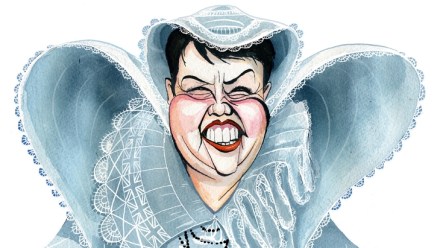
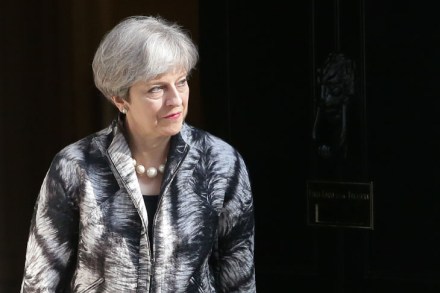
Tory activists last week were heard to refer to Mrs May as ‘Mummy’. No Corbynista calls their hero ‘Dad’. The human race is guided by myth as much as by logic, and mythology explains people to themselves more vividly than economics. The agony expressed in the liberal intelligent press is understandable. The sensible people who all voted Remain direct much of their fury against the Corbynistas who have taken over the Labour party. Fair enough. Interestingly, however, they attend so closely to what Tony Benn liked to call ‘the ish-oos’ that they ignore the bigger mythological picture. Last summer the country voted — very unwisely according to the sensible 48 per cent — in favour of Brexit.

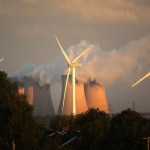
More gas, less wind

The Global Wind Energy Council recently released its latest report, excitedly boasting that ‘the proliferation of wind energy into the global power market continues at a furious pace, after it was revealed that more than 54 gigawatts of clean renewable wind power was installed across the global market last year’. You may have got the impression from announcements like that, and from the obligatory pictures of wind turbines in any BBC story or airport advert about energy, that wind power is making a big contribution to world energy today. You would be wrong. Its contribution is still, after decades — nay centuries — of development, trivial to the point of irrelevance. Here’s a quiz; no conferring.

Libya’s best hope

We were in a detention centre for migrants in Tripoli and we came to a big locked door. It was impressively bolted and padlocked. Someone murmured that we didn’t have time to look inside. But I felt somehow obliged to do so. Outside in the sun I had already said hello to about 100 migrants — almost all of them from West Africa: Guinea-Conakry and Nigeria. They were sitting on the concrete in rows, their heads in their hands; the men in one group, and about half a dozen women a little way off. They had been here for months, in some cases, and they wanted to go home. Kwasi Kwarteng and Kim Sengupta consider the future of Libya: ‘J’ai faim,’ said one of the men. ‘C’est pas bon ici,’ said another.

At the cutting edge

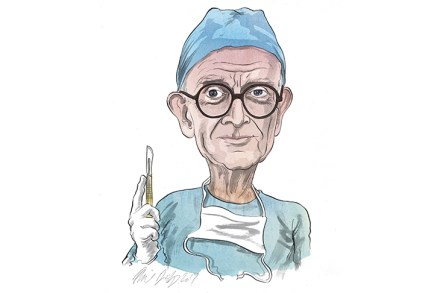
There’s a graveyard inside Henry Marsh’s head, though you’d never guess it to look at him. There he sits in his elegant flat in a small castle on a small island in the Oxford Thames: 67, attractive, restless. There he sits with the world all around him: Persian rugs, French tapestries, Japanese prints and his beautiful blonde wife (the anthropologist Kate Fox) in a separate flat below. But the ghosts of past patients are never far away. Henry Marsh is a brain surgeon, celebrated for his skill in operating on patients under just local anaesthetic. He’s famous also for his astonishing memoir Do No Harm, to which he’s now written an equally remarkable sequel, Admissions.

Divided they stand

 New York As the malevolence and incoherence of the Trump administration continue to amaze, Democrats are taking heart from the popular revulsion against the Mad Hatter of Mar-a-Lago. The media class is chattering excitedly about anti-Trump momentum after special Congress elections in conservative Kansas and Georgia resulted in a narrow Republican victory in the former and a run-off in the latter. Last week, Paul Kane of the Washington Post cited this as proof ‘that Democrats have galvanised the anti-Trump activism of the past three months into votes at the ballot box’.

Liberté, egalité, supériorité

The French election, of unprecedented interest, hazard and potential for violence, has been largely about who is to blame. Blame for what, exactly? For the country’s chronic malaise. But is it the fault of the bankers, the bosses, the bureaucracy, or the immigrants? Quite often the British press gives the impression that France is in some kind of deplorable condition that we must at all costs avoid, a hybrid, perhaps, of economic Guinea-Bissau and ideological North Korea. In part, this is because the French themselves so strongly lament the state of their country; I have a whole shelf of books (by no means exhaustive) in which French authors predict its imminent collapse. Like any nation at any time in history, France has its problems.

Is Le Pen really ‘far-right’?

What is ‘far-right’? With the progress of Marine Le Pen to France’s presidential run-off, the term has been liberally used — as it has been over recent years across the West. Golden Dawn in Greece, Jobbik in Hungary, and the Sweden Democrats are all said to be far-right, to name but three. The fact that the first two of those groups engage in intimidation, racism and overt displays of political violence would ordinarily distinguish them from a peaceful democratic party opposed to mass immigration like the Sweden Democrats. Yet everywhere there is the same name creep. The website Breitbart is frequently called far-right, as is the administration of Donald Trump.

Moths vs the middle classes

It’s not the free movement of people I spend my nights fretting about; it’s the free movement of pests. It’s the thuggy Spanish bluebells invading our woodland and killing our own delicate flowers; it’s the Asian caterpillars devastating our box hedges; it’s the black-winged killer ladybirds from North America wiping out our spotted red ones with a nasty fungal disease. And — particularly worrying for anyone trying to run a household — it’s the tiny webbing clothes moths, thought to have originated from South Africa, their larvae feasting on our favourite cardigans and carpets — probably feasting right now, under the very bed in which we are failing to sleep.

Why Theresa May’s 1970s-style energy price caps won’t work

Better access to education. Tax cuts for anyone in the struggling middle. More affordable homes, and more money for the National Heath Service. There is nothing wrong with Theresa May seeking to stake out the centre ground of British politics and stop Brexit turning into a right-wing campaign to turn back the clock. But one might have imagined she’d use conservative means to achieve this, rather than raiding Ed Miliband’s last manifesto for ideas. The proposed price cap on energy companies is an alarming example of Mrs May’s left turn. There are so many ways in which the price cap is a genuinely terrible idea that it is hard to find space to list them all. But here are four big flaws to be getting on with.

A little too perfect

Emmanuel Macron is going to be the next president of France. I know people are saying Marine Le Pen isn't out of the race and it's important to keep the suspense going as long as possible. But I see no scenario in which the French will vote her into the Elsyée.  Le Pen's attempt to distance herself from the toxic National Front founded by her father, declaring herself an independent, just like Macron, is entertaining. But it will change nothing. The French may claim to be revolutionaries but they are terrified of change and Marine scares them. Avec raison.  So the serious questions are, who is Emmanuel Macron, the future president of the republic, and what should we expect from his forthcoming quinquennat?

What’s the matter with Macron?

Coming out of a celebratory dinner at a Montparnasse brasserie after topping the poll in the first round of the French presidential election on Sunday, Emmanuel Macron had a brief brush with the press. A reporter asked: ‘Is this your Fouquet moment? This referred to a notoriously showy celebration by Nicolas Sarkozy at Fouquet’s restaurant after his own victory in 2007. The 39-year-old centrist was visibly cross. He simply wanted to thank his secretaries, security officers, politicians and writers, he said. Then came the dig. ‘If you don’t understand that,’ he said, ‘you understand nothing about life. I have no lessons to learn from the petit milieu Parisien.

Do do God

This election was won two days before it was announced, on Easter Sunday. Theresa May put out an Easter message in which she suggested that British values had a Christian basis. It was her version of David Cameron’s message two years before, in which he said that Britain is a Christian country. She was rather more convincing. I don’t know whether Cameron is sincerely religious, but he didn’t seem it. He didn’t even seem to try very hard to seem it, as if fearing that his metropolitan support might weaken, and perhaps that George Osborne would make a snarky jibe about it at cabinet. But it still did him good to make those pro-religious noises. St Theresa should keep her piety out of politics, said a few pundits.

The lords of poverty

 Kenya I met Dr Tom Catena in Sudan’s Nuba Mountains — the site of an African war and famine few have even heard about — in a hospital overflowing with children. I saw bombs had ripped away their arms, flying shrapnel had taken out a baby’s eye, anti-personnel mines had shredded legs to jagged bone and ribbons of gangrenous flesh, infants suffering kwashiorkor and the other horrors of malnutrition. Inspired by St Francis of Assisi, ‘Doctor Tom’ has worked almost every day, all day, since he arrived as the only surgeon for the Catholic hospital in Nuba nine years ago. I asked him: ‘Why do you stay?’ He replied: ‘There’s no other option. You leave and abandon everyone here or you stay and keep going.

Anti-social media

On Tuesday morning I was thinking to myself how oddly pleasant social media seemed. Then Theresa May dropped her election bomb. Immediately the posts started appearing: ‘Tory scum’ and ‘Tories launch coup’, then came the memes and I thought: I can’t take another two months of this. I’d only just tentatively returned to Twitter and Facebook following Brexit and Trump; now I find myself wanting to suspend my accounts again. I think back nostalgically to general elections of yesteryear. I vaguely remember some fellow students being pleased about Blair winning in 1997 but most of us were more excited about seeing Teenage Fanclub at Leeds Metropolitan University. The polls of 2001 and 2005 passed by without me noticing.

Left in the shadows

In the early hours of 9 June 2017, Jeremy Corbyn conceded defeat. For the luckless political journalists forced to cover the Labour campaign this was a rare moment. The leader of the opposition had avoided the press and public. Now, as Labour was going down to its worst defeat since 1935, Corbyn was at last prepared to take questions. But not before he had made one of the most graceless concession speeches in British political history. He offered no apologies to the scores of Labour MPs who had lost their seats or the millions of voters who needed an alternative to conservatism. He accepted no responsibility. On the contrary, the passive-aggressive Labour leader was as close to jubilation as anyone had seen him. His eyes shone. His voice rang with an unearned self-confidence.

Theresa’s party tricks

Theresa May has long been clear about what sets her apart from other politicians: she doesn’t play political games. When she launched her bid for the top job last year, she was clear that — unlike her rivals — she hadn’t succumbed to the temptations of Westminster. She told us that she didn’t drink in the bars or gossip over lunch. She invited the TV cameras into her first Cabinet meeting as Prime Minister to record her telling ministers that ‘politics is not a game’. The danger for May in calling an election three years ahead of schedule is that it looks a lot like game-playing. Has a 20-point poll lead proved too much of a temptation, even for this vicar’s daughter?

Proud to be a prude

What advice would you give to this modern moral question posed by my friend’s younger sister? A boy at school had asked her to send him a selfie. Nude, naturally. She was dithering. She liked the boy, a sixth-form crush, and was keen to endear herself. But she knew that if she sent a naked picture he’d pass it on to his friends. She had thought of compromises: just her breasts, or her bottom coyly reflected in a mirror. It hadn’t crossed her mind to say ‘get lost’. Then, she explained, he’d tell his friends she was a prude. That, to her, was far worse than the First XI seeing her in the nuddy.