Exhibitions

Altered images | 30 June 2012

An important part of the critic’s role is to search out artists, living or dead, whose work has disappeared from general view, and to attempt some kind of reassessment of their value. The trouble with most coverage of the visual arts today is that the same few artists are constantly written about because their work is currently fashionable. Editors seem not to encourage their critics to be wide-ranging. Meanwhile, museums and galleries are not readily inspired to put on exhibitions of less well-known painting and sculpture because they’re primarily concerned with high visitor attendance and sales. As a result, the public is not best served — and neither are the artists.
Viewpoint: Screen test

Before 2006, the idea of watching a play or an opera from the discomfort of a cinema seat, with the scent of popcorn, nachos and hotdogs wafting through the air, would have been ludicrous. But New York’s Met Opera’s broadcast of a live performance of The Magic Flute to cinemas changed that. Arts institutions the world over, from Glyndebourne to the Bolshoi Ballet, started to copy the Met and soon cinemagoers were pouring out of multiplexes, amazed at the intimacy and immediacy of these screenings.  The amalgamation of live performance and cinema sounded, to my ears at least, to be a terrible idea.

Italian surprise

It’s a rare pleasure to find an unfamiliar artist of the 18th century whose work speaks to the contemporary mind as lucidly as Carlo Labruzzi (1748–1817). I had never heard of him before this show, being still in my playpen when the last Labruzzi exhibition excited the art world in 1960. Although celebrated in his day, he was largely forgotten in the 19th and for most of the 20th century, but it’s clear from this excellent exhibition that he deserves a permanent place in the history books. Not much is known about him beyond the meagre biography that he was born in Rome, the son of a weaver and finisher of velvet, and that his younger brother Pietro was also an artist and became court painter to the King of Poland.

Red alert

Rumours of disaffection were widespread even before I had seen this year’s RA summer extravaganza (sponsored by Insight Investment). The usual complaints about the hanging and selection had doubled or trebled, not just from non-members but from the Academicians themselves, but the critic tries to keep an open mind for as long as possible. Unfortunately, my equanimity did not survive the first room. This year, the visitor enters the exhibition via the Central Hall, where a gallimaufry of work has been hung against bright red walls. Some of it survives this shock treatment, but other exhibits are disastrously affected. Is it insensitivity or spite that accounts for the hanging of two early masterpieces by John Hoyland against this destructive red?

Changing tack

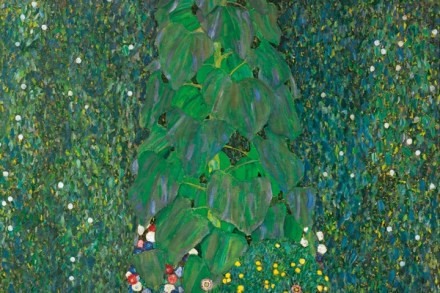
Gustav Klimt first came to Venice in the spring of 1899, in pursuit of Alma Schindler, the young stepdaughter of his friend and fellow artist Carl Moll. The nascent love affair between the artist, who was then in his late thirties, and the 19-year-old Alma was brought to an abrupt end when the girl’s mother read her diary and Klimt was asked to leave. Three years later she married Mahler. But before Klimt departed from Venice, Klimt and Alma had visited San Marco where, as Alma recorded, the Basilica’s mosaics, glittering in the half-light, made a profound impression on him.

Sculptural conundrums

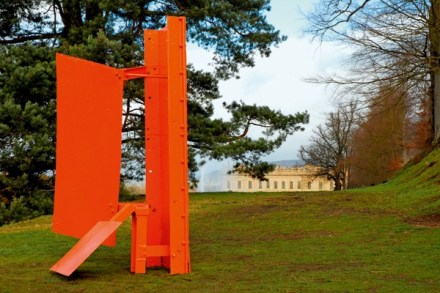
2012 is proving something of an annus mirabilis for Anthony Caro OM CBE RA, now 88, with no fewer than three exhibitions of his work on view around the country.  And he continues to beaver away daily in his studio in Camden Town, London, with the strength of a man much younger than himself, one who has been manhandling heavy, often intractable materials throughout the course of his creative life.

Glass act | 26 May 2012

The name of Patrick Reyntiens (born 1925) is indissolubly linked to the recent history of stained glass in this country. Reyntiens bridges the often troublesome gap between craft and art: not only is he a superb and innovative craftsman, but he is also a substantial artist. The second quality is not always recognised. Best known as John Piper’s associate, many assume that Piper was the artist behind their stained- glass collaborations, with Reyntiens as technical expert. Actually, Reyntiens played a more creative role than is generally supposed.

Fruitful oppositions

There are so many good exhibitions at the moment in the commercial sector that the dedicated gallery-goer can easily spend a day viewing top-quality work without paying a single museum admission fee. The following shows nicely complement some of the current or recent displays in public galleries — such as Mondrian||Nicholson at the Courtauld and the Tate’s Picasso and Modern British Art. Despite the financial squeeze and such new burdens as the bureaucratic nightmare of Artists’ Resale Right, commercial galleries continue to play an extremely important role in the nation’s artistic life, though they are not given much credit for it.

Domestic bliss

At Home with the World, the Geffrye Museum’s latest exhibition (until 9 September), reinterprets objects from its permanent collection, highlighting those from overseas or those that have been influenced by other cultures. Because the museum concentrates on the changing styles and tastes of the urban middle class, rather than of the aristocracy, we can appreciate what became popular as a result of mass manufacturing and trade. The most obvious example is the craze for ‘taking tea’ from the mid-18th century onwards. The porcelain teapots on display throughout the period living-rooms (that range from 1600 to the present day) remind us that much of what we consider English actually originates elsewhere — in this case, China.

Continental drift

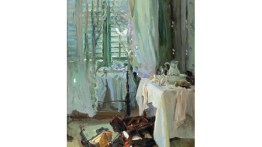
Why did Florence become a hotspot for Americans in the late 19th and early 20th century? Henry James, Edith Wharton, John Singer Sargent and a gang of other American artists and writers descended on the Arno, often for years at a time. Sargent, born in Florence, the son of a Philadelphia eye surgeon, didn’t get to see America until he was 20. This engaging — if chaotic — exhibition answers the question. The Grand Tour had been around since the 16th century, first for the aristocracy and then for the bourgeoisie of northern Europe; Americans were part of the artistic immigrant crowd from the mid-18th century.

A most eccentric master

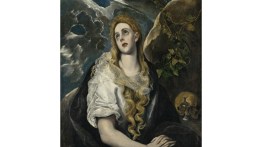
In 1895 the Spanish art collector John Charles Robinson donated a picture to the National Gallery. ‘On the whole I think it is very much above the average of this most eccentric master’s work,’ he phrased his offer less than enticingly. ‘At the same time you know the man was mad as a hatter and his work must be taken with “all faults” of which there are plenty.’ The man was Domenikos Theotokopoulos, aka El Greco, and the picture was ‘Christ Driving the Traders from the Temple’. To an English late 19th-century audience weaned on Murillo this ‘most eccentric master’ — a Cretan-born Byzantine icon painter turned Venetian colourist turned Spanish Mannerist — looked dangerously outré.

Inside No. 10

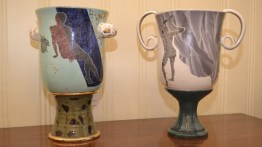
We are standing in the wood-panelled anteroom to the state rooms at No. 10 Downing Street — myself, Mo Hussein, David Heaton and Janice Blackburn, the former curator of the Saatchi Gallery who has been putting examples of contemporary decorative art and design into No. 10 since last July. We gaze up at Michael Eden’s Wedgwood Tureen on a high mantelpiece above the fireplace. Eden used to make earthenware pots in deep Cumbria but now he designs with 3D software and his pieces are built layer by layer by a 3D printer. His Wedgwood Tureen is based on a classic Wedgwood shape, translated into a vivid red diagram of the original. It looks like a replication of a familiar object made by intelligent aliens. We are all quietly impressed.

Marketing man

People go to exhibitions for different reasons, and although I was highly critical of David Hockney’s recent show at the Royal Academy, I accept that a great many people visited it and came out smiling and uplifted. They tended to be individuals who don’t usually go to exhibitions or look at real painting, and it may thus be said that they had very little idea of what they were actually looking at, or indeed should be looking for in an exhibition of painting, but if the experience made them happy, where’s the harm — you may ask — in that? Undoubtedly a great many went because it was the thing to do, and they felt better for being able to say that they’d been there and done that.

Outsider artist

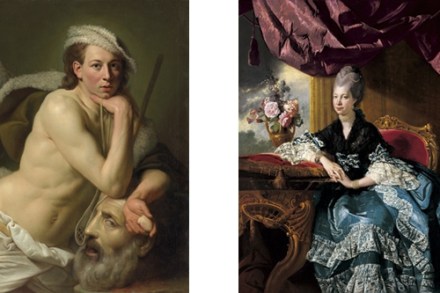
In the various mixed exhibitions I’ve seen over the years that dealt with 18th- and 19th-century British art, Johan Zoffany (1733–1810) has always seemed to stand out. Yet there hasn’t been a museum show devoted to his work in this country since the National Portrait Gallery’s survey of 1977, so Martin Postle must be congratulated on organising the current exhibition (supported by Cox & Kings), already seen at the Yale Center for British Art in Connecticut, especially since plans to hold it at the Tate were scuppered. I wonder why? The show has proved successful: it was very busy the day I went, though I did wonder what proportion of visitors had turned up to see the Hockney show, baulked at the queues and gone upstairs to see Zoffany instead...

Rocky ride

Now that the great design surveys regularly mounted by the V&A have come up to date, what will it seek to beguile us with next? These exhibitions have always been of interest, at least in parts, and often infuriating, a combination that has helped to ensure their success. The wide range of paintings and objects on display has also given them the status of offering ‘something for everyone’, rather like a vastly superior village bazaar. The current show is no exception. It begins very well, and then conks out repeatedly like an untuned engine. Ah well, who said the course of true progress (and innovation —  don’t forget innovation) runs smooth?

Flying colours

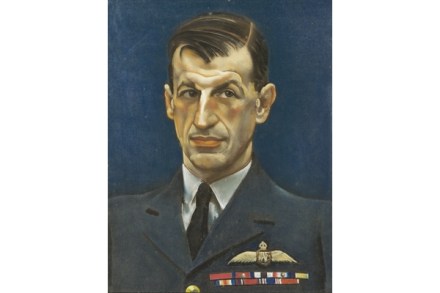
If you take the Tube to Colindale on the Northern Line and then hop on a 303 bus or walk for ten minutes, you arrive at the Royal Air Force Museum, open daily from 10 a.m. until 6 p.m., admission free. The place is full of planes, as might be expected, and has a wonderfully relaxed atmosphere (not nearly as frenetic as the Imperial War Museum) and a feeling of spaciousness. The Museum also mounts temporary exhibitions, and the one that drew my attention is of the pastel portraits of Eric Kennington (1888–1960), a war artist in both world wars, and an incomparable draughtsman, interesting painter and tough, inventive sculptor. The exhibition has been curated by the Kennington expert, Dr Jonathan Black, who has written a substantial and densely informative catalogue (£19.

Relatively eccentric

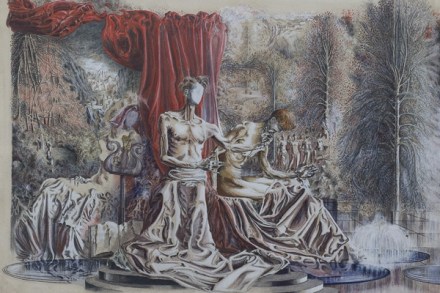
My uncle Robin Ironside bewailed the demise, after the scandal of the Wilde trial and the early death of Beardsley, of the imaginative tradition which, he wrote, ‘had been kept flickering in England since the end of the 18th century, sometimes with a wild, always uneasy light, by a succession of gifted eccentrics’. The truth is that he himself was one of those very eccentrics. Born in 1912 of a staunchly upper middle-class background, and after stints at the Courtauld and the Sorbonne, he landed, in 1937, the job of assistant keeper to Sir John Rothenstein at the Tate Gallery.

To the point

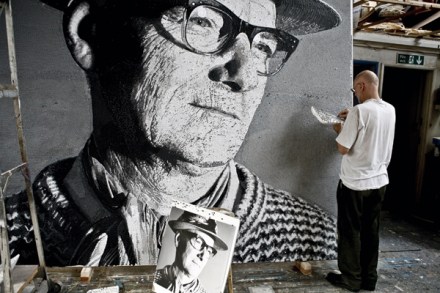
Ten years ago, Duncan MacAskill went into Rymans to buy some drawing pins and was struck by the range of colours on offer. That moment of revelation led him to construct a self-portrait from drawing pins, adapting the ideas of Seurat’s pointillism, and the ben-day dot approach of Roy Lichtenstein, to contemporary needs and materials. Now he has been commissioned by the Royal Opera House’s Deloitte Ignite festival, curated by Mike Figgis, to make two vast pin portraits for The Link at the ROH. These ‘paintings with pins’ hang near the box office over the exit to Covent Garden Piazza, and depict MacAskill’s father in black and white, and the choreographer Wayne McGregor in colour.

Sacramental vision

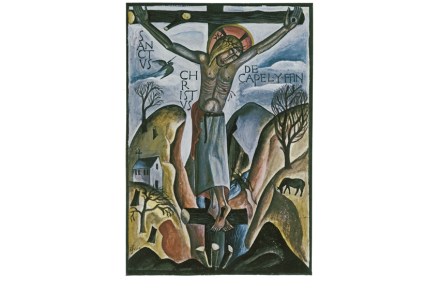
As the focus for an Easter meditation, David Jones’s ‘Sanctus Christus de Capel-y-ffin’ (1925), a small, heartfelt painting in gouache on paper, could scarcely be bettered. The Crucifixion takes place in a luminous landscape with the bird of hope in attendance. This is the world of medieval illuminated manuscripts and ivory carvings, a highly sophisticated spiritualised and classicised vision of existence that is sometimes dismissed as primitive. A Welsh hill pony is set off against a chapel, trees and a bridge over running water in an arabesque design quivering with natural and spiritual life. Rhythm is crucial. As Jones said, ‘I don’t care how static the subject is, but it must be fluid in some way.

On the beach | 31 March 2012

As exhibitions in London’s public galleries become increasingly mobbed and unpleasant, it is heartening to report that the drive to take art to the provinces continues apace. New museums seem to be opening all over the country, from Wakefield to Margate, and although one may entertain doubts about their sustainability, their enhancement of our current cultural budget is very welcome. The latest public art gallery to open on the south coast is in Hastings, a once rather grand town that has in recent years been down on its luck. It takes more than an hour and a half to get there from London by train, and there isn’t a fast road, and these factors have contributed to keeping the town just outside the easy commuting belt.