Exhibitions

Eduardo Chillida — the great modern sculptor, whom we shamefully ignore

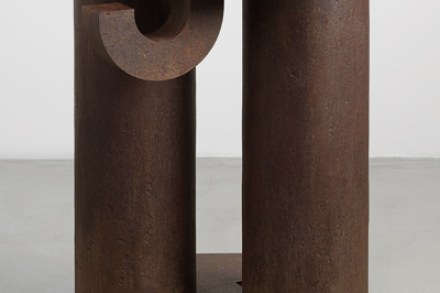
Eduardo Chillida (1924–2002) is one of the greatest of modern sculptors yet curiously little known in this country. The last major show in London was at the Hayward Gallery in 1990, where I first encountered his work in real depth. Before that, he had only exhibited once in the UK, a solo show at the McRoberts & Tunnard Gallery in 1965. Pilar Ordovas is to be congratulated for putting on this small but very choice new show. It’s high time we saw more of Chillida’s work: its powerful sculptural presence combines a satisfying sense of geometry with a love of materials, investigates space and light in new ways and is as much to do with poetry as with construction.
Exhibition review: Rory McEwen: the botanical artist who influenced Van Morrison; Paul Delvaux: a show to savour for its unusualness

By all accounts, Rory McEwen (1932–82) was a remarkable man, hugely talented in several different disciplines (artist, musician, writer) and very much loved by his friends. Grey Gowrie calls him ‘a spectacular human being’ and writes: ‘Even now, 30 years after his death, he lights up the mind of everyone who knew him.’ Renowned as a botanical artist, McEwen was also an exceptional musician, specialising in blues and folk, whose mastery of the 12-string acoustic guitar rivalled the legendary Lead Belly. With his brother Alexander, Rory toured across the USA in 1956, becoming one of the first British acts to appear on the Ed Sullivan Show. Back in London, Rory became the resident singer on the Tonight programme, later hosting his own late-night TV show.

One leaves the Patrick Caulfield exhibition longing to see more

In the wake of the Roy Lichtenstein blockbuster at Tate Modern comes Patrick Caulfield at Tate Britain, and what a contrast! Where Lichtenstein looks increasingly like a one-trick pony, an assessment driven home by the excessively large show, Caulfield emerges as fresh, witty and visually inventive. Undoubtedly this impression is fostered by the size of the exhibition: Tate Britain’s Linbury Galleries have been divided between Caulfield and Gary Hume, allowing each enough space for a highly focused solo exhibition. There are thus only 35 paintings by Caulfield spanning his entire career, and one leaves his show wanting to see more, not suffering from the usual museum overkill.

Exhibition review: The charm and dexterity of Sir Hugh Casson

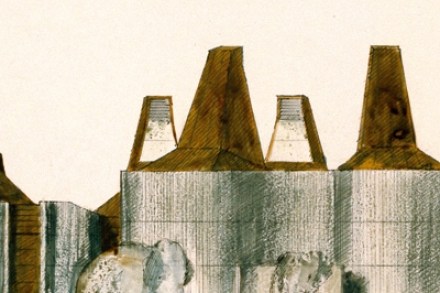
It is nothing short of a miracle that this aptly titled exhibition could be shoehorned into just two rooms at the Royal Academy, such was the range of the irrepressible Hugh Casson’s work and influence during his lifetime. Architect, artist, designer and writer, he was a fireball of energy and a fount of ideas. He was described by one friend as ‘the golfball on an IBM typewriter’. Not the least of his multifarious talents was, indeed, making friends with anyone, from the casual visitor queuing for the RA’s latest exhibition to the Queen and Duke of Edinburgh, for whom he worked discreetly but tirelessly for many decades on a series of royal apartments, unaltered to this day.

To survive the Royal Academy Summer Exhibition, don’t linger — just scan and pounce

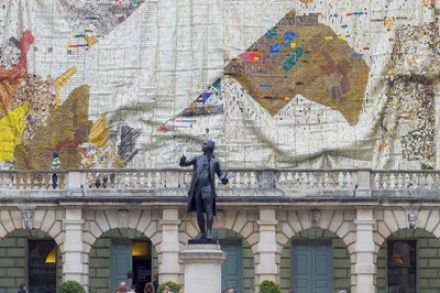
The Royal Academy’s biggest annual prize is the Charles Wollaston Award, worth £25,000, for the most distinguished work in the Summer Exhibition, this year won by the Ghanaian sculptor El Anatsui (born 1944). Although his preferred media are clay and wood, El Anatsui has taken to making installations from found materials woven together like cloth, and has done rather well with them around the world. He was invited to make a hanging for the façade of Burlington House for the duration of the Summer Exhibition, and this junk curtain (composed inter alia of aluminium bottle tops, printing plates, copper wire and roofing sheets) now obscures or ornaments — depending on your taste — the Academy’s noble brow.

Exhibitions: Leon Kossoff, The Bay Area School

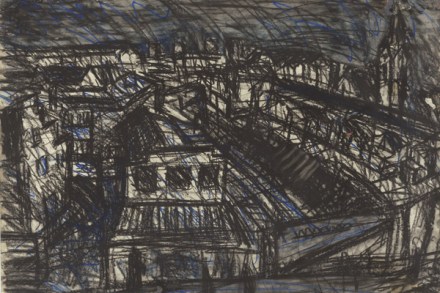
Paint is but coloured mud, pace scientists and conservators, and it can be said that the human animal comes from mud and goes back to it. Thus are the activities of painting and being human linked at a fundamental level, which can be raised by consciousness to impressive heights. As the philosopher T.E. Hulme wrote, ‘All the mud, endless, except where bound together by the spectator.’ This is an apt description of an exhibition by Leon Kossoff (born 1926). Kossoff paints thickly with much piling up of the mud of paint, which is trenched and seamed and dribbled across the surface of board supports.

Exhibitions review: William Scott

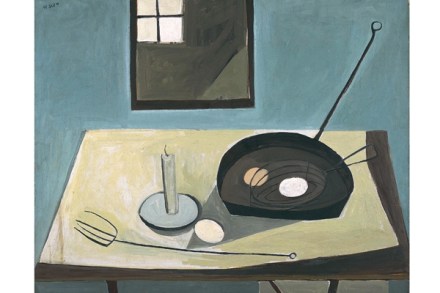
The centenary celebrations for William Scott (1913–89) are well under way, and the retrospective of his work that started in January at Tate St Ives is currently in Wakefield. There are more works in its latest incarnation and more archive material, and the installation looks very impressive in The Hepworth’s riverside galleries. Scott has not always fared well in historical surveys of 20th-century British painting (he was famously excluded from the Royal Academy’s 1987 exhibition), and his reputation does not stand as high today as it might. In his lifetime, he was much acclaimed, represented this country at the 1956 Venice Biennale and enjoyed a significant degree of international esteem.

Exhibition review: Saloua Raouda Choucair, Shanti Panchal

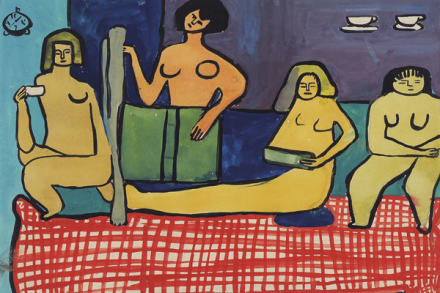
Forgive my ignorance, ladies and gentlemen, but I must confess that I had never heard of Saloua Raouda Choucair before the advance publicity of the Tate’s exhibition. She’s not in the Yale Dictionary of Art & Artists (always a useful reference book, but by no means infallible) and I don’t believe I’d ever seen her paintings or sculptures before this show. But I may have overlooked one somewhere in a mixed exhibition, for her work does resemble that of a dozen other artists of international Modernism, and even of a number of the British variety. So why does Tate Modern now devote a solo show to her? Could it be because she is Lebanese (and we don’t see the work of many Lebanese artists in this country), female and has reached the distinguished age of 97?

Exhibitions: Tiziano

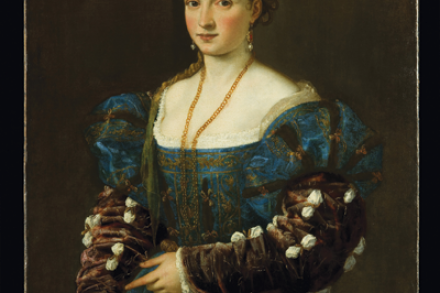
‘When Titian paints eyes,’ observed Eugène Delacroix, who spent a lifetime admiring, studying and copying the Venetian artist, ‘they are lit with the fire of life.’ The truth of Delacroix’s aphorism is on striking display in the magnificent exhibition of Titian’s paintings at the Scuderie of the Quirinale Palace in Rome. The exhibition does not pretend to be a comprehensive collection of Titian’s works. It is merely a selection of some of his greatest masterpieces. The gorgeous young woman known simply as ‘La Bella’ looks at you with a penetrating, unblinking gaze, her eyes so hot with the fire of life that you feel sure that, in just one moment, she will move.

Julian Trevelyan, a Jekyll and Hyde painter, at the Bohun Gallery

Between 1917 and 1923, Julian Trevelyan produced a map and an illustrated guide to Hurtenham, an industrial town on the Tees between Stockton and Darlington. You’ll search in vain for the place in an atlas today, as the entire town, with its warren of streets, railways, parks, public buildings and monuments to local luminaries, was the figment of a pre-teen imagination. But the wit and ingenuity of its conception — and its bird’s-eye views of an abstracted world — set the creative pattern for what was to follow. Born into a family of writers and intellectuals, Trevelyan was not destined for an artistic career. When he dropped out of an English degree at Cambridge in 1931 to study art in Paris, his uncle G.M.

Is the Louvre suggesting that Germany is programmed for war and catastrophe?

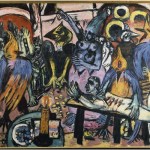
Curated by the Louvre as a tribute to mark the 50th anniversary of the Franco–German co-operation treaty signed in January 1963, De l’Allemagne 1800–1939: German thought and painting from Friedrich to Beckmann sounds like a harmless survey of German art. But it is stranger than that, less a measured look at German painting and more a very French attempt to interrogate the German soul, Nietzsche’s writings in hand. The exhibition opens dramatically with eight 12ft-high canvases by Anselm Kiefer. They were made especially for the show and provide the exhibition’s title, in turn taken from Madame de Staël’s famous book De l’Allemagne.

Museums in dire straits forced to sell treasure to raise funds

It is a desperate state of affairs when museums and art galleries sell outstanding works of art in order to raise funds. It is even worse, perhaps, when they do so because they no longer want them. Next month, on 5 June, Sotheby’s New York is offering some 25 classical carpets on behalf of the Corcoran Gallery of Art in Washington DC, which includes what the auction house describes as ‘one of the most important and revered carpets in the world’. No one taking the trouble to contemplate the 17th-century Isfahan ‘Clark Sickle-Leaf Carpet’ (right) for more than a minute could fail to be entranced by it, or to recognise that this most beautiful and astonishingly complex of textiles is a remarkable work of art. That is, in one sense, precisely why it is being sold.

Alexander Calder, Eilis O’Connell, Mary Newcomb

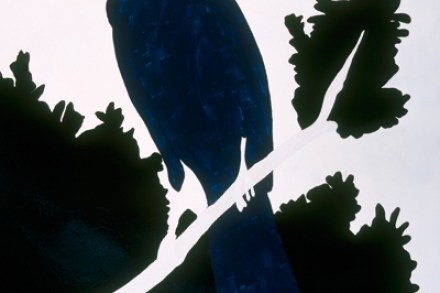
Alexander Calder (1898–1976) needs no introduction. The master of the mobile — that poignant hanging arrangement of moving elements — he also invented the stabile (stationary) and the standing mobile. There was no one who could cut and shape sheet aluminium and suspend it from wire with quite the same wit, economy and shape invention. His imagery is primarily abstract and organises flat geometrical forms in contrasting planes through space: discs and triangles balance more biomorphic shapes and are linked by bent sprung wire into a multidirectional kinetic experience of colour and light. Calder mostly used black, white and red, supplemented with blue and yellow, his forms poised and counterweighted with supreme grace and the kind of intricacy that demands utter clarity.

Springtime of the Renaissance: Sculpture and the Arts in Florence, 1400–1460

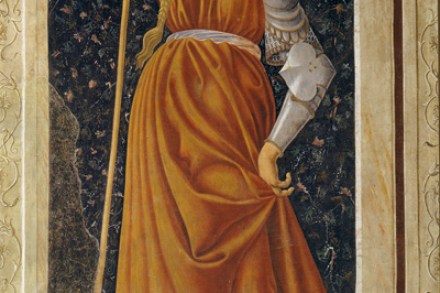
Sixty per cent of the best Renaissance art is said to be in Italy, and half of that is in Florence. So why bother going to Florence for a particular Renaissance sculpture exhibition when there’s huge amounts of the stuff on show in the city’s museums any day of the year? It’s true that some of the best Donatellos at the Palazzo Strozzi have taken only a short trip from the Bargello, ten minutes’ stroll away; ditto works from the Duomo Museum. But there’s lots more from museums around the world — from the Louvre, Berlin and the V&A — and from the rest of Italy, Naples in particular, that make this show a must, even for Firenze addicts. It’s even more of a must for anyone who’s a bit hazy about the Renaissance.

Cabinet of curiosities

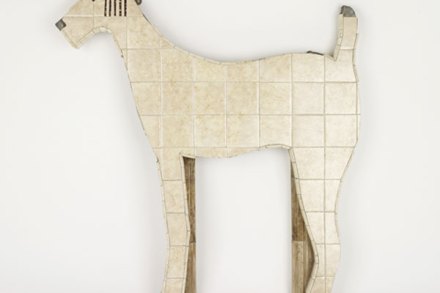
In 1951, the artist and writer Barbara Jones (1912–78) organised an exhibition called Black Eyes and Lemonade at the Whitechapel Gallery celebrating the popular arts of toys, festivities, souvenirs and advertising, to reveal to a largely unsuspecting public the richness of vernacular art in Britain. The original exhibition was evidently an Aladdin’s cave of objects, from decorated pub mirrors to ships’ figureheads, horse brasses, corn dollies and needle packets. Jones crossed the boundaries of folk art, mingling the handmade with the machine-made, and the traditional with the contemporary and ephemeral. She wrote a book about the subject, published the same year and called The Unsophisticated Arts.

Why on earth paint portraits in the age of photography?

‘Everybody faces rejection,’ the portrait artist Aaron Shikler said. He should know, having had three official White House portraits of former President Ronald Reagan rejected — one was too large, one was too casual and one ‘they just didn’t like it’. The commission finally was given to a different artist. Don’t feel too sorry for him. His posthumous portrait of President John F. Kennedy hangs in the White House along with those of First Ladies Jacqueline Kennedy and Nancy Reagan, and he has also painted likenesses of US senators, Supreme Court Justices, cabinet officers, socialites and people who just had a lot of money. Still, fame and past successes don’t make one immune from criticism.

Exhibition review: Looking at the View, Tate Britain

Most of us like to look at a view, though not all are fortunate enough to live with one, in which case art can offer an alternative, a window on the world. Landscape is a great solace, and particularly refreshing for the tired urban spirit, but we want more than holiday snaps of foreign places briefly visited. We need the deeper exploration of art to feed hearts and minds, an investigation through the procedures of painting and drawing, a reordering of shapes and a fitting together, a showing again under other than a purely mimetic guise. With luck and application, through bearing witness to that process of recreating, we come to greater knowledge of our world and our place within it. As D.H.

Exhibitions: R.B. Kitaj: Obsessions The Art of Identity

Nowadays, R.B. Kitaj (1932–2007) tends to be ignored by the critics in this country — like a bad smell in the corner of the room. It was not always thus: for years he was an admired, if somewhat controversial, presence, but then came his great retrospective at the Tate Gallery in 1994. A large proportion of the British critical fraternity united to condemn and vilify him, to ‘take him down a peg or two’, as if he were an unruly schoolboy too big for his boots, too clever for his own good. This chorus of complaint (some of which amounted to abuse) was deeply felt by Kitaj, and when his beloved second wife, Sandra Fisher, died suddenly in the midst of what he called his ‘Tate War’, he was heartbroken and his love for England all but extinguished.

Life and Death in Pompeii and Herculaneum

The Reading Room is currently packed with Roman remains and with visitors attempting (or pretending) to look at them. The latest blockbuster at the BM (sponsored by Goldman Sachs) looks set to exceed all other oversubscribed sensationalist exhibitions, with more than 250 objects in a mazy but airy layout. When I first heard about this show, my main concern was how it could possibly compare or compete with the experience of visiting what’s actually left of the cities of Pompeii and Herculaneum in Italy. The principal attraction of this subject for those with some interest in the fine arts must be the famous wall-paintings, and how could these be transported to London? Yet, as is swiftly apparent on entering the display, there is enough here to make even the specialist excited.

George Bellows; Sydney Lee RA

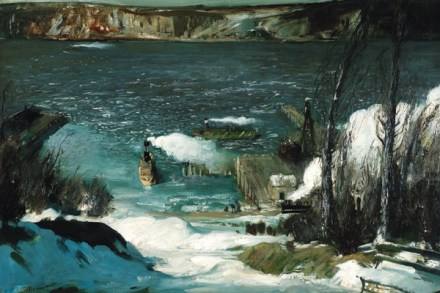
The American artist George Bellows (1882–1925) is best known for his boxing paintings, but as this surprising exhibition reveals, that was only the half of it. We don’t really know his work in this country, apart from the odd picture in a mixed show, but here is indisputable evidence that we have been missing out. Bellows died from appendicitis aged only 42, so this exhibition inevitably offers us work which varies wildly in style and competence, as he tried his hand at different approaches and different subjects. Nevertheless there are at least half-a-dozen paintings of real worth and presence, in addition to the boxing pictures, which I personally find of limited interest, though Bellows’s handling of bodies in dynamic movement is dramatic and convincing.