Classical

The Hallé is on a roll

Say what you like about Manchester – and who doesn’t, right now? – but when it comes to imaginative programming, the Hallé is on a roll. It opened its new season with two substantial premières. First up was Sir James MacMillan’s Sixth Symphony, conducted by the orchestra’s principal conductor Kahchun Wong, and superficially a more abstract conception than MacMillan’s tremendous Fifth Symphony, which was premièred in Edinburgh in 2019. That work had a subtitle, Le grand Inconnu, and it dealt with the Holy Spirit. The Sixth has no name, though MacMillan has said that it incorporates musical portraits of family members, alluding to the ‘friends pictured within’ Elgar’s Enigma Variations. It’s an interesting model.

Rattle makes Schumann shine and sing

Phrenology, eh? It’s cobblers, plainly, but Robert Schumann didn’t know that and his biographer Martin Geck tells how in 1846, near Dresden, he submitted to a full once-over from Europe’s leading cranium-fondler Robert Noel. Noel clearly knew his patient, because his analysis echoes what anyone who knows Schumann’s music might say about the personality of this supreme romantic. Noel detected ‘sense of form – modesty – strength of purpose’. Touchingly, he also detected ‘anxiety that stands in the way of happiness’. Then the clincher, the observation that grabs straight at the heart of any Schumann fan: ‘emotional through and through’. Well, we Schumann-lovers will take all the back-up we can get.

Words are the most important part of any opera

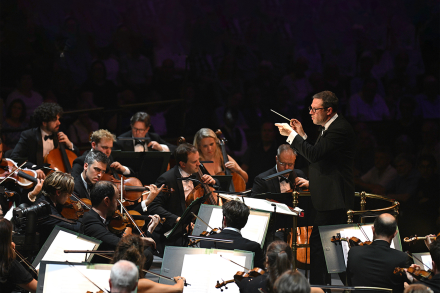
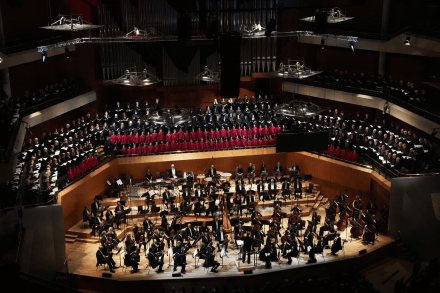
The long days wane, summer fades and sure enough, the big international guest orchestras begin to land at the BBC Proms. A rare catch this year was the Proms debut of the orchestra of the New York Metropolitan Opera, under its music director Yannick Nézét-Séguin. Debut? No, I couldn’t quite believe it either. What with the regular Radio 3 broadcasts from the Met, and all those live cinema relays, the Met Orchestra almost feels like part of the family. Certainly, there must be few overseas orchestras whose live performances are more familiar to British audiences. No question, though, there’s always something rather festive about hearing a great opera orchestra in concert.

A true visual spectacle: Edinburgh’s The Galloping Cure reviewed

Those lights! Thinking back on The Galloping Cure, Missy Mazzoli’s new opera for the Edinburgh International Festival, that’s what lingers: cascades of lights, shimmering and flickering in every hue that modern LED technology can supply. At first the effect is almost Zen – soothing washes of pinks and blues and ochres, with carousel horses rising and weaving among them. Then, as the action intensifies and the characters succumb to collective mania, they’re brighter, faster, more aggressive: a frantic sensory overload, flashing to the rave-derived backbeat of Mazzoli’s score. Lucy Carter’s lighting designs are meant to transfix you, and they really do. Hardly the point of an opera, you might say.

Apple Music has redeemed itself

Just two weeks ago I was ready to cancel my subscription to Apple Music. I’d stumbled across its ‘Composer Essentials’ – a list of 100 composers so significant that they merit their own curated playlists. It includes Bonds, Boyle, Caccini, Dawson, Dett, Perry, Poldowski, Sohy, Strohl and Walker. If those names don’t ring a bell, how about the composers who are missing? Albeniz, C.P.E. Bach, Bellini, Berg, Bizet, Borodin, Chabrier, Kodaly, Martinu, Messiaen, Mussorgsky, Nielsen, Poulenc, Schoenberg, Walton, Weber and Webern. See what I mean? The ‘Essentials’ list is stuffed with DEI hires. Which – an analogy with Cambridge University comes to mind – does no favours to the black and women composers who deservedly feature in it, such as Joplin and Beach.

Don’t miss this dark Hansel and Gretel

The Three Choirs Festival always feels so nourishing, so eternally English, that you sometimes forget how much history has been made there. It was in Gloucester in 1910 that the young Herbert Howells and Ivor Gurney heard the world première of Vaughan Williams’s Tallis Fantasia while Elgar, in rented digs, tried out his Violin Concerto with Fritz Kreisler. Three years later you’ve got Sibelius despatching Aino Ackte to première Luonnotar, and Saint-Saëns, at 77, playing Mozart by day, then cracking out his celebrated musical impersonations at the post-show party. Apparently his Cosima Wagner was quite the knockout. The point is that there have been moments when the musical universe pivoted around this quiet cathedral close.

The concert of the year

Ah, so that’s where the kangaroo comes in! Garsington Opera produces a souvenir mug each summer decorated with cartoons of that year’s operas. Buy yours early enough, and you get a ceramic preview of the season – in the case of Gerald Barry’s The Importance of Being Earnest, a drawing of a kangaroo. True, Barry’s operas are famously anarchic. But quite where a marsupial was supposed to fit into Oscar Wilde’s comedy was unclear until halfway through Act One. Suddenly, there it was: fuzzy and large as life, lolloping dolefully across the stage. Because? Well, because someone said ‘Australia’, silly. That’s how it works.

The greatest symphony that no one’s heard of

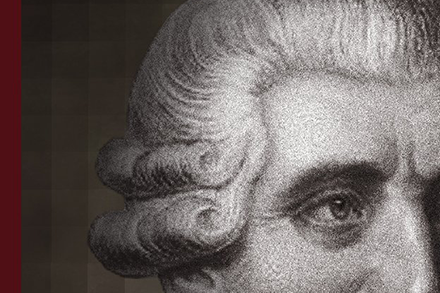
I’ve been listening to a symphony that I would describe as an almost perfect masterpiece by a composer of towering importance. But until last month I’d never heard it. Most music-lovers would struggle to identify the piece; most orchestras have never performed it and have no plans to do so. We can only be talking about a symphony by Joseph Haydn. He wrote 104 of them, plus two or three others that didn’t make it into the catalogue. For that reason alone there aren’t going to be many opportunities to hear the less popular ones. Which raises the question: what makes a Haydn symphony popular? The short answer is: a nickname. That’s not surprising. The Farewell, the Hen, the Clock and the Military play tricks that invite affectionate titles.

Choral church music must be heard within the liturgy

Choral church music is at its most effective when it’s embedded in the liturgy as it was designed to be, rather than performed on stage in a concert. The Mozart Requiem works well in both situations; but if you happen to be in a pew, mid-mass, eyes closed and head in the praying position at the moment when the choir breaks into the ‘Lacrimosa’, the music will somehow be doubly powerful. Two annual summer festivals of music within the liturgy celebrate this truth. The first is the Roman Catholic St Birinus Festival, now in its fourth year.

The British modernist who was airbrushed from history

Elsewhere in British music in 1960: William Walton was writing his Symphony No 2, Benjamin Britten his opera on Midsummer Night’s Dream and Michael Tippett was about to start King Priam. Meanwhile in Cambridge, an ex-pat composer from Catalonia, Roberto Gerhard, was puzzling out how to knit together a new large-scale piece for orchestra and electronics. Simon Rattle and the London Symphony Orchestra are about to give that work, Gerhard’s Symphony No. 3, Collages, a rare outing at the Barbican on 21 May. It’s a mind-stretching piece, both very much of its time and of the future. Gerhard’s electronics gurgled, bleeped and cracked their knuckles, as he atomised the orchestra, finding a kaleidoscope of inventive ways to cement its working parts back together.

In defence of Hindemith

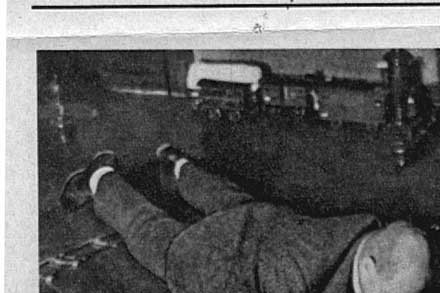
There’s a photo of Paul Hindemith with the pianist Artur Schnabel on hands and knees, surrounded by model railway track. Huge railway enthusiast, Hindemith, you see: he laid sprawling networks through the rooms of his Berlin apartment (before the Nazis drove him out), and organised marathon operating sessions with friends. Anyway, for various reasons, this knowledge makes me warm to him in a way that his music only erratically manages. It’s not that it’s impossible to like (although this is a man whose idea of a crowd-pleaser is called Symphonic Metamorphoses of Themes by Carl Maria von Weber). But there can be few composers whose effect is so hard to anticipate.

The return of orientalism

I’m bullish about AI. All aesthetic snobs should be. In the war on man-made slop – still the most pressing threat – algorithms are an ally. After all, how much of the output of Netflix, Hollywood or Sony will retain its allure once AI is ventriloquising it to perfection? The qualities that have made popular art popular – legibility, fluency, tidiness – will surely be fatally tainted, perhaps even start to repel us. What we will crave instead is for culture to look and feel weird – opaque, messy, frangible. The experimental might even become box office. Wishful thinking? Well if the Rewire music festival in The Hague is anything to go by – so rammed this year that it was actually rather unbearable – it might already be happening.

A spring mood lifter: Tales of Love and Loss at the Linbury Theatre reviewed

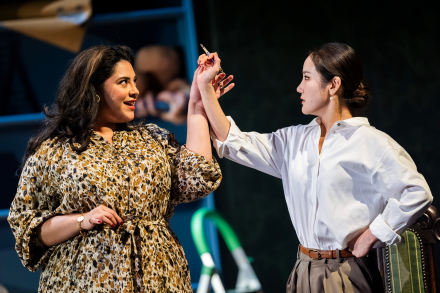
This year’s Jette Parker Artists showcase is a triple bill of modern-ish operas; a cleverly assembled trittico of one-acters, linked by a theme of bereavement. That sounds bleak until you consider that Puccini’s Trittico was originally inspired by The Divine Comedy, and who bothers about that today? Anyway, the three operas that make up Tales of Love and Loss are far from dispiriting in their overall effect. Like Puccini, Talia Stern – who directs all three – has gone for two tragedies plus a raucous, palate-cleansing comedy. And like Gianni Schicchi, the final laugh-fest (Elena Langer’s Four Sisters) plays out around a barely cold corpse and sends you into the night feeling uneasy, but undeniably entertained. The Puccini parallels stop there.

The magic ears of Hyperion

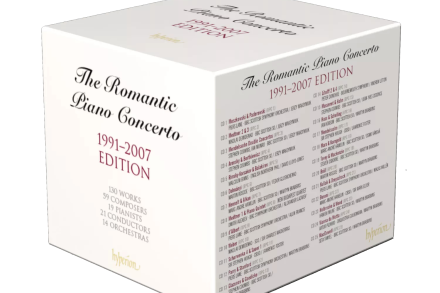
How do we evaluate Hyperion’s Romantic Piano Concerto series, which over a period of 35 years recorded more than 200 works for piano and orchestra? Was it one of the glories of the catalogue or a repository of works whose ambitions exceeded their achievement? The answer, of course, is that it was both. The paradox is unavoidable. You can’t assemble a giant collection of mostly forgotten concertos on the assumption that they all deserve to be famous – which, to be fair, Hyperion doesn’t claim: the liner notes often concede that a piece ‘perhaps understandably failed to secure a place in the repertoire’ or some such euphemism. But they may deserve to be recorded. Keyboard pyrotechnics can be their own reward, compensating for vapid melodies or structural lumps.

Heart-melting loveliness from John Rutter

Anyone for a spot of acoustic science? Apparently the distinctive colour of a musical note is concentrated almost wholly in the attack: the first split-second; the beginning of the sound wave. Obscure or somehow cut off, that first bite of a note or chord and what’s left sounds – well, not the same as everything else, exactly, but a great deal more samey. It’s like wine-tasting while holding your nose. Everything becomes neutral, and suddenly it’s remarkably easy to fool the senses. The Italian composer Salvatore Sciarrino seems to enjoy playing these games. In Le voci sottevetro (1999) – four arrangements of works by the homicidal madrigalist Carlo Gesualdo – a quick splash of tuned percussion does the job of hiding the start of a line.

Why the Goldberg Variations fill me with dread

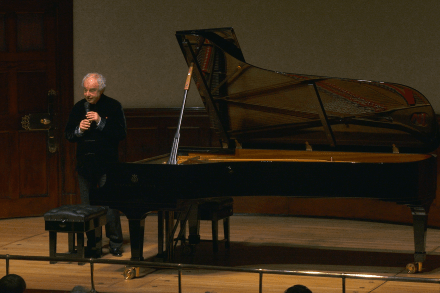
Is Sir Andras Schiff becoming the Ken Dodd of the piano? In his later years, you’ll recall, the Yorick of Knotty Ash took to delivering marathon one-man routines that finished long after midnight. A couple of years back, Schiff expressed a similar wish: why should he have to tell us in advance what he was going to perform? And fair enough, because even with no advertised programme, the Wigmore Hall was sold out. Clearly, a lot of people will gladly pay to hear Schiff play anything at all, and part of me hoped he’d launch into Chopsticks or Richard Clayderman’s Ballade pour Adeline. But no, Schiff had a far crueller joke up his sleeve. He walked out without a word and began the ‘Aria’ from Bach’s Goldberg Variations. A purr of happy recognition ran through the room.

Recordings have stunted us

Bring me my bow of burning gold; or failing that, the opening notes of Elgar’s Second Symphony. That’s how I’ve always imagined them anyway, those three swelling B flats –  a mighty drawing back of the bow before Elgar propels his arrows of desire into the restless heart of this greatest of British symphonies. Thinking back, though, I’m not sure I’ve ever felt quite that tension in a live performance – not from Pesek in Liverpool or Barenboim at the Proms, and not from this most recent encounter, with Mark Wigglesworth and the Bournemouth Symphony Orchestra in Bristol. So where am I getting it from? Recordings, presumably, and the long-embedded imprint of two boyhood idols, John Barbirolli and Vernon ‘Tod’ Handley.

A playful, big-hearted, intelligent new opera

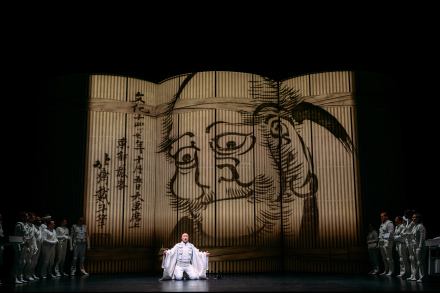
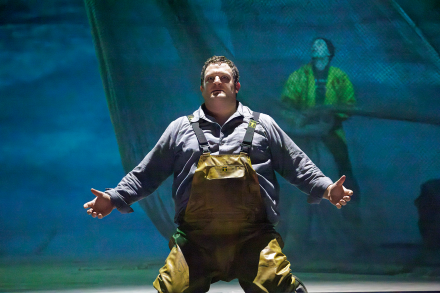
Some people like art to have a message. So here’s one, delivered by Katsushika Hokusai near the end of Dai Fujikura and Harry Ross’s new opera The Great Wave. ‘Remember art won’t change the world,’ sings the great painter (as incarnated by the baritone Daisuke Ohyama), and for that line alone I’d gladly have given the show five stars, if the Spectator did anything as barbaric as award stars. Words to live by, at least if you’re an artist; and the very private bliss of a life devoted to creativity is the heart, mind and dramatic engine of The Great Wave. Is that enough to sustain a full-length opera?

What a masterpiece. What a man: Borodin at the Barbican reviewed

Gianandrea Noseda conducted the London Symphony Orchestra last week in a programme of Stravinsky, Chopin and Borodin. The Stravinsky was a relative rarity – the divertimento from The Fairy’s Kiss – and Chopin’s F minor concerto was played by Seong-Jin Cho, a pianist with a large following and a soaring reputation. Full disclosure: I was there for the Borodin, his Second Symphony of 1877. What a masterpiece, and what a man! Alexander Borodin was a scientist of international standing and a campaigner for women’s rights. Deeply in love with his wife, and an inveterate rescuer of stray cats, he was, he confessed to Liszt, ‘only a Sunday composer’. ‘But after all,’ replied the wizard of Weimar, ‘Sunday is a special day.

The early-music movement is ageing well

The early music movement: it’s grown up so quickly, hasn’t it? The Orchestra of the Age of Enlightenment is 40 years old in 2026 and if you can remember its debut, back in the 1980s when Beethoven on period instruments was pretty much the wildest thing going, you’re going to feel terribly, terribly old. Right from the start, the OAE was in the vanguard of the second wave. As late as 1978, the gut-strings and Bach brigade had assumed that Mozart was beyond them. The newly founded OAE was straight out of the traps with Weber, Mendelssohn and Schubert – halfway down the 19th century without drawing a breath.