Any other business

And Another Thing | 20 September 2008

Today’s Friday so we must be in Spain Recently a Syrian lorry driver, making his cumbrous way across Turkey and Europe to Gibraltar, and following his satellite navigation system and online mapping service, found himself in Lincolnshire, on the Gibraltar Point Nature Reserve. These devices cannot make allowance for monoglot ignorance and soggy IQs of that magnitude. Nor do they merit the attack on what she called ‘corporate cartography’ recently launched at the RGS by Mary Spence. She is president of the Cartographic Society and ought to know better. Route maps on a ‘need-to-know’ basis, that is, omitting everything you don’t need, are not new: far from it.
Global Warning | 17 September 2008

My one regret at having retired from the National Health Service is that I no longer receive official circulars. I used for a time to derive a small secondary income from publishing them; and such was their idiocy that very little commentary on my part was required. They spoke for themselves; it was money for old rope. I am glad to say, however, that old friends keep me in touch with Gogolio-Kafkaesque-Orwellian developments in Europe’s biggest employer (now that the Gulag is no more).

From Northern Rock to Lehman: who should share the blame?

Martin Jacomb assesses the extent of the damage to the banking system so far — and the effectiveness of responses by central banks, regulators and lawmakers Will it be short and sharp, or drawn out and deep, with lasting damage? A recession is upon us, but no one knows its path. Its course and its force are, like Hurricane Gustav’s, unpredictable. It is already more than a year since it all started. Banks everywhere have made enormous losses; some, even important ones such as Lehman Brothers in New York, have collapsed, and more may do so. They are being blamed for the catastrophe. But it is not as simple as that. A decade of the miraculous combination of low interest rates and low inflation inevitably led to banks lending ever higher volumes to riskier borrowers.

The Housing Market

If Britain’s housebuilders really want to sell more homes, they ought to slash their prices rather than lobby the government for packages like last week’s ill-conceived attempt to boost the property market. That’s what the rest of us have done, but while prices of all other houses have plunged, new homes have still been selling for more than they did a year ago. When the Halifax announced that the fall in house prices had reached double digits in the year to July, the figure that failed to catch the headlines was that new homes had gone up by 1.1 per cent over the previous year. Are we really to believe that new-build is the oasis in the housing market desert — or are the builders playing tricks? There is indeed sleight of hand by the housebuilders.

And Another Thing | 13 September 2008

When is too old? When too young? Almost every day I hear a story of someone, at the height of his power and energy, being compulsorily retired at 60. Or there is a fuss because a girl wants to get married at 15. I recall that Lydia, youngest of the Bennet girls in Pride and Prejudice, was 15 when she ran off with the miscreant Wickham. She prided herself on the fact that she was taller than her siblings and was obviously precocious. When it came to the point the problem was not her age but getting Wickham to marry her. An underage girl is a moveable feast. I have been reading about the fascinating case of Margaret Beaufort (1443-1509), who might fairly be described as the founder of the Tudor dynasty. She was both the beneficiary and the victim of outrageous fortune.

Greener than thou: the carbon tax contest

Labour’s climate change levy has led to lower emissions, says Elisabeth Jeffries, but can the Conservative alternative yield better results — or command business support? There are many ways to eat a potato: chopped into chips and deep-fried, baked in the oven or slivered as crisps. Not many consumers care about the dozens of ways to cut down on the energy used to cook, store or produce it, such as buying a super-efficient freezer. But it is a question many retailers and food suppliers have been trying to unpeel. McCain chips installed three new wind turbines and an anaerobic digestion facility (which processes food waste to capture emissions of the greenhouse gas methane) at its Whittlesey plant in the East Midlands.

And Another Thing | 6 September 2008

When I first experienced literary life in London it was 1955 and poor Anthony Eden was prime minister. His delightful wife Clarissa was to be seen at literary parties and, amazingly enough, still is. The great panjandrums were Cyril Connolly and Raymond Mortimer on the Sunday Times, Philip Toynbee and Harold Nicolson on the Observer, and V.S. Pritchett and John Raymond on the New Statesman. John was my friend, and he opened all the doors to me, doors which were firmly shut in many eager faces. Every morning, in the Commercial on the King’s Road, or the French Pub in Dean Street, he and Maurice Richardson would pool their knowledge of book-launch parties that evening, and decide which to go to. I would tag along. These events were worth attending, too.

Nice pork, pity about the pizza

Judi Bevan finds her local Lidl discount store full of bargains — but not Boden-clad middle-class shoppers Intrigued by reports that the middle classes are shopping at the German discount stores Aldi and Lidl — and even stuffing their purchases in Waitrose bags — I set off to track them down. My nearest Lidl is a couple of miles from my house at the northern end of Cricklewood Broadway — not exactly an area known for yummy-mummy sightings, and without a Starbucks or Caffè Nero for miles. Yet the statistics say that sales at both Aldi and Lidl have been growing strongly since householders have been hit by higher petrol and utility bills.

King coal prepares for a comeback

Neil Barnett says the miners’ union that took on Margaret Thatcher and lost is now talking surprisingly good sense about Britain’s future energy security The National Union of Mineworkers’ headquarters in Barnsley has a splendid retro feel. In the assembly hall hang banners celebrating the struggles of the working class: from one of them, Arthur Scargill, Shredded Wheat comb-over to the fore, stares into the middle distance; another from Kellingley Colliery shows a miner wearing only trousers and a helmet, throttling a huge python labelled ‘Capitalism’. The script below declares ‘Only the strong survive’, while behind him an optimist has written ‘Socialism Leads to Prosperity’.

City Life | 30 August 2008

The credit crunch reaches the home of the rotten apple and the ‘Rolexo’ watch James Gregory Pool III is an elderly, stooping Canadian with a most un-usual job. Every month he boards a plane from Canada with 200 sedated heifers and flies with them to Almaty to beef up and variegate Kazakhstan’s breeding livestock. He’s the archetypal eccentric foreign entrepreneur one finds in this eccentric Central Asian city.

And Another Thing | 30 August 2008

The spectacular increase in scientific knowledge during the last hundred years tempts me to ask: cui bono? We now live on average twice as long as in the early 19th century. But what does our ability to repair our bodies and fend off fatal diseases do except prepare us for a long twilight of Alzheimer’s and debility, a burden on our families and a reproach on ourselves. I recall a woman in her mid-nineties, who had led a life of duty, saying over and over again: ‘I have lived too long.’ I spend much of my time studying history, especially letters, diaries and biographies, and I see no evidence that all the technical knowledge we now possess has increased the sum of human happiness by one smile or a single heartbeat of delight.

Global Warning | 30 August 2008

I think I should abandon the world: I am too easily irritated by it. I should follow the example of Xavier de Maistre, brother of the brilliantly reactionary philosopher, Joseph, and stick henceforth to my room. In his Voyage autour de ma chambre, de Maistre tells us that by describing his journey he is offering an infinite number of unhappy persons a perfect antidote to boredom, and that the pleasure of such a journey is proof also against the ceaseless envy of men. Moreover it is cheap, an advantage not to be sneezed at in time of rising prices. No sooner do I leave my house than I meet, or at least pass, people who chew gum. This vile habit makes them look like vicious and ruthless but stupid ruminant carnivores, chewing endlessly on the gristle of a corpse.

And Another Thing | 23 August 2008

It is an indictment of our society that, despite huge scientific advances in the last century, particularly in the production of food, millions of people, perhaps hundreds of millions, do not get enough to eat. The principal culprit is the Green movement, in its many species or fanaticisms. The Prince of Wales, who might be described as the most prominent Green man, has recently drawn attention to the destructive power of his ideology by attacking the growing of genetically modified crops, perhaps the largest step forward ever taken by mankind to reduce the cost of basic foodstuffs, and to increase their production and worldwide availability.

Credit Crunch: First Anniversary

When Britain had a secondary banking crisis in the 1970s the big banks launched a lifeboat to rescue the sinking smaller lenders. Today we have a primary banking crisis. It is the big banks that are in trouble — but this time there are no bigger brethren, at home or abroad, to launch the lifeboats. Barclays, HBOS and Royal Bank of Scotland have had to raise £20 billion of new capital to fill the holes left by bad lending. That is enough cash to buy one of their high-street rivals — though expansion is the last thing on their minds. Northern Rock, Alliance & Leicester and Bradford & Bingley are no longer in the FTSE 100, of which they were all members until they were mangled by the credit crunch.

New Deal economics: lessons from Herbert Hoover

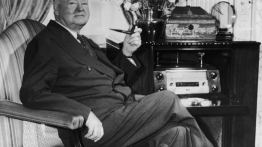
Bill Jamieson says calls for a Rooseveltian New Deal to stave off US recession are misinformed; it was FDR’s much-maligned predecessor who set the course for recovery A year into the credit crunch and the world’s leading economies seem locked in a macabre race to be first over the recession line. America, a few months ago firm favourite, has lost the lead to Germany. Or is it France? Or Spain? Is Japan already over the line? In truth, who ‘wins’ is secondary to the direction in which the global economy is heading and the sense of apprehension over further shocks to come in the banking system.

Global Warning | 23 August 2008

Recently while travelling on the London Underground, the opening words of Marx’s The Eighteenth Brumaire of Louis Bonaparte ran through my mind like a refrain: ‘Hegel remarks somewhere that all great world-historic events and personages appear, so to speak, twice. He forgot to add: the first time as tragedy, the second time as farce.’ Why, you might ask, did this passage insinuate itself into my brain on the District Line between West Brompton and Earl’s Court? Standing opposite me was a young man badly dressed in black, on whose baseball cap was inscribed the word ‘Victim’. On his black T-shirt were the words, ‘I wish I could be you’, which implied self-pity on an industrial scale.

Any Other Business | 16 August 2008

Does Medvedev really believe in the rule of law? The fate of TNK-BP is the test Is President Dmitri Medvedev of Russia — who looks and sounds like a liberal-leaning modern technocrat — really his own man, or is he merely the stooge of his predecessor, the sinister, warmongering Vladimir Putin? The mad situation engulfing BP’s Russian joint venture, TNK-BP, is surely the test of this question. Its BP-appointed chief executive, Robert Dudley, has met such hostility from the gang of oligarchs who are BP’s partners in the company that he is now trying to run it by email from a secret address somewhere in eastern Europe.

And Another Thing | 13 August 2008

One of the great paradoxes, for most of us, is the hatred of work, and the need for it to fill what Dr Johnson called ‘the great vacancies of life’. We sigh for leisure, then don’t know how to handle it when it comes in abundance. Occupation is wearisome, but essential, and retirement is longed-for but disappointing. A typical example was Charles Lamb. During the 33 years he worked at the East India House he perpetually grumbled about the way his work gobbled up the best hours of each day and left him tired and listless, with virtually nothing for himself and his pleasures.

The end of Euro Disney’s white-knuckle ride?

After years of financial struggle, say Christian Sylt and Caroline Reid, the Paris theme park has finally found a path to profit — just as the European economy hits a downturn Disney and happy endings go hand in hand. But after 16 years, shareholders in Disney’s theme park near Paris are still waiting for their frog to complete its transformation into Prince Charming. In November, Euro Disney is set to announce its first net profit for more than five years — a success achieved not by pixie dust but by hard, old-fashioned graft. Despite an economic slowdown in Europe, things have never looked better for Mickey Mouse’s maison secondaire. Attendance is at record levels and its parks are brimming with new attractions.

And Another Thing | 6 August 2008

Splendours and miseries of the Queen’s English in the 21st century The wonderful thing about language, and especially English, with its enormous vocabulary, is the existence of groups of words with broadly similar meanings but each of which conveys something slightly different. Such subtle distinctions add to the richness of meaning, in speech and writing, and to the pleasure of using words. And the sense changes over time, as historic events add moral overtones or undertones to particular words. Take, for instance, the group of words meaning ‘friend’, of which there are about 30 or 40. None is exactly interchangeable. Many have undergone osmosis even in our own lifetime. Some are mysterious in origin and malleability. Crony, for instance.