Europe

Can Burnham resist the siren call of the left?

Power, when it is gained and lost, is transferred in stages: the actual, the visual and the constitutional. The latter took place on Tuesday evening when the prime minister presumptive sent a letter to Antonia Romeo, the Cabinet Secretary, requesting that she commence access talks with his team. Keir Starmer had already given permission for them to proceed, but the propriety and ethics team in the Cabinet Office had told Romeo she could not initiate proceedings. Andy Burnham had to ask first. To all intents and purposes, he is already the vessel from which power flows. At the same time, it became clear that James Purnell, the former Blairite cabinet minister, will lead the transition team and stay on to become chief of staff in 10 Downing Street.

burnham

Northern Ireland has been the biggest loser from Brexit

In the decade since the vote to leave the European Union, arguably no issue has consumed more energy, column inches, political capital and careers than how to solve the problem of Northern Ireland. It was on that narrow, jagged border between North and South that the substantive skirmishes took place between the UK and EU on what their future relationship would look like. While Michel Barnier and Lord Frost arguing the toss over the finer points of agri-food regulation may lack the luster of the Battle of the Boyne or the romantic connotations of 1916, it was no less significant a moment in Northern Ireland’s history.

northern ireland

Britain is the weak man of Europe on border control

Britain and France have rewritten the "one in, one out" migrant deal nearly a year after it came into effect. The treaty, described as "groundbreaking" by both countries last summer, has struggled to stem the numbers of migrants heading from France to England in small boats. It soon became apparent that the deal contained a loophole that enabled a handful of deported migrants to return to Britain in the back of a lorry. Britain's Home Secretary Shabana Mahmood has agreed with her French counterpart, Laurent Nuñez, to close this loophole by tweaking the treaty to stipulate that its terms apply to any returning migrant regardless of whether they enter a second time by boat or by vehicle.

The real threat to democracy after Brexit

Ten years after the Brexit referendum, its long-term impact on British politics is evident. Not so evident is why this is the case. Every general election sees comparable debates. So too did the 1975 referendum on membership called by Harold Wilson. But none of these other elections has ever produced such an extreme and long-lasting reaction, or a concerted attempt to use both informal and formal methods – constitutional and legal – to block the result.

brexit

The truth about Keir Starmer’s legacy

It was when Keir Starmer claimed never to have had a dream that I knew we were dealing with potentially one of the funniest prime ministers Britain had ever seen. Sure, some people would have been amused by the magnetism for calamity exhibited by Theresa May, the almost comedically unbelievable mendacity of Boris Johnson or the downright absurdism of Liz Truss, but a really funny prime minister is the one who demands to be taken seriously, and particularly one who is convinced that he has forced the British people to do so.

keir starmer

The small Dutch town that said no to more asylum seekers

A political crisis is unfolding in the small Dutch town of Maassluis, a former fishing village which sits between Rotterdam’s vast port and industrial complex, the glasshouses of the agribusiness powerhouse known as the Westland, and the historic fishing town of Vlaardingen. Despite what some may claim, it is not a far-right insurgency, just a group of local politicians responding to concerns widely shared by their electorate The natives of Maassluis were once nicknamed "snails." They acquired the name in the 1770s, when the parliament of the Dutch Republic decreed that Psalms should be sung at a faster tempo in church.

dutch

‘I identify with Daenerys Targaryen before she went mad’: an interview with Kemi Badenoch

There was a moment backstage, before I interviewed Kemi Badenoch for a Spectator event, when I felt like John Sergeant with Margaret Thatcher bearing down on him as he pronounced her leadership in difficulty. I suggested to Badenoch that she was a rare example of a politician I had changed my mind about. “You mean you were very negative before?” she said, fixing me with the full alpha female glare. I muttered something placatory, but the truth is that a year ago I thought she was rubbish – and that was the mainstream view in her own party. She was arrogant, flat-footed, absenting herself from a stage that was being dominated by Nigel Farage, resistant to advice, convinced she was great at PMQs when even Keir Starmer was wiping the floor with her.

kemi badenoch
restore

Can Reform see off the threat from Restore?

Nigel Farage has always prided himself on being able to see off any threat from his right flank. But now a new force has emerged in the form of his ex-colleague Rupert Lowe. When the two Reform MPs fell out 15 months ago, friends shared memes of Farage’s past fallen rivals ascending to heaven. “Come and join us, Rupert!” they exhorted. Instead, Lowe fought back, setting up his own party, Restore Britain. In the Makerfield by-election on June 18, one poll puts Restore on 7 percent – enough to stop Reform and hand the seat to Labour’s Andy Burnham. Restore’s strategy is simple: use Farage’s playbook against him. Like Farage, Lowe has put his faith in social media, building up a noisy following that can then be turned into a campaigning force.

Why is it mainly loyalists rioting in Belfast?

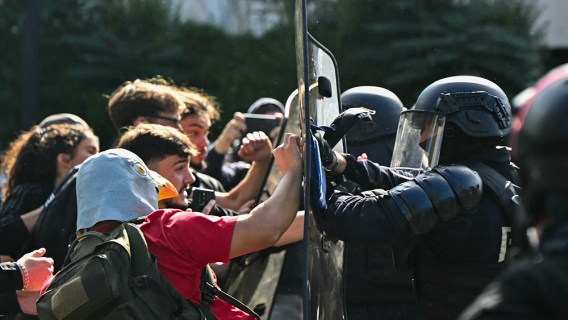
Monday’s alleged attempted beheading in North Belfast was not the first time an act of brutality has taken place in the area. During the Troubles, it was one of the most violent and dangerous parts of Northern Ireland. Robert Curtis, the first British soldier to be killed in the Troubles, was shot by the IRA in New Lodge. North Belfast was also the grim stage for many of the brutal sectarian killings carried out by the Shankill Butchers. In North Belfast, the loyalist ceding of ground to nationalists has been compounded by the impact of immigration It is a deeply deprived part of the city and the population shifts and turmoil of the late 1960s and early 70s turned it into an ethnic and confessional maze.

loyalist

Should Europe shelter Sudan’s refugees?

The Sudanese man who is in custody in Belfast, Northern Ireland, settled in the city after traveling through Paris and Dublin. In 2023, he was given asylum by the British Home Office. That same year, Sudan descended into civil war, a conflict that continues to rage with appalling accounts of barbarity. On the one side are the Sudanese Armed Forces (SAF) and on the other the paramilitary Rapid Support Forces (RSF). Caught in the middle are civilians, particularly women and children, who are being abused by both sides. Earlier this year, the UN’s Human Rights Council accused combatants of displaying "utter disregard for human life.

Denmark and the myth of centrism’s reinvention

The European center’s favorite trick, when losing voters, is to explain that democracy is under grave threat and that power must therefore remain inside the circle of “sensible” centrists who know why voters are wrong. Starmer embodies the British variant of centrism: despite promises of real change, only managerial declinism has emerged Denmark has now provided the latest demonstration. Almost ten weeks after the election, Mette Frederiksen has secured another government. Her Social Democrats suffered their worst result since 1903, falling to 38 seats in a parliament of 179.

greenland denmark centrism

Revealed: the missing Mandelson messages

Darren Jones has become the UK government’s Walter Model, the general known during World War Two as "the Führer’s fireman" for his deployment to shore up any position which appeared lost. In that capacity, Britain’s first Chief Secretary to the Prime Minister had the thankless task of presenting the government’s case to the House of Commons on Monday following the publication of 1,500 pages of documents relating to Peter Mandelson. Jones himself was spared direct embarrassment because none of his exchanges with the disgraced peer came to light in the trawl of memos, emails and WhatsApp exchanges.

mandelson

Henry Nowak and the politics of deflection

While Britain is still reeling from the horrific murder of 18-year-old student Henry Nowak, an astonishing article has appeared in El País, Spain’s largest national newspaper. Rather than focus on the failures of the police officers, or the institutional bias within the force, the headline steers its readers away from the case and towards the outlet’s own obsessions. The headline translates as "Farage’s far right stirs up hatred in the UK after a young man is stabbed to death by a Sikh man." As Alejo Schapire (an Argentine journalist based in France) has pointed out, this is the first and only article produced by El País on the subject of the Nowak killing. Instead of an image of the victim, the newspaper has opted for a photograph of Nigel Farage.

henry nowak

Belgium has a free speech problem

The conviction by a Belgian court of far-right activist Dries Van Langenhove has alarmed both the country’s right and left. Van Langenhove – let there be no doubt – belongs to some of Belgium’s darker far-right movements. He has previously been convicted of racism and Holocaust denial. Yet he has now been fined €4,000, for what the judge described as  "apparently having the intention' to incite hatred and violence, rather than for a crime he was clearly proven to have committed. Bart Eeckhout, chief commentator of Belgium’s left-leaning daily De Morgen – certainly no friend of Van Langenhove – unexpectedly described the conviction for incitement to hatred, violence and racism as an injustice.

belgium
ukraine

Ukraine’s Jehovah’s Witnesses are refusing to go to war

Prison guards led Vitalii Kryschenko to an inhospitable, cramped cell. Inside, the prisoners were curious. They watched with great interest as Kryuschenko found his allotted place. A small, gentle man with a nervous expression, he wasn’t a typical criminal but a Jehovah’s Witness. Kryschenko was jailed by Ukrainian authorities for refusing to go to war; taking up arms is forbidden by his religion. He was now going to share his days with the very worst of Ukrainian society. This would include thieves, those guilty of assault or worse.  "I was living with murderers, people jailed for life," he said. "It was terrifying. On my first night, I asked myself how I would survive in these conditions. All the same, I continued my daily prayers and read the Bible.

europe

Should Europe mediate Russia-Ukraine talks?

The worst job in the world is to try negotiating with President Vladimir Putin to end the war in Ukraine to everyone’s satisfaction. Yet European leaders want to do just that. Frustrated by the failure of the Trump administration to negotiate anything of value with Putin, Europe is scurrying around looking for the ideal candidate to confront the Russian leader across the table and bash out a peace deal. It’s a fantasy world, of course. If Putin obstructed Trump, his old sparring partner, and never remotely got close to a deal with the Americans, why would he consider sitting down with some European leader, or ex-leader, to bring the four-year war to an end?

The secret shame of being ‘Reform-curious’

As a sucker for any melody which relies heavily upon fourth and eighth notes hammered out on a piano, I was always going to fall for Billy Joel’s 1978 hit single "My Life." The lyrics were, as ever with Joel, awful, mixing his cringeworthy ordinary guy New York vernacular shtick with what I dare say he thought were original and profound psychological insights. He is such a hack singer-songwriter. He makes Neil Diamond resemble Wittgenstein. But the tune made me swoon, even its two predictable cod-Beatles middle eights. What to do? Obviously, I couldn’t buy it. There were four record shops in Middlesbrough back then and I was known in all of them.

Berlin Wall

My annual pilgrimage along the route of the Berlin Wall

Each time I return to Berlin – that wonderful, awful city where I whiled away the best days of my misspent youth – I take a walk along the cobbled path that marks the route of the Berlin Wall. Half a lifetime since it came tumbling down, there isn’t much left to see. A few stretches have been preserved as memorials, but it’s mainly an absence not a presence – a ghostly gap between the backs of buildings, a fissure between past and present, between the hard truths of the last century and the uneasy ambiguities of today. Why do I persist with this melancholy Wanderung, year after year? Because a walk along the Mauerweg (as Berliners call that zigzag footpath) is the best way to take the temperature of this Faustian metropolis.

France’s migration crisis will outlast Emmanuel Macron

France has maxed out on migrants. It’s a message that Marine Le Pen’s National Rally party has been pushing for years, but it’s one now endorsed by the government’s Justice Minister. In an interview with a newspaper at the weekend, Gérald Darmanin declared that the Republic has "reached the limits of our capacities for integration and assimilation." Darmanin believes that a three-year suspension of legal immigration is the answer, and in particular he wants a crackdown on the policy of family reunification. Introduced in 1976, the policy allowed migrants – mainly from North Africa – who came to France to work to also bring their family. "We must put an end to immigration as it exists today," said Darmanin.

france

Welcome to Transnistria: the country that’s not a country

I’ve been on holiday to a country that doesn’t officially exist. It has its own border, passport, flag, currency and army but no one recognizes it – not even its main sponsor, Vladimir Putin. Transnistria is sandwiched between its proper motherland Moldova – which is itself really Romania – and Ukraine, which Putin thinks is part of his motherland. Confused? It doesn’t get any easier.  In 1992 there was a short war between the newly created state of Moldova and separatist, ethnic Russians which resulted in nearly 1,000 deaths and the breakaway "country" (via a peace accord) policed by Russian "peacekeepers.

Transnistria

Why did the Queen push for Andrew to become a trade envoy?

The Andrew formerly known as "Prince" was always supposedly his mother’s favorite child. He had a degree of indulgence paid to him that his (far more deserving) siblings never received. Newly released files suggest that this indulgence went far beyond any kind of explicable or appropriate fashion. Correspondence between Sir David Wright, chief executive of British Trade International, and then-foreign secretary Robin Cook from 2000 suggests that the late Queen was "very keen" for the former Duke of York to take on a "prominent role in the promotion of national interests." This, in turn, led to the creation of "Air Miles Andy," with Mountbatten-Windsor acting as a roving trade envoy.

andrew

Trump’s NATO troop reduction isn’t Europe’s biggest problem

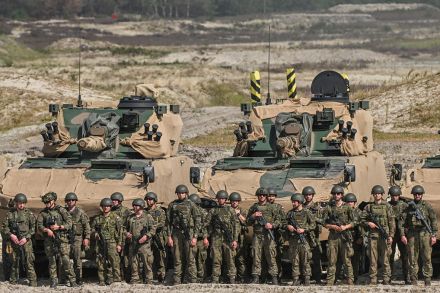
Before Donald Trump returned to the White House last year, there were many commentators who sought to sanitize the President. Take him seriously but not literally, they said. Some hinted that his cruder and wilder hyperbole was not the ignorant, boorish reflex it seemed but a shrewd and daring negotiating tactic in Trump’s beloved "art of the deal." It has been reported that the United States is planning to announce a reduction in the number of troops it will make available to NATO in Europe. America is planning to shrink its commitment to the NATO Force model, under which troops "carry out the alliance’s operations, missions and other activities during peacetime.

nato

Did ‘millions’ attend Tommy Robinson’s Unite the Kingdom rally?

The Metropolitan Police were braced for one of the "busiest days for policing in London in recent years" on Saturday, with both a Unite the Kingdom rally organized by Tommy Robinson and a pro-Palestinian Nakba day rally taking place. Some 4,000 officers were deployed, along with helicopters, drones, Sandcat armored vehicles, dogs, horses and live facial recognition systems. The last Unite the Kingdom rally, in September, drew a crowd of 150,000 according to the police, three times what the Met expected – and organizers said this one would be "the biggest patriotic rally to grace this planet." Addressing the crowd at the event, Robinson said "we are here in our millions" and that attendees were at the "biggest event in British history.

rally