A middle-aged man in a tracksuit approaches the car, gestures for us to stop and then marshals us into a tight space between two black Fiat Pandas. He wipes a trail of sweat from his brow, knocks on the driver’s window and opens his bumbag full of loose change. He is part of the parcheggiatori abusivi: unofficial, unlicensed, self-appointed parking attendants operating across Naples.
He asks for €5, a relatively steep price, even for central Naples. My girlfriend, who is Neapolitan, does the talking. We get him down to €3. We also pay at the official parking meter. “You have to do both,” says my girlfriend.
Walking toward Piazza Municipio, we pass the semi-illuminated outline of Maschio Angioino, a medieval castle rebuilt in 1479 after the Aragonese conquered the kingdom’s capital. Naples is a city that has weathered empire after empire, and its architecture stands as a witness to those changes.
Naples has weathered empire after empire and its architecture bears witness to that
A local friend joins us for dinner. As we sit down, a ten-year-old boy zooms past on a Voi scooter. “He’s a bit young to be riding one of those,” I say. Our friend laughs. “Actually, at that age they are usually driving mopeds. This is probably safer.”
The boy stops in the square and an equally young girl clambers on the back. I watch as they disappear up a side street, laughing.
I first visited Naples when I was 12, ten years before I met my partner. We were staying in nearby Sorrento, where the streets smell of lemons and old men called Nino propose to your mother. But we only went to Naples for the day, and I wouldn’t see the city again until 2023, when I flew with my girlfriend to meet her family and stay in their apartment in the neighborhood of Piscinola.
Piscinola borders Scampia, a former commuter town now famous for the Vele di Scampia, an urban housing project featured prominently in Roberto Saviano’s book Gomorrah. Previously a hotbed for criminal activity, almost all of the buildings have been demolished. Piscinola, Scampia and nearby Secondigliano are not tourist destinations. You won’t see any of these neighborhoods on a postcard.
But they are as much a part of Naples’s vena cava as Chiaia, Quartieri Spagnoli or Centro Storico, the latter with its frenetic Piazza Dante and the boho, distinctly Mediterranean cultural crucible of Piazza Bellini.
Naples is a city of resilience. It always has been. When the writer Norman Lewis arrived on its shores in 1943 – then a sergeant in the British Army Intelligence Corps – he found the place on its knees: mothers and daughters forced to sell their bodies for tins of rations, buildings that once housed Neapolitan nobility reduced to rubble or transformed into pigeon coops, and young men hustling for a palmful of lire.

But he also found a city full of tenacity: fighting to survive, even when everything had been taken from it.
Social mobility is an oxymoron in Naples, at least in the linear sense. Neapolitans do what they must. They are the scugnizzi (the streetwise kids) of Italy. As Lewis wrote in Naples ’44, “Naples… the city that had ignored and finally overcome all its conquerors, dedicated entirely and everlastingly to the sweet things of life.” But as Lewis later figured, those “sweet things” often contain bitter seeds.
Before my recent trip, I make a note of the places that Lewis had visited during his time in Naples. There are two locations I am keen to see. The first is San Sebastiano, a commune destroyed by Vesuvius’s last eruption in 1944.
We drive our car along the Napoli-Salerno motorway before climbing the provincial roads to the rebuilt town. It seems incomprehensible that people could – and still do – live their lives in the face of imminent danger.
I want to see the church of San Sebastiano Martire, which was partially spared during the eruption. It is a Sunday and the church service is in full swing. Standing at the doors, a local man hisses at me to be quiet, though I’ve only shuffled my feet.
Looking inside, I worry I might see the remnants of mass destruction. But instead, I see a clean, polished church, its congregation a collection of wealthy Neapolitans too old to spend time in the city and bother with the noises of urban life.
The second is Pozzuoli, a city on the outer lip of Naples. Pozzuoli is the site of the martyrdom of San Gennaro, patron saint of Naples. Much of what we know about San Gennaro is legend, but rumor has it that he was to be thrown into a pit of wild bears (or lions) in Pozzuoli. Either they refused to eat him or the authorities were scared of public uproar. In the end, they beheaded him at the nearby Solfatara crater.
Three times a year, his blood, which is preserved in the Duomo di Napoli, is turned within its ampoules as the crowd chants and prays. If the blood liquefies, it is a good omen for the city.
Naples may feel calloused at times, but it is a deeply superstitious city – a city that respects its rituals, and the Festa di San Gennaro is undoubtedly its most important ritual.
We try to park in Pozzuoli. It’s busy. Every parking spot is taken. Eventually, a parcheggiatore abusivo sees us and coaxes us into a sliver of a parking space. Before we can pay, a carabiniere (a national military police officer) calls him by name, and he leaves.
We wander to a seafood restaurant.
The third-largest city in Italy faces ignominy from its own country on a daily basis
“You must hate this,” my girlfriend says.
“Hate what?” I ask.
“The lack of rules.”
“But I love it here,” I say. And there are rules. I just don’t understand them, though I’d like to. The night before we fly back, we go for a drink with my girlfriend’s sister. There’s a famous bar in Posillipo where you can look at the Bay of Naples while supercilious waiters serve you negronis.
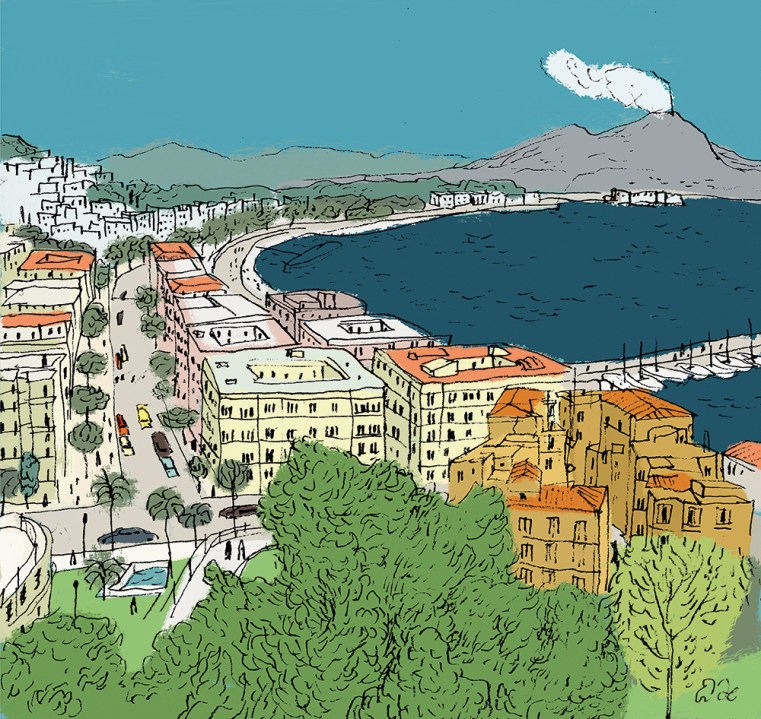
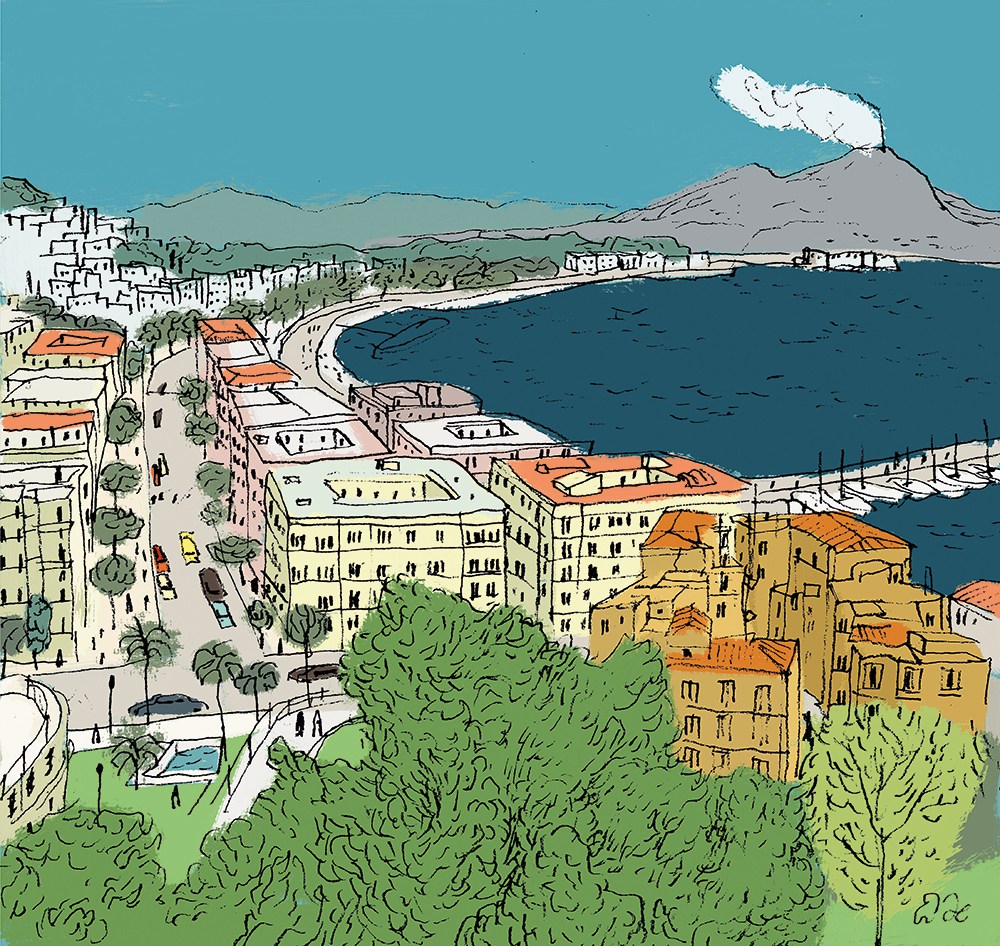
When we leave, we make a right along a winding road. For a second, the view is obscured. Then, suddenly, Vesuvius comes into frame. For a moment, we are all silent. Then I say, dumbly, “Christ, look at that. Have you ever seen something so beautiful?”
Her sister replies, “No. But sometimes I forget it’s there.”
But how could anyone forget about Vesuvius? Indeed, how could anyone forget about Naples?
This is the city that gave us sugo alla Genovese, modern pizza, salsiccia e friarielli and sfogliatella. The home of Sophia Loren, Pino Daniele, Paolo Sorrentino, Roberto Saviano and Totò. “O sole mio.” A platform for the Baroque movement. The Veiled Christ. The biggest Diego Maradona fanbase in the world.
Naples is hardly forgettable, but it is certainly overlooked. On November 15, 1943, Lewis wrote, “The facts are, as every Italian will admit, that the South is virtually a colony of the industrialized North.”
Has anything changed since then? The third-largest city in Italy faces ignominy from its own country on a daily basis. But why? Crime? Economic stagnation? Cleanliness? These issues are persistent throughout Italy and the rest of Europe. Why should Naples bear the brunt?
The Polish poet Juliusz Słowacki wrote, “If Europe is a nymph, then Naples is the nymph’s bright, blue eyes.” Those bright, blue eyes have looked out across the Bay of Naples for nearly 3,000 years. It’s about time we looked back.





Comments