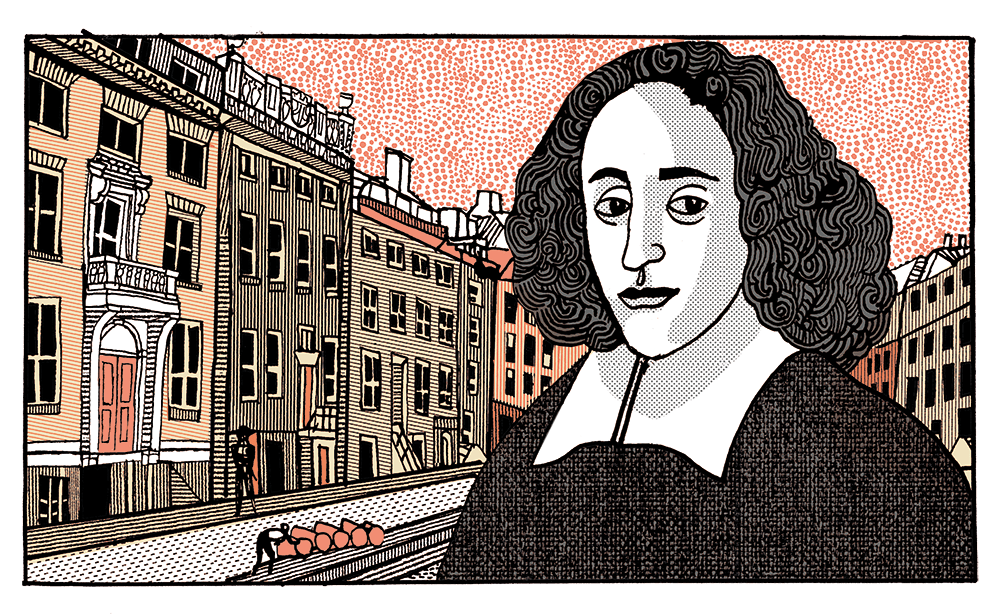
The scrupulously maintained traditions of the Spanish and Portuguese Jewish congregation in London, where I worship, still forbid the rabbi from pronouncing the name ‘Spinoza’ from the pulpit. London, as the sister Jewish community of Amsterdam, inherited the same customs, and in both congregations, Baruch Spinoza continues to be regarded with a lingering sense of abhorrence on account of the herem, or excommunication, pronounced against him in 1656.
In secularist philosophy, that excommunication has acquired an almost mythical status. Along with the trial of Galileo and the excesses of the Inquisition, it is often seen as one of the great episodes in the battle to emancipate western thought from religious obscurantism and intolerance.
Spinoza was arguably the first wholly secular man
But the myth is misleading. As Steven Nadler’s 2018 updated biography of Spinoza makes clear, Amsterdam was, by the standards of 17th-century Europe, a remarkably tolerant city. It permitted an unusual degree of religious freedom and granted the Jewish community considerable autonomy in the conduct of its affairs. But that tolerance came with conditions. Jews enjoying this privileged status were expected to affirm belief in one God, creator and ruler of the universe; to accept the divine inspiration of Moses and the prophets; and to acknowledge reward and punishment in the life to come.
This was not an age in which theological disputes remained merely theological. The Dutch Republic contained Calvinists, Mennonites, Remonstrants, Catholics and Anabaptists, and confessional disagreement constantly threatened political stability. The burden therefore fell upon the lay leaders of the Jewish community to ensure that its internal affairs did not become a source of public scandal or political embarrassment. Open advocacy of atheistic or freethinking doctrines was simply not an option.

As a tool to enforce communal discipline, the use of excommunication was not un-common. Between 1622 and 1683 the Amsterdam community issued some 40 bans against recalcitrant members. Almost all were eventually rescinded after expressions of regret or promises of conformity. Even the celebrated Menasseh ben Israel – the rabbi who successfully petitioned Cromwell for the readmission of Jews to England – found himself under excommunication before apologising and being restored to the community within 24 hours.
Spinoza was offered the same opportunities. He was urged to moderate his views, encouraged to maintain at least outward conformity, and even offered financial inducements to attend synagogue occasionally. But unlike others before him, Spinoza refused every compromise.
Like Coriolanus welcoming exile, he met the threat of expulsion with defiance: ‘I know the gravity of the threat, and in return for the trouble that you have taken, allow me to teach you how to excommunicate.’ Years later he reportedly remarked that even 10,000 guilders would not have persuaded him to return, for he sought ‘truth and not appearance’. Given this refusal, the final ban was severe, ending with the words: ‘May the Lord erase his name from under the heavens… and separate him for evil from all the tribes of Israel.’
The punishment undoubtedly strikes modern sensibilities as harsh and deeply troubling. Yet once the precarious circumstances of the Amsterdam community are properly understood, it becomes easier to see why its leaders believed that they had little choice.
To appreciate fully the significance of the dispute, however, we must turn from Nadler to another great Spinoza scholar: Jonathan Israel. For if Nadler explains why Spinoza was expelled, Israel explains why he mattered. Indeed, Israel’s life’s work has been devoted to demonstrating that Spinoza was the most consequential thinker of the modern age: the intellectual architect of what Israel calls the Radical Enlightenment.
For Spinoza was arguably the first wholly secular man. He believed in God, certainly – but not in the God of Abraham, Isaac and Jacob. His God neither commands nor judges, neither enters history nor calls humanity into covenantal relationship. As Pascal would later put it, Spinoza’s deity was the God of the philosophers rather than the God of the patriarchs.
His famous formulation Deus sive Natura – God or Nature – dissolved the distinction between Creator and creation. The universe became a system of necessity rather than a drama of freedom and responsibility. For the first time in Christian Europe, biblical categories such as revelation, covenant and divine command could be set aside without intellectual embarrassment.
In many respects, Spinoza’s project was noble. He sought to liberate humanity from superstition, fear and persecution. He defended toleration, freedom of inquiry and democratic government. In important ways, the modern liberal tradition begins with him. But whether the wholly secular civilisation that followed has been an unqualified success is another question.
By transferring ultimate authority from revelation to reason alone, Spinoza set European thought on a path that would eventually encounter its own limits. The Romantics soon complained that reason could explain much but inspire little. If reason could no longer command allegiance, perhaps feeling, authenticity and will could do so instead.
The consequences were profound. In the English-speaking world, where biblical language and religious assumptions continued to shape public life well into the modern period, constitutional government and liberty under law achieved a remarkable degree of stability. On the European continent, by contrast, the decline of religious authority often left a vacuum that politics itself attempted to fill. The result was not always liberal democracy. The 20th century witnessed the emergence of secular creeds every bit as dogmatic as the religions they sought to replace.
Perhaps, then, the Sephardi communities of London and Amsterdam – those last stubborn redoubts of anti-Spinozian sentiment – are not quite as anachronistic as they appear.
Alan Bekhor’s The Hebraic Thread is out in February 2027.





Comments