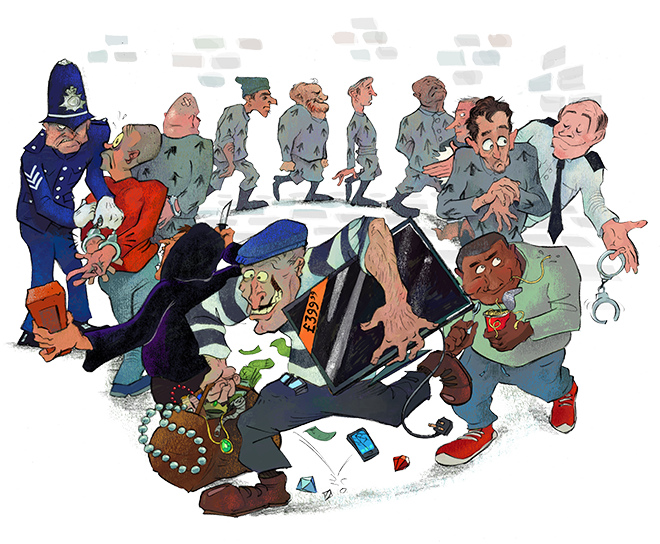


Four days after he was released from HMP Wandsworth, Michael Bogle was back inside. The 38-year-old had served 11 of 32 weeks in prison for stealing before he was freed last month via the government’s early release scheme. He strolled out of jail, told reporters he would ‘hopefully not’ shoplift again, then stole from a Sainsbury’s a few hours later.
The early release scheme was meant to increase prison capacity. But it isn’t working. Since it began two years ago, 80,000 people have been freed, yet there are just 1,000 extra prison spaces. Last week, the Ministry of Justice revealed that more offenders were recalled to jail in the first half of this year (25,531) than were let out (25,255). More violent and sexual crimes were committed by ex-offenders last year than any previous year on record.
The early release scheme has moved dangerous people into our towns and cities, piling the burden on to perhaps the one part of the British state more defective than our prisons: the probation service.
A probation system should stop criminals reoffending. Ours does not. Take Aiden Pinder, 33, who was last week convicted of his 61st offence. In the early hours of 30 August, Pinder went on a rampage in Scunthorpe town centre. He assaulted people while wielding a flick knife, kicked, headbutted and tried to bite police officers, and threatened to firebomb the homes of whoever intervened. He was also in possession of marijuana and cocaine.
A high-risk criminal like Pinder should be rehabilitated in jail, then watched by the state for a period while living back in the community. Historically, this monitoring has been done in halfway houses – these days called approved premises (AP) – where offenders are supposed to be supervised by staff, given curfews and drug tested. (Half of the prison population in England and Wales has an identified drug problem.)

Much like our prisons, however, APs are in decay. Since the early release scheme began, 11 of around 100 APs have closed. Weston, an AP in Weymouth supposed to house 27 high-risk offenders, shut last month due to staff shortages. Deer Park in Sheffield – built to house 34 dangerous men – has also closed. Its answerphone still tells callers that it is shut for refurbishments… until April 2026. There is an ongoing inquest into the death of a resident last year.
Absurdly, the chief inspector of probation, Martin Jones, whose job it is to monitor APs, tells me he has no ‘line of visibility’ over which facilities are open or closed. Until last year, there was no routine government inspection of APs, so Jones is undertaking a review of the entire estate. It’ll take him two years to look at them all.
Of the APs which Jones has so far inspected, he has found many to be dysfunctional. Cupboards storing medication are left unlocked; offenders with drug and alcohol problems are not being tested; rehabilitation programmes are bad. Even the good APs can be short-staffed and local communities are understandably nervous about being near our broken justice system.
But Pinder wasn’t living in an AP when he mounted his Scunthorpe attacks. He was homeless, like a growing number of ex-offenders. APs were struggling for space before the early release scheme, but it has made them even fuller. One parole source says spots in APs are now ‘incredibly rare’.
During his inspection of Ascot House in Stockport, Jones found ‘routine overbooking’ as a result of ‘legislative changes to ease the pressure on prisons’.
Last year, 40 offenders each day left prison and became immediately homeless, a rise of more than a quarter on pre-Covid levels. Homeless prison leavers are twice as likely to reoffend as those who are permanently housed.
When prisoners are released from jail early, they often don’t have time to arrange suitable accommodation. Benjamin Stewart, 46, who was imprisoned in HMP Birmingham for 17 months for possession of a knife and freed via the early release scheme last month, says he was given only a few hours’ notice before he was let out.
We will see increasingly dangerous criminals becoming homeless because of the early release scheme. Next week, 650 offenders serving up to three years and two months will be let out of prisons in England and Wales. There will be rolling commutations, and by June 2027 the offenders being freed will have been sentenced to prison for more than 12 years. Typically, more dangerous criminals might be sent to an AP before being freed. But if there is no AP space, they will still have to be released.
Some inside the system are already fearful of the danger the current early releases pose to the public. One probation source says that when the scheme began, the list of eligible criminals included some from their caseload who had just been refused release from jail because they posed too much of a risk to other people.
In north Staffordshire, 36 per cent of all offenders released from prison last year became homeless immediately. It’s more than one a day. Will Morris, who runs House of Bread, a charity for homeless people in Stafford, says: ‘People will turn up at our door in their prison fatigues.’ He feeds them, helps them find shelter and tries to encourage them out of crime and addiction.
From Morris’s perspective, our defective system is making it harder for criminals to reform. He tells me about ‘GH’, a man who has been a repeat offender most of his life. In prison, GH is fed and sober. Outside, with his mother dead, no family wanting to look after him, and no space at an AP, he lives on the streets with other homeless people. Inevitably he goes back to drugs. Morris says he fears GH will die soon. It would be the 25th funeral of a homeless person Morris has attended.
He strolled out of jail, told reporters he would ‘hopefully not’ shoplift again, then stole from a Sainsbury’s
Some homeless offenders in Stafford are being housed in a Travelodge, Morris says, alongside paying guests. An employee at the hotel tells me the probation service, local council and police have all booked freed offenders into rooms. For data protection reasons, they don’t inform staff which crimes the person committed. ‘We’ve had the police drop people off at the bottom of the car park, watch them walk in, then drive off,’ the employee says.
Offenders can be volatile: one caused thousands of pounds of damage to their room. Most stay a week or two while alternative accommodation is sourced.
Morris has designed ‘kettle bags’ for the Travelodge. The hotel’s staff – who at this point are basically part-time social workers – give them out to their criminal guests. It is better than them stealing food. The bags have instant noodles and Cup-a-Soups: products which require only boiling water.
Other charities are also trying to fill in the gaps left by our broken probation system. When the early release scheme began in September 2024, the Inside Out Trust, a Berkshire charity, put together a ‘release pack’ containing a tent, sleeping bag, mat and backpack for newly freed offenders. The local probation service took many of them. At the beginning of last year, however, the probation service reportedly said that it would no longer provide the packs directly to released criminals.
‘Probation can’t be seen to be creating tented cities,’ Stefan Fafinski, the chairman of the Inside Out Trust, tells me. ‘Prior to early release starting I can’t remember us being asked for a tent. Then all of a sudden we have more prisoners leaving and they had nowhere to live.’
The government said it would mitigate the impact of the early release scheme by fitting ankle tags on freed offenders. Justice Secretary Alex Norris promised it would be the ‘toughest supervision in British history’. The reality, however, is that only 55 per cent of tags are being put on offenders when they are supposed to be, and homeless offenders struggle to charge their tags.
But even this reduced tagging is too much additional work for the police to handle. A fortnight ago, the Metropolitan Police announced that it would no longer act on breaches of curfew of under an hour, to cut officers’ workloads. Commissioner Mark Rowley said that 95 per cent of offenders who breach their tag conditions are being let out anyway – there is no space in jail – ‘so there is zero sanction’.
Perhaps the pain of the early releases would be worth it if the government was building more prison spaces. This is the surest way out of the mess, but the estate’s capacity has risen by only 37 spaces since July 2024. Unrehabilitated prisoners are being juggled out of and back into our jails. Early release is not fixing the problem. It is just criminal neglect.





Comments