Arts Reviews

The good, bad and ugly in arts and exhbitions

To finish or not to finish?

Here’s your starter for ten. What’s the most famous unfinished piece of classical music in the world? Schubert’s ‘Unfinished’ Symphony, his Symphony No. 8, of course, which is usually played as a two-movement torso, bereft of the Scherzo and finale which a symphony of its provenance would normally include. Usually, but not always. The latest man to attempt to fill in the missing parts is the Russian composer Anton Safronov, whose version the Orchestra of the Age of Enlightenment is due to play for the first time on 6 November at the Royal Festival Hall in London under the baton of Vladimir Jurowski, with performances both in the main evening
Cut-throat world

This is either a seriously good film with some flaws or a seriously flawed film with some good elements. I am hoping to work out which it is by the finish of this, otherwise I will have denied you a proper ending, and we all know how irritating that is. Eastern Promises opens with a throat-cutting slaughter in a barber’s shop — and why wouldn’t it? This being a David Cronenberg film — and then almost instantly cuts to the bloodied birth of a baby. Life and death, death and life, and all of it pretty brutal and all that. Nothing new here. Nothing to write home about. But, thankfully,

Horse play

Here’s something new to ban. Writers who use the Great War as an emotional backdrop to their stories. It’s embarrassing to see so many authors marching up the alley marked ‘failure of invention’. And it dishonours the dead to use their blood as wallpaper. Sadly the subject is just too tempting. It’s our equivalent of the Oedipus myth. Jocasta is the war. Oedipus is the eager recruit. Their union leads to mutilation, chaos, death and a wave of blood-guilt spreading down the generations. Michael Morpurgo’s novel War Horse focuses on the millions of animals who died in the trenches and the NT has put the book on the stage to

A dark and stormy night

‘Where were you when they crucified the Lord?’; when news of Waterloo was brought, or the Mutiny, or the Charge of the Light Brigade, or the death of Victoria? Thence into living memory and universal communications — when Edward VIII announced his abdication; when Neville Chamberlain returned from Munich with ‘peace in our time’; when VE, then VJ, were proclaimed; when the Suez débâcle shocked the nation; when JFK’s assassination shook the world. All these except the last are before my memory begins to go beyond feeding the ducks and collecting civic clocks (anything from the high street jewellers to Big Ben himself). With the Kennedy tragedy I remember looking

Dream team

Opera: Das Rheingold; Die Walküre Halfway through the second cycle of the Ring at the Royal Opera, I’m feeling far more positive than I could have expected. When I saw the separate parts of the work I found Keith Warner’s direction cluttered and confusing, Stefanos Lazaridis’s sets ugly and evidently unsafe, Antonio Pappano’s conducting wayward and sacrificing the grand design to fussing with details, and much, even most of the singing barely adequate, sometimes calamitous. Admittedly it was the latter half of the cycle where the singing was weakest; but I have found that in both the first two dramas there is now such a strong sense of teamwork among

Filth detector

I wish Mary Whitehouse were still among us. In my teenage years, she was an invaluable guide to where the filth could be found on television — though to be frank most of what she disliked was disappointing: hardly titillating, and far from filthy. I suspect that if she were invited back to earth to see a special showing of Belle de Jour, Californication, and now Fanny Hill, she would realise with horror that her life had been in vain, and she would do whatever people who are already dead do instead of committing suicide. Andrew Davies is the adaptor who is famous for putting in the sex that the

Sense and sensibility

Sex is never any good on radio. Think of all those excruciating scenes in The Archers — Sid and Jolene in the shower, or, for those addicts with a good memory, Shula on a picnic rug with that seamy journalist from the Borchester Echo. On radio, without the carefully crafted images of a film-maker and instead just the sound effects — splashy kisses and primeval squeals — it’s ludicrous. Worse still, when listening to sexual antics rather than watching them on screen you’re left with space in your head to wonder at the absurdity of a couple of actors standing at a microphone pretending to make all that noise. Paul

Listen up

Tomorrow morning you’ll want to tune into The Week at Westminster on Radio 4, Matt will be presenting and he’s got some great guest lined up including Dennis Skinner, Gisela Stuart—whose comments on the European constitution have so discomforted Gordon Brown—and Malcolm Rikfkind who set the cat amongst the pigeons with his attack on Tory Europhobes in this week’s issue of The Spectator. The show airs at 11 and you can listen to it anytime after that on the programme’s website.

No question about it, it was a great performance

Around Westminster today plenty of normally hard-bitten folk have been saying to me how good Fraser was on Question Time. He’s far too modest to say it, so let me add my own congratulations, and here’s Tim at Conservative Home (who is a very nice guy but doesn’t dole out praise indiscriminately) doing the same. What do Coffee Housers reckon? A star is born, I’d say. (I just hope Fraser invites me on when he gets his own show).

And her hair hung over her shoulder tied up in an Orange velvet band…

A splendid Daily Telegraph obituary of Sammy Duddy, a, er, colourful figure in Loyalist paramilitary circles: Sammy Duddy, who died on October 17 aged 62, had a rather unusual curriculum vitae for a member of the Loyalist paramilitary Ulster Defence Association in having been a drag artiste who went by the stage name of Samantha. During the 1970s the self-styled “Dolly Parton of Belfast” became well known on Belfast’s cabaret circuit, presenting a risqué act in Loyalist pubs and clubs, dressed in fishnet tights, wig and heavy make-up. Once he even performed for British troops on tour.”I wore a miniskirt many a time,” Duddy remembered, “but it was usually a

Hollywood goes to war

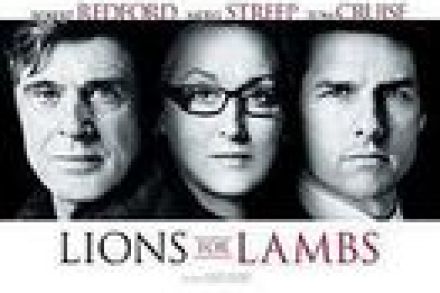
Just out of the Lions for Lambs premiere in Leicester Square. It is the latest of Hollywood’s celluloid attacks on the White House, and a call to arms. The plot: Tom Cruise is a senator with presidential ambitions giving a reporter (Meryl Streep) an exclusive on his latest strategy in Afghanistan – ongoing as they talk. It backfires and two soldiers end up stranded on an Afghan mountain top, hoping they’re rescued before the Taleban arrive. Robert Redford (who plays a university professor, trying to talk those two soldiers out of signing up) directs. His message is that it is time for good people (Democrats) to intervene, and stop the

Packing a punch

It’s a good month for the Great War. At the National Theatre this week a new play by Michael Morpurgo tells the story of the war seen through the eyes of a horse. Staged with huge puppet nags, War Horse sounds on paper like the theatrical lovechild of Equus and Birdsong. Up in Bolton, with a good deal less hype, they are doing another war horse — Oh! What a Lovely War. It was first staged in 1963 by the radical Theatre Workshop, in the East End. The Great War satire was aimed at the political edification of the working class, but sadly for the Revolution it quickly attracted posh

Restless mind

For once a major blockbuster exhibition at the Tate justifies its size: the imaginative world of Louise Bourgeois is so potent and all-encompassing that a show of more than 200 works, from small experimental objects to large installations, seems not a fraction too extensive. Bourgeois, born in Paris in 1911, is famous — in this age of confession and determinedly autobiographical art — for her troubled childhood. Whereas most artists of this type foist their traumas on us raw, Bourgeois cooks hers to a turn. What is more, she has the imagination and creative vision to translate and transform her source material, transcending its personal impetus and making it universal.

Subversive narrative

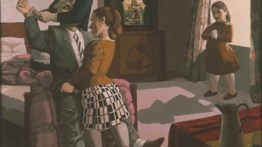
Paula Rego had a retrospective at Tate Liverpool a decade ago and a big show in her native Portugal, where she is properly regarded as the country’s greatest living artist, but both exhibitions seem niggardly in comparison with the more than 200 works shown in some 14 rooms at the Reina Sofia in Madrid. Even to someone who has made a close study of her work, this is a revelatory, even overpowering, display of both her versatility and her passion. The exhibition has been curated by Marco Livingstone who, in his elaborate catalogue, includes as well as his own lucid introduction, refreshingly free of artspeak, a fascinating interview with the

Familiar fantasy

OK, here we have a fantasy film and I absolutely hate fantasy films. They bore me to hell and back, plus what if one day I don’t actually make it back? What if I end up stuck for all eternity in some place where, for example, everyone insists on speaking Elvish and having three-day message-board conversations about the story arc of Blake’s 7 or the nuances of Quidditch before going back to work on the helpdesk at the library? I accept this is probably my limitation; that my imagination is a dried, shrivelled-up husk of a thing, which does makes it simpatico with my face but does not make it

Blurred boundaries

Dance: Giselle — on love and other difficulties; Shaker As the blurb at the back of the programme says, it is well known that ‘Dance Umbrella celebrates and champions contemporary dance’. Yet the notion of ‘contemporary’ dance, once an artistically neat classification, has long lost its transparency. The vibrant and provocative combination of diverse performing idioms, techniques and genres that characterises today’s dance has indeed contributed greatly to blurring the boundaries of an historically defined artistic genre. It is not surprising, therefore, that ballet, namely the arch-opposite of contemporary dance, took centre stage last week in one of the world’s most significant platforms of new dance-making. And the person responsible

Competitive edge

Amid all the fuss about cuts at the BBC and how this will affect programme output, I can’t help thinking, why the outrage? For years, there have been dark rumblings among writers that there’s no longer a drama department to nurture young talent and commission new work — the Birtian revolution of the 1990s saw to that, and it did initially cause a sharp decline in standards, especially in the number and range of original drama productions. Over at Radio Three, the Controller Roger Wright has been attacked for not encouraging live performances of new music, but you could say he has brought other virtues to the network. Sometimes a

Pointless bickering

The thing I want to talk about this week is random and unnecessary tension-generation because it ruins almost every TV programme I watch and, once I’ve explained it, I like to think it will ruin all your TV viewing too. I’ll give you a classic example from Heroes (BBC2, Wednesday), a series to which I’m afraid I’ve become mildly addicted. I’m thinking of the episode where sinister Mr Bennet tries to stop his adopted daughter Claire from going to her prom-queen homecoming because he knows it’s her destiny to be attacked there by the evil serial killer Sylar. Does he a) say, ‘Look, Claire. I know about your superpowers. And