Arts Reviews

The good, bad and ugly in arts and exhbitions

A parade of monstrous and toxic generals: Beatriz Gonzalez reviewed

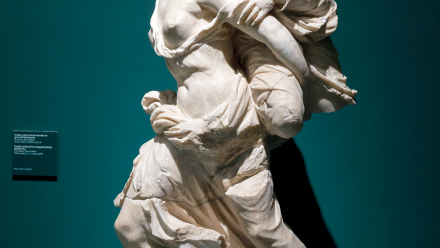
You might be forgiven for thinking that a charity sale of particularly kitschy furniture has been set up just past the entrance of the Barbican Art Gallery. There’s a chunky brown dressing table, an ornate table several decades out of fashion and a trio of bedside tables. They are piled haphazardly and on each is a garishly painted picture, invariably a pastiche of a historical painting or a Biblical scene. Raphael’s 1512 ‘Madonna and Child with St John’ rendered slightly sloppily where the mirror of the bureau once was; ‘The Last Supper’ on the table top; three popes in profile staring impassively from the tops of the nightstands. They are

‘I didn’t expect to love Wagner’

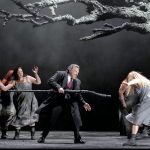
By the end of Siegfried, the third opera in Wagner’s Der Ring des Nibelungen, the king of the gods is in freefall. In the first opera, Das Rheingold, Wotan is a confident protagonist; a world-builder. In Die Walküre, we’ve seen him discover the limits of power, and felt his heart break. Now, in Siegfried, he’s a haunted figure; the solitary Wanderer, searching the world for answers that his all-powerful wisdom can no longer supply. He confronts the young hero Siegfried, and his law-giving spear shatters on the sword of a reckless, clueless boy. ‘All he can say is, “Go, then. I can’t hold you any more,’’’ says Christopher Maltman, who

Will the Houses of Parliament burn down?

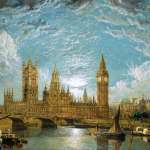
What does £450 million get you these days? With that cash, you could buy a Premier League football club. Or fund 10,000 nurses for a year. If you’re feeling civic-minded, why not give everyone in the UK a fiver and have a chunk of change left over? In the case of the Parliamentary Restoration and Renewal (R&R) programme – the plans to rebuild and repair the Palace of Westminster – the best part of £500 million has been spent on, well, it’s quite hard to tell. MPs and peers have batted ideas back and forth about how to fix their grade I-listed, Unesco World Heritage workplace for more than two

Marvellous but repetitious: Gwen John – Strange Beauties reviewed

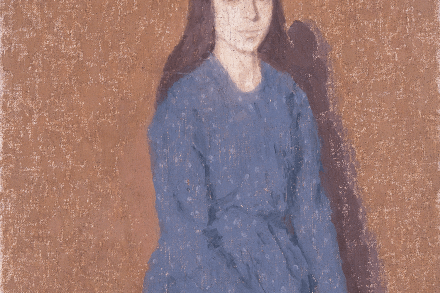
A pilgrimage to Cardiff Central, sorry, Caerdydd Canolog (according to the signage in the station, which also had my return train’s destination ‘Lundain Padd’ton’) to see the new Gwen John show. She is being lauded as Wales’s greatest artist, but she left Tenby at 18 in 1895, and never went back. After studying at the Slade she moved to Paris, fell in love with Rodin, and adopted the Catholic faith. She ended her days in Meudon in 1939, leaving a cache of work that her nephew Edwin John thankfully rescued before the Nazi invasion, and that the National Museum of Wales (now National Museum Cardiff) had the foresight to acquire

The blandness of Hugh Bonneville

Shadowlands, by William Nicholson, is a solid and unsurprising account of the brief marriage between C.S. Lewis (known as Clive), and the American poet Joy Davidman. Her cancer diagnosis overshadowed their romance but they snatched a few lustful holidays together before she expired in an NHS hospital in 1960. Hugh Bonneville, as Clive, delivers his standard three-note performance – bemused decency, bumbling hesitation, ironic charm – which tells us nothing about the author’s inner life. Bonneville has succeeded in building a huge presence in the movie industry from an almost complete dearth of actorly qualities. He’s not handsome, sexy, tough, athletic, amusing, mysterious, evil or even slightly unpleasant. He’s not

Fascinating: EPiC – Elvis Presley in Concert reviewed

EPiC: Elvis Presley In Concert is a concert documentary that grew out of the 65 boxes of unseen Las Vegas performances discovered by Baz Luhrmann while researching his 2022 biopic Elvis. As I have little interest in ‘the King’ I approached with a heavy heart. But now? I’m abundantly interested. In fact, I’ve shifted from indifference to thinking that if I could see one musical artist live at their peak it would have to be him. He’s that electrifying. A warning, however: it’s a 12A. ‘Elvis picks up a bra thrown on to the stage during a concert performance and puts it on his head,’ notes the BBFC. I wish

Enjoyably old-fashioned: ITV’s The Lady reviewed

I lasted all of five minutes with Netflix’s tasting menu-length Being Gordon Ramsay. This surprised me, because I’ve long had a bit of a soft spot for the irascible, crevice-faced, sweary old ham. I know that all reality TV is fake but I’ve always quite enjoyed watching carrot-top pretending to lose his rag yet again in some rat-infested culinary cesspit before transforming it, in the space of a month, into a Michelin three-star. Ramsay no longer even pretends that his programmes are anything more than extended plugs for his brand But the dishonesty and contrivance and brazen commercialism of this autohagiography are just too much to stomach. Supposedly, a small

A playful, big-hearted, intelligent new opera

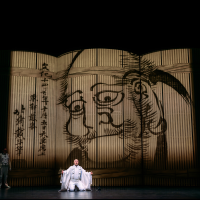
Some people like art to have a message. So here’s one, delivered by Katsushika Hokusai near the end of Dai Fujikura and Harry Ross’s new opera The Great Wave. ‘Remember art won’t change the world,’ sings the great painter (as incarnated by the baritone Daisuke Ohyama), and for that line alone I’d gladly have given the show five stars, if the Spectator did anything as barbaric as award stars. Words to live by, at least if you’re an artist; and the very private bliss of a life devoted to creativity is the heart, mind and dramatic engine of The Great Wave. Is that enough to sustain a full-length opera? Opinions

The genius of John Vanbrugh

Van’s genius, without Thought or Lecture,Is hugely turn’d to Architecture. Jonathan Swift’s dismissive jest has never been forgotten. It may not be as vituperative as ‘A Beautiful Young Nymph Going to Bed’ but it is there ready for duty whenever the skirmish between the principals’ proxies is resumed in all its petty self-importance. It’s England, so social class looms. While Vanbrugh strode with ease among kings and bitchy duchesses, heavily made-up Foppingtons and grand cru horizontales, the resentful Hawksmoor – his collaborator – lurked in the shadows meekly giving great forelock and not receiving the commissions he deserved. Some suggest Vanbrugh stole the credit from Hawksmoor, a batman of genius

Dazzling: I’m Sorry, Prime Minister at the Apollo Theatre reviewed

Jim Hacker is back in the West End. I’m Sorry, Prime Minister, written by Jonathan Lynn (who co-wrote the original TV series), brings us the former PM in semi-retirement as the Master of Hacker College, Oxford. Jim, now Lord Hacker, is facing a revolt by the students and the senior fellows who claim to have been offended by his high-table banter. He was overheard making positive comments about the British Raj and suggesting that the word ‘negro’ should not be expurgated from the work of James Baldwin. Both opinions are blasphemous according to the killjoy theocrats who govern our political discourse. Jim is ordered to quit his post but he

The problem with books podcasts

The Rest Is History has a new spin-off podcast called The Book Club. If you listen to the former, you’ll know Dominic Sandbrook but perhaps not his producer Tabby Syrett, who has joined him as co-host for the new venture. Tom Holland had presumably nipped off early to feed the cats. The release follows, slightly unfortunately, on the heels of a Sunday Times article in which the current crisis in sales of non-fiction is attributed in part to the boom in factual podcasts. If people are no longer buying history books because they’re ‘getting their history’ from Spotify for free, then ought we to be wary of a podcast about

Entirely absorbing – and wonderfully tense: Cairn reviewed

Grade: A– A cairn, as readers will know, is a pile of stones often placed to mark a grave. Yikes. Not the most encouraging title to give to a videogame about someone trying to climb a mountain. Aava is a dedicated rock-climber determined to make the first solo ascent of Mount Kami, despite the countless lives it has already claimed. Equipped with chalk, rope, pitons, climbing tape and a limited supply of snacks and bottled water, not to mention a friendly robot that follows you around picking up your pitons and screening your calls, off you set. The heart of the game – though the story contains surprising emotional and

A highlight in an otherwise dull season: Pierrot Lunaire reviewed

Even if Schoenberg’s song cycle Pierrot Lunaire is never going to feature on anyone’s Desert Island Discs, it stands as a work of rich and complex resonance shot through with all the neurotically introverted obsessions behind expressionism. Through Albert Giraud’s 21 opaque lyrics, scored atonally for a soprano who declaims rather than sings them, accompanied by seven instruments, it presents some sort of parable of the tormented artist adrift in a hostile world. Perhaps one can’t be charmed by the result, yet its power is undeniable: it grips even when it baffles and repels. Perhaps one can’t be charmed, yet its power is undeniable: it grips even when it baffles

John Mulaney at his best is unstoppable

John Mulaney appeared to be just another of those identical, slick, clean-cut, young comedians in suits until Covid. But all was not well. In December 2020, a bunch of his showbiz pals staged an intervention and sent him to rehab for his addictions to cocaine and various prescription drugs. Out of rehab, he promptly parted from his wife, the artist Annamarie Tendler, and met the actress Olivia Munn. As he noted in Mister Whatever, his latest show, when their son was born, he and Munn had known each other for ‘nine months and 45 minutes’. They are now married. There was a woman in the front row wearing pyjamas emblazoned

Doesn’t put a foot wrong: The Secret Agent reviewed

Kleber Mendonca Filho’s The Secret Agent, which is about an academic on the run during Brazil’s brutal military dictatorship, won two Golden Globes, and has been nominated for four Oscars, and it’s truly special even if it is languorous and sprawling. It is one of those long films (two hours and 40 minutes) populated by so many characters you may well find yourself praying: ‘Please let me keep track of who’s who.’ Do hang on in there. It will all come right and be so worth it. The house is run by Dona Sebastiana, who may now be my favourite film character ever The film is set in 1977 which,

What a masterpiece. What a man: Borodin at the Barbican reviewed

Gianandrea Noseda conducted the London Symphony Orchestra last week in a programme of Stravinsky, Chopin and Borodin. The Stravinsky was a relative rarity – the divertimento from The Fairy’s Kiss – and Chopin’s F minor concerto was played by Seong-Jin Cho, a pianist with a large following and a soaring reputation. Full disclosure: I was there for the Borodin, his Second Symphony of 1877. What a masterpiece, and what a man! Alexander Borodin was a scientist of international standing and a campaigner for women’s rights. Deeply in love with his wife, and an inveterate rescuer of stray cats, he was, he confessed to Liszt, ‘only a Sunday composer’. ‘But after

The art of conspiracy

If you lived anywhere near Kilburn half a decade ago, you might have noticed the messages one of our neighbours kept spray-painting over our walls and bridges. They’d appear overnight across a fairly wide swathe of north-west London, always in an immediately recognisable loopy handwriting, and the content was always recognisably loopy too. This person was trying to communicate something, but it was hard to tell exactly what. The messages said things like ‘STAND UP TO BLACK MASSES’ and ‘MERCY FROM DR HACK’ and ‘TAKE MERCY UNTO ME TAKE IT OUT OF IT’. Every few days for about a year, I would come across another one of these messages, and

The BBC’s Lord of the Flies is mesmerically brilliant

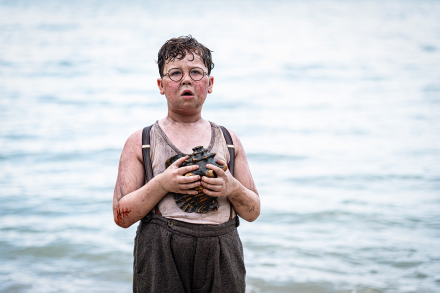
I don’t much like Lord of the Flies. It’s nasty, weird in an oblique, psychotic way and wrong. William Golding – a war-damaged, depressive alcoholic – wrote it as an antidote to the uplifting escapism of The Coral Island, a Victorian yarn by R.M. Ballantyne about plucky young British castaways surviving and thriving in the tropics. Golding turned it on its head and revealed, supposedly, the heart of darkness that lurks within us all. Au contraire, Golding’s misanthropic message was bollocks Says who? The lesson of the Christmas truce in the trenches is that ordinary men have to be coerced into killing one another. The lesson of Jena is that