Arts Reviews

The good, bad and ugly in arts and exhbitions

The joy of composers’ graves

I called on Hugo Wolf the other week, and he didn’t look too great. He wouldn’t, of course; he died in a mental asylum in 1903 after suicide attempts, professional disappointment and the slow poison of tertiary syphilis. His face gazes glumly out from his monument in Vienna: above him, a single laurel branch, beneath him an eternal flame. But at least he’s not alone. A muscular youth, semi-ripped, looks away at one side. And on the other, a naked couple clinch in a passionate embrace. Talk about rubbing it in. It’s not that I make a habit of hanging around composers’ graves, you understand. But somewhere along the way

The cardinals spill the beans on the conclave 

Secrets of the Conclave seemed rather optimistically titled, given that everybody at this year’s papal election had made a solemn vow before God not to divulge any. But, while we duly heard nothing about backstage politicking – apart from regular assurances that none took place – this respectful and quietly charming documentary did succeed in humanising the strange process of picking a new pope, and even in supplying a few gentle revelations. It transpires, for example, that Catholic cardinals suffer from the same anxiety about phonelessness as the rest of us, with the requirement to hand in their mobiles before entering the Sistine Chapel initially causing feelings of slight panic.

Intoxicating Elgar from the London Phil

By all accounts, the world première of Elgar’s Sea Pictures at the October 1899 Norwich Festival made quite a splash. Elgar conducted, and the soloist was the 27-year-old contralto Clara Butt – dressed in a silky, sinuous number which drew gasps in those corseted late-Victorian days. Elgar thought she looked ‘like a mermaid’; the critics, of course (of course!) confined themselves to the music. They reported that Elgar and Butt were called back four times, and the second of the five songs – the delicate ‘In Haven’, to words by Elgar’s wife Caroline Alice – was singled out for particular praise Interesting how tastes change. When Edward Gardner and the

Rescuing the Nativity from cliché

The Nativity. In ‘Over 2,000 Illustrations and a Complete Concordance’, Elizabeth Bishop ends her travelogue-poem – St Peter’s, Mexico, Dingle, Marrakesh – by opening the Bible. ‘(The gilt rubs off the edges/ of the pages and pollinates the fingertips.)’ She gives us the famous stable, ‘lulled within, a family with pets’. Domesticated, nothing out of the ordinary, yet prefaced by strangeness: ‘the dark ajar, the rocks breaking with light,/ an undisturbed, unbreathing flame.’ Undisturbed because it is an illustration and therefore fixed. Undisturbed also because it is the Holy Spirit – steady, unchanging – not spirited, but spiritual. Bruce Chatwin’s On the Black Hill has a school nativity: ‘“I am

Ivo van Hove tries and fails to destroy Arthur Miller

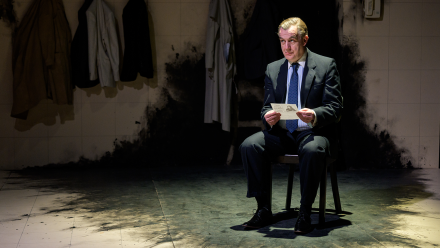
All My Sons, set in an American suburb in the summer of 1947, examines the downfall of Joe Keller, a wealthy and patriotic arms manufacturer. During the war he was falsely accused of selling wonky parts to the US military which caused the deaths of 21 airmen. He blamed his partner for the blunder but when the truth emerges he also finds out why his eldest son, Larry, went missing in action. The plot is one of the greatest inventions in world drama and it deserves to be presented with candour, simplicity and naturalism. Director Ivo van Hove dislikes Miller’s decision to set the play on Joe’s front lawn where

The Beast in Me is surprisingly addictive

The Beast in Me is one of those ‘taut psychological thrillers’ that everyone talks about in the office. This might sound disparaging – as it is, obviously – but I have to admit that, having succumbed in desperation (because, as usual, there is so little else on), I did find the show pretty addictive and unusually satisfying. What makes it stand out is that it doesn’t go for the obvious. Yes, its heroine – played by Claire Danes – is feisty, talented and capable. But she’s also whiny, uptight and really quite unsympathetic, as perhaps screenwriter Gabe Rotter intended when he gave her the weirdly repellant name Aggie Wiggs. Aggie,

Bruckner on Ozempic – and the première of the year

Bruckner at the Wigmore Hall. Yes, you heard right: a Bruckner symphony – his second: usually performed by 80-odd musicians – on a stage scarcely larger than my bedroom. How? Welcome to Anthony Payne’s very smart 2013 chamber arrangement. Bruckner on Ozempic. Composition is an Alice in Wonderland activity. A key duty is mastering how to make things bigger and smaller, how to stretch and compress and bend – time and space and sound. Bruckner understood this well. If you know anything about his symphonies, it’s that they’re vast – and that critics are mandated to compare them to cathedrals or mountain ranges. What survives after such an extreme trim?

Noah Baumbach needs to try harder: Jay Kelly reviewed

Noah Baumbach’s Jay Kelly stars George Clooney as a handsome movie star playing a handsome movie star who has an identity crisis and is forced to reflect on his life. It’s being sold as a Hollywood satire, but it’s far too affectionate to be biting, and contains moments where it drowns in schmaltz. For a director of Baumbach’s calibre (Marriage Story, The Squid and the Whale, Frances Ha), it all feels like very low-hanging fruit. That said, it’s not such an ordeal to spend a couple of hours in the company of Clooney as the golden Tuscan sunshine beats down (it’s mostly filmed in Italy). I found I could cope.

A Spectator poll: What is the greatest artwork of the century so far?

Slavoj Zizek        Hegel thought that, in the movement of history, the world spirit passes from one country to another, from the East to the West. Something similar happened at the beginning of the 21st century: the world spirit passed from cinema, the art of the 20th century, to the TV series. At the top of my list are three sci-fi dystopias: Charlie Brooker’s Black Mirror, which takes place in a world just a little ahead of ours where tendencies we clearly discern today have become reality; Patrick Somerville’s Station Eleven, a uniquely optimistic utopia depicting how performing art can save the human spirit after a global apocalypse; and Three-Body, a

The genius of William Nicholson

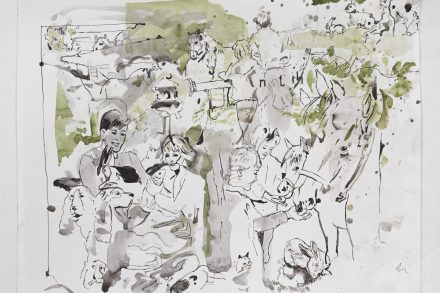
Even if you think you don’t know William Nicholson, it’s a fair bet that you’ve come across his work. If you’ve read those excellent children’s books, The Velveteen Rabbit or Clever Bill, you’ll have taken in his drawings – never wholly sentimental, even the rabbit – into your mental world. And if you’ve seen his woodcuts (they’re everywhere) – say, of Queen Victoria looking stout and dour – you’ll have noticed their economy, their clever use of space and their humour. This exhibition has the familiar elements of his work, but also the grander stuff: the still lifes, the landscapes, the portraits. Then there are the unexpected aspects – who

Thom Yorke reminds me of David Brent: Radiohead reviewed

There were times watching Radiohead’s first UK show for seven years when Ricky Gervais came to mind. As Thom Yorke dad-danced around the circular stage in the middle of the arena, his bandmates all hunched over their equipment – which made it resemble a server room of a call centre – I felt as though I was witnessing David Brent doing the samba around the office. I have to confess that there are large chunks of Radiohead I simply don’t understand. I am absolutely certain that most of the music that they have released in the past 20 years – and much of the music they performed at the first

Why are today's choreographers so musically illiterate?

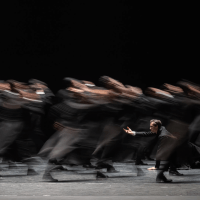
Most choreographers today have lost interest in using music as anything more than a background wash of colour and mood. More’s the pity. For an earlier generation the idea that the dance grew through the music – into and out of it – was of the essence: or, as Balanchine famously said: ‘See the music, hear the dance.’ In a fascinating piece for the Guardian recently, the composer Nico Muhly explains how rich the interaction between a choreographer’s phrasing of movement and the bar lines or metrical structures specified in the score can be: ‘If the music feels as if it’s in comfortable cycles of four bars, is the dance

A sack of bilge: End, at the Dorfman Theatre, reviewed

End is the title chosen by David Eldridge for his new relationship drama. Clive Owen and Saskia Reeves star as Alfie and Julie, a pair of wildly successful creative types who live in a mansion near Highgate. Both are 59. Alfie is a retired DJ who made a fortune touring the world at the height of the ecstasy craze and Julie earns a living from crime fiction. But she’s bored with detective stories and wants to publish her memoirs and to write a state-of-the-nation novel set during the 2012 Olympics. Despite their amazing careers, both characters are moaning dimwits who swear constantly and have nothing of value to say about

Gothic lives matter: BBC2's Civilisations reviewed

Anybody growing weary of the debate surrounding the BBC’s unexamined assumptions and biases about modern politics might have expected to find some relief in a scholarly documentary about the sack of Rome in AD 410. Sad to say, though, the first episode of Civilisations: Rise and Fall offered very little of it. Of course, it’s not unusual for history programmes to want to prove that the people in the past were Just Like Us. But in this case the parallels drawn/rather desperately imposed were a particularly uncanny fit with those same pesky assumptions and biases. It transpired, for example, that Ancient Rome ‘was a two-tier society that favoured the rich

An adorable Taiwanese debut: Left-Handed Girl reviewed

Left-Handed Girl is a Taiwanese drama about a single mother who moves back to Taipei with her two daughters to run a noodle stand in the night market. It’s one of those films where the stakes don’t appear that high – will the mother make the rent this month?; will the littlest daughter settle at her new school?; what’s grandma’s game? – yet we become so attached to this family and their survival it will all matter a great deal. It also features an adorable pet meerkat, GooGoo, and I doubt you’ll see a better film starring an adorable pet meerkat called GooGoo this year. I’d bet my life on

Indian classical music's rebellion against modernity

When Gurdain Ryatt, Ojas Adhiya, Milind Kulkarni and Murad Ali Khan take to the stage at Milton Court this Sunday they will be united by a common language: the tradition of Hindustani Indian classical music, rooted in the north of India. Ryatt and Adhiya’s job will be to keep beats circulating on their pitched, drum-like tablas, while Kulkarni’s harmonium will sustain drones, apparently towards infinity. Khan plays the sarangi, a string instrument famed for its uncanny invocation of the wavering of the human voice. Shankar’s tireless advocacy spawned a crossover culture that he felt too often sullied the very music he loved British audiences have a head start when it

London's stupidest gallery

Everyone loves a private view, and I am no exception. I don’t know how many hours I must have spent trudging around central London’s art galleries in search of warm white wine – my social life doesn’t extend much beyond the confines of that circuit to be honest. Lately, however, I’ve been to some dreadful things; shows that seem to exist purely in order to enable their ritzy opening galas. I suppose I have only myself to blame for turning up to an evening at London’s stupidest gallery last week, but it was truly horrible: a party thrown for a scenester artist who turned DJ for the night, spinning butchered