Arts Reviews

The good, bad and ugly in arts and exhbitions

Dream Stories

It’s a slightly surreal time to be a theatre-goer in London. Two of the most exciting productions running at the moment both trace descents into the more disconcerting reaches of human fantasy. But, while Richard Jones’s production of The Government Inspector at the Young Vic turns Gogol’s political satire into the blithest of comic capers, the absurdist nightmare of a somnolent, small town, small time bureaucrat, Arthur Schnitzler’s Dream Story, at the Gate is an altogether darker take on the boundaries of sexual pathology. In The Government Inspector, a group of corrupt town bureaucrats discover that St. Petersburg is sending an incognito inspector to check up on them. As soon

A feast of visual delight

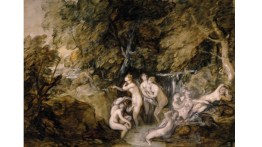
There are just 26 drawings and watercolours in the magnificent exhibition at Lowell Libson, but they are all of such quality and interest that the show is a feast of connoisseurship and visual delight. Selected by Libson and Christopher Baker from the National Gallery of Scotland, the range of work gives a distinct flavour of the museum’s holdings, from major watercolours made for exhibition to more informal studies. Here are the big names (Turner, Constable, Blake) and the lesser-known (William Callow, John Webber). Most deal with travel or landscape, but there are figure studies and visions, too. The variety within such a small compass is impressive. For pure pleasure, this

Whose art is it anyway?

Niru Ratnam tackles the thorny question of what constitutes British — or should that be English? — art In the past few months there have been two large-scale exhibitions showcasing British art. The first was the British Art Show at the Hayward Gallery; the second Modern British Sculpture at the Royal Academy. On show at the former were an elegant suite of works by Wolfgang Tillmans (born in Germany), a tapestry by David Noonan (Australia), the much-lauded film ‘Clock’ by Christian Marclay (America) and the delicate paintings of Maaike Schoorel (Netherlands). The latter boasted an impressive array of colonial plunder displayed next to British sculpture, a neat juxtaposition of Chinese

St Oscar of Oxford

It was in his room in Magdalen College, Oxford, in 1875 that Oscar Wilde said, ‘I find it harder and harder every day to live up to my blue china.’ Now, more than 130 years after he left Magdalen, with a double first in classics, the room has been decorated in his memory by Robert Douglas-Fairhurst, a Magdalen Fellow. It was in his room in Magdalen College, Oxford, in 1875 that Oscar Wilde said, ‘I find it harder and harder every day to live up to my blue china.’ Now, more than 130 years after he left Magdalen, with a double first in classics, the room has been decorated in

The ultimate challenge

Tristan und Isolde is one of the greatest challenges that an opera house can take on, in some ways the greatest of all. So it is wonderful to be able to report that at Grange Park it has been mounted with a large degree of success, and that most of the things that are wrong with it could easily be righted, though they won’t be. The most remarkable thing about it is the level of singing, almost uniformly high, and certainly with no weak link. Isolde is Alwyn Mellor, Longborough’s Brünnhilde, and also scheduled to sing that role for Opera North and for Seattle. Besides her impressive voice, she has

Past the postmodernist

According to a superstition shared by several Mediterranean countries, the frantic buzz of a fly trapped in a room spells the arrival of unpleasant news. I wonder whether the controversial and multitalented Catalan artist Sol Picó knows that, for in her 2009 El Llac de les Mosques (The Lake of the Flies) the annoying sound is used like a mini-overture. Yet it would not be fair to dismiss as ‘bad news’ this one-hour-long mix of extreme physicality, live music and funny, cheesy theatrical stunts. After all, many in the audience seemed to enjoy the deafening blasts of guitar, percussion and sax, as well as the apparently inconsequential series of puzzling,

Come off it, Tom

Larry Crowne is horrible, just horrible, and I urge you to avoid it like the plague. It’s a ‘rom-com’ starring Tom Hanks and Julia Roberts and if you thought you can’t go wrong with Hanks and Roberts, two of the greatest screen presences alive, here is proof that you can. This is stilted, lifeless, bears absolutely no relation to how real people talk or behave, and is offensively sexist, or at least I found it so. Tom Hanks directs himself in this, and also wrote the original script, so if you ever thought you can’t have too much Hanks here is something else to blow your mind: you so, so

The inspirational Suu Kyi

‘To be speaking to you through the BBC has a very special meaning for me. ‘To be speaking to you through the BBC has a very special meaning for me. It means that once again I am officially a free person,’ says Aung San Suu Kyi at the beginning of the first of her Reith Lectures on Radio 4 (Tuesday mornings). That connection between the BBC and the powerful, emotive word ‘freedom’, made by one of the most influential figures of the 21st century, has finally broken through to the politicians who are deciding on the fate of the World Service. Last week the Foreign Office, coincidentally maybe, but probably

A Superbly Accessible Introduction

The text that codified the old legend of the learned man who sells his soul to the devil, Christopher Marlowe’s Doctor Faustus is one of the most influential plays in English history. It’s also one of the worst, from the point of view of the director. Scenes of intense religious struggle are intercut with the crudest of groundling comedy skits, in the most incongruous of juxtapositions. It may be Marlowe’s way of emphasizing that, under his silks, Faustus is as ineffectual and decayed as the world he inhabits, but it doesn’t do much for narrative flow. And that’s before you get to the serious problems with the pacing of the

Lautrec’s dancing muse

Henri de Toulouse-Lautrec (1864–1901), diminutive aristocrat and radical artist, was roundly travestied in John Huston’s 1952 film Moulin Rouge, and at once entered the popular imagination as an atrociously romanticised figure doomed for early death. Henri de Toulouse-Lautrec (1864–1901), diminutive aristocrat and radical artist, was roundly travestied in John Huston’s 1952 film Moulin Rouge, and at once entered the popular imagination as an atrociously romanticised figure doomed for early death. In fact, Lautrec was a tough and original artist, incisive and unsparing in his observation though also compassionate of the human comedy, a perfect painter of what then passed for modern life. His images of the extraordinary dancer Jane Avril

Viewpoint – Valuing culture

How should we measure the value of a work of art? Let’s take, for example, Michelangelo’s statue of David in the Accademia in Florence. How should we measure the value of a work of art? Let’s take, for example, Michelangelo’s statue of David in the Accademia in Florence. The 17ft marble figure attracts a huge number of visitors from all over the world, so the box denoting popularity gets a tick. The revenue box gets ticked as well because of the gallery’s entrance fees and the money spent on accompanying T-shirts and postcards. And also to be considered is the amount this piece would fetch in a hypothetical sale. Crunching

Growing old gracefully | 25 June 2011

Michael Tanner says that the Wigmore Hall, celebrating its 110th birthday, combines Edwardian grandeur with contemporary appeal The Wigmore Hall is so expert in advertising itself with taste and discretion that it manages to give the impression, simultaneously, of belonging to a previous era and thus having all the charm of the Edwardian age at its most appealing, while also showing its adaptability to contemporary technology and, at least as important, to contemporary music. Even its website contrives to have a winningly traditional air, while of course being completely up-to-date. Certainly the building itself, especially as you approach it, evokes the age in which it was constructed, 110 years ago,

Keeping an eagle eye

The resident ravens of the Tower of London seem to croak a little louder these days. A few yards from their gathering spot, a golden eagle, traditional symbol of power and kingship, perches on a military standard, keeping watch. It is one of several exhibits on display at the newly refurbished Fusilier Museum in the Tower of London. The Royal Regiment of Fusiliers is a British infantry regiment named after the Fusil musket and raised at the Tower in 1685. In 1809, having routed the French in Martinique, the Fusiliers carried off the eagle insignia, which had originally belonged to the 82nd Regiment of the French Line, serving under Napoleon.

Schiller’s killer Miller

I bumped into a restoration expert last week. ‘What’s new in heritage these days?’ I asked him. ‘Oh, same old, same old,’ he told me. I bumped into a restoration expert last week. ‘What’s new in heritage these days?’ I asked him. ‘Oh, same old, same old,’ he told me. In similar vein, London has been enjoying a spate of classic revivals on stage. At the Donmar a production of Schiller’s Kabale und Liebe (Intrigue and Love) has been barmily retitled Luise Miller. This promotes a minor character to the protagonist’s role. It incorrectly suggests the atmosphere of Romford roundabouts and roaring hen parties. And it echoes the author’s name

The real thing | 25 June 2011

Bridesmaids isn’t directed by Judd Apatow, the reigning champion of American comedy, but it might as well be. Bridesmaids isn’t directed by Judd Apatow, the reigning champion of American comedy, but it might as well be. In addition to establishing himself as Hollywood’s leading comedy director — The 40-Year-Old Virgin, Knocked Up, Funny People — he is the industry’s most prolific auteur producer, having overseen a string of recent hits including Superbad, Forgetting Sarah Marshall and Get Him to the Greek. Apatow’s films generally have a freewheeling, loosey-goosey atmosphere, as though we’re eavesdropping on a group of comedians riffing off each other rather than watching a bunch of actors reciting

Four by Two

All eyes will be on Andy Murray this week and perhaps next, but 50 years ago it was British women tennis players who were on top, with two of them fighting for the trophy in the final at Wimbledon. Christine Truman lost by a narrow margin but only after she fell and hurt her ankle. The victor, Angela Mortimer, afterwards declared, ‘Well, I knew I must make her twist …It’s not a nice thing to do …but I knew that if she has an injury I must exploit it.’ It was 1961. Who would have thought a woman could be so mercilessly competitive back then, years before the Pill and

The glory of Rory

I watched Rory McIlroy win the Open Golf last weekend (it was on Sky, so there was no Peter Allis and his reminiscences of clubhouse banter past; to my surprise, I missed him). What sportspersons need is ANF — attraction to non-fans. You might be a great admirer of, say, Ashley Cole, but his ANF-rating is near zero. Whereas David Beckham and George Best are way up there, appealing even to people who hate football. We try to like Andy Murray, but his ANF is poor, whereas Roger Federer is a near-perfect ten. Muhammad Ali had a terrific ANF, something no other boxer can approach. Colin Montgomerie, who was commentating

Exciting New Adam Curtis* Project!

Better still, it’s only three minutes long! Sadly the video can’t be embedded so you’ll have to hop over here to watch and enjoy it. Norm, mind you, was ahead of the game as far back as 2007. Previous Curtis-sniping here. *Not to be confused with that other Adam Curtis of course.