Arts Reviews

The good, bad and ugly in arts and exhbitions

The Discerning Eye show is full of great art pieces. I know because I chose them

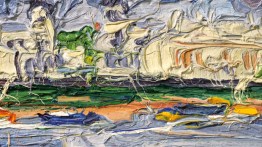
If you want to buy a picture or a piece of sculpture and have lots of money or not very much, or if you just want to look at more than 450 contemporary works, then the Mall Galleries is the place to go. For some 20 years the Discerning Eye charity has held an annual exhibition of work by invited artists, plus contributions from an open submission, selected by a panel of six — two artists, two collectors and two critics. The charity’s aim is to encourage a wider understanding of the visual arts — an aim that surely no one can disagree with — and the commission it charges
Paris: Parc life

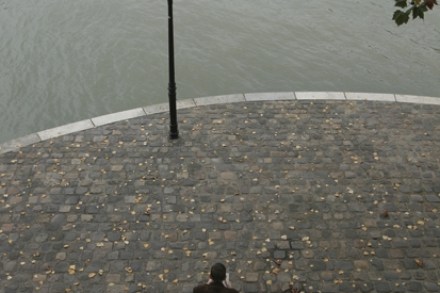
Autumn in Paris has been immortalised in one of Rainer Maria Rilke’s most poignant poems. Having left his wife in Berlin, Rilke moved to Paris in 1902 where he wrote ‘Herbsttag’ (Autumn Day). ‘Whoever is alone now, will remain so for long. He will stay up late, write long letters and wander restlessly in the avenues as the leaves drift.’ If you have ever taken a solitary walk in the gardens of Versailles as the sun glints coldly on the bright autumn colours, you will know that feeling. For four months of the year, from December to March, living in Paris is like being trapped inside Tupperware. The grey skies

‘You can’t handle the truth!’ — the greatest courtroom dramas of all time

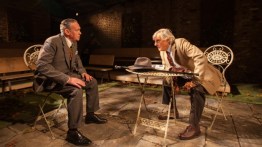
Our legal system is pure theatre and always has been. Many barristers stand accused of being failed actors and vice versa. Judges love the dressing-up box and a chance to give their gavel a good bang. With murmuring galleries, shocking verdicts, swooning witnesses, cries of ‘all rise’ and ‘take him down’, the flummery and drama of the courtroom has always supplied a rich genre for film, theatre and telly. Now there’s a chance to see one of the more serious courtroom classics in the West End. Twelve Angry Men — originally written for the screen and directed by Sidney Lumet — is about a grumpy New York jury deciding on

How China’s Bayeux Tapestry differs from ours

The V&A’s remarkable survey of Chinese painting begins quietly with a beautiful scroll depicting ‘Court Ladies Preparing Newly Woven Silk’, from the early 12th century, which, with its bright colours, shallow space and lack of setting, invites comparison with a western masterpiece of a similar date, the Bayeux Tapestry. The crowded urgencies and narrative drive of the English/French embroidered cloth couldn’t be further from the refined intervals and sophisticated relationships of the Chinese scroll, and yet both tell much about the cultures that produced them. However, neither should be read simply as historical documents: both offer rare aesthetic pleasures of quite different distillations. The Chinese elixir seems to me to

What my addiction to Chinese painting made me do

My addiction to Chinese landscape painting began in 1965 at the V&A, in a travelling exhibition of the Crawford Collection from America. The catalogue entries were supplied by the doyen of Chinese art historians in Britain, Michael Sullivan, who died aged 97 just a month before the opening of this latest exhibition of Chinese painting at the V&A. His particularly well-written and stimulating books on Chinese art, especially Symbols of Eternity, published in 1980, kept my addiction smouldering until at last I felt I had to do something about it and wrote a novel, The Ten Thousand Things. Its central character is a 14th-century Chinese landscape-painter, Wang Meng, whose ‘total

British empire? What British empire?

Here’s a tip for play-goers. When the curtain goes up on a garden, prepare for some feeble plotting. The glory of gardens, for the playwright, is that the characters can enter and leave without reason. The rites of welcome and valediction, the physical opening and shutting of doors, the declaration of motive are all abandoned. Anyone can wander in and out of a backyard. But that freedom of action is denied to a character who enters, say, a palace or a travel agents or a bedroom. Shaw is fond of gardens. Ayckbourn quite likes them too. Shakespeare used them more than once (but he’s forgiven) and David Storey sets his

Keith Warner’s Wozzeck doesn’t make me as angry as it used to

When Keith Warner’s production of Berg’s Wozzeck was first produced at the Royal Opera, nine years ago, it made me more angry than any that I had ever seen. At its first revival in 2006, my response was milder, though still outraged. Now, on its third outing, I mind it even less, partly because the musical performance is so strong. Warner has returned to oversee this revival, which, if memory serves, is little different from the last one, so he still regards Wozzeck as the portrayal of an experiment, with Wozzeck as the guinea pig, and the rest of the cast, with minor exceptions, as his tormenting experimenters. Most of

Come to the Spectator office, Gareth Malone, and hear our ‘Carmina Burana’

They’re now televising proceedings from the Court of Appeal. Great. As if I didn’t have enough to do already, keeping tabs on Strictly Come Dancing and EastEnders, I now have to monitor what’s happening within the hallowed judicial temples of the land. The broadcasting of court cases has been much debated, with people fussing about whether it will influence the meting out of Justice, and the implications for Law and Order once these are exercised in front of the cameras, and other high-minded issues. My own worry is about my job scope. Everything is televised these days, which means everything can be reviewed. There are the main channels such as

You lost Aled Jones and Catherine Bott, Radio Three — but all is forgiven

It’s hard to stay cross with Radio 3 for long. Just when I thought the network had stretched my loyalty too far by not only allowing Aled Jones to decamp to Classic FM but also saying goodbye to the great Catherine Bott, I had a comeback conversion. I’ll explain how that happened later. First, we should bewail the loss of Bott, who made The Early Music Show her own, with her enthusiasm, her practised authority, her ability to convey insights without being ponderous. She drew us in to share her passion for music and composers we’d never even heard of, let alone felt any desire to hear. Without her the

How we beat the Boche — at sidecar racing

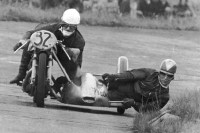
There’s courage, there’s fearlessness, and then there’s the sort of sublime audacity you need to do something like sidecar racing. Stan Dibben, 87, has it in spades. He won the world sidecar championships in 1953, still whizzes around the racetrack today and is the subject of a beautiful short documentary film by Cabell Hopkins, No Ordinary Passenger. Sidecar racing is terrifying to watch. The passenger — the non-driver — has to hurl himself from one side of the three-wheeled bike to the other as it zooms around corners; his head is often inches from the tarmac. Mistakes are disastrous. Stan Dibben got into this crazy sport after the war. ‘I

How I learned to start screaming and love the horror movie

Buddy, you can keep your Christmases and your Easters, your Hanukkahs and your Eids. For someone like me, the annual celebration that really matters is the one that falls on 31 October — Halloween. This isn’t because I’m an inveterate trick-or-treater, out for candy and larks. It isn’t because I own shares in a pumpkin patch. It’s because I am a film fan, grateful for any excuse to indulge in horror movies as night’s dark curtains draw closer. No other time of the year offers such a perfect alignment of occasion and genre. ’Tis, after all, the season to be scared. And this season is shaping up better than most.

Is Paul Klee really a great modern master?

There is a school of thought that sees Paul Klee (1879–1940) as more of a Swiss watchmaker than an artist, his paintings and drawings too perfect, too contrived. Viewing this new exhibition at Tate Modern, one might add that they are also too mannered and precious. I had been looking forward to this show, but going round it I found myself all too frequently impatient and disappointed. Yet Klee is a great modern master, you say; can he be dismissed so easily? Perhaps it is all in the selection of work, for Klee was prolific even though he died young, with a total output of about 10,000 paintings, drawings and

Finding

(for Aidan Williams) After a difficult week at work, when I was trying too hard on a short fuse, I suddenly knew that all the hurt would have a certain way of being released, Googled stables in the centre of town and telephoned, but not to book a ride, just to have five minutes with any one of the ponies, and as he fed I cried deeply from a well I thought was dry, and while I hugged, breathed fully of his sweat, heard him intently chomping on the hay, told him I loved him and kissed his neck, I knew calm like that with you this afternoon, my head

David Tennant plays Richard II like a casual hippie

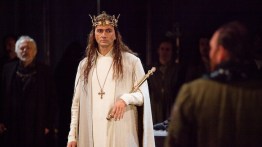
Gregory Doran, now in command at Stratford in succession to Sir Michael Boyd, launches his regime with Richard II, intending to stage the complete Shakespearean canon over the next six years, ‘making every play an event’. What’s really good is that the plays will also be seen on tour, in London, online and ‘live on screen in cinemas and classrooms nationwide’. It’s taken too long for the publically funded RSC to put live ‘streaming’ in place; Richard II, broadcast on 13 November, will be the first play so honoured. With David Tennant in the title role this may already be a sell-out, but encore screenings are already planned in many

Philomena is Dame Judi’s film

Philomena is based on the true story of an Irish woman searching for the son stolen from her by the Catholic Church 50 years earlier, and although, as a cinematic experience, it could so easily have felt as if you were being repeatedly slapped round the head by a copy of Woman’s Own, it is, thankfully, quite a few notches up from that. Indeed, as directed by Stephen Frears, it is quiet, restrained, unfussy, and has, at its heart, an injustice so grave it will make your blood boil. You will also cry. Seven minutes in, and I was already crying. Not proud, but it is a fact. Dame Judi

Your life is not like a Detroit assembly line — it’s worse

This year’s Free Thinking festival at the Sage in Gateshead has been asking the question,  Who’s in Control?. Oddly, or perhaps presciently, as soon as I typed that last word ‘control’, the power went off in the midst of Monday’s storm. No word processor, no internet connection, no phone line, almost no radio (since the only battery-operated radio I now possess is in the bathroom). A weekend of debates and talks about who’s really in charge of our health, our imagination, our privacy soon becomes a lot of hot air in the face of hurricane-force winds. The most sophisticated technology is useless without power, and yet in spite of this

James Delingpole: All students need a ‘sense of entitlement’ — ask my fundie friend Rupert 

‘Life is what happens to you while you’re busy making other plans,’ said John Lennon. Quite apposite from a man who — presumably — meant to spend a ripe old age staging increasingly embarrassing art happenings with Yoko Ono, rather than be shot dead by a nutcase. It also applies to the two things that most grabbed me on TV this week: A Very English Education (BBC2, Sunday) and the Red Wedding episode of Game of Thrones (available via Blinkbox). The first, a follow up to Public School — the BBC’s 1979 fly-on-the-wall series about Radley — sought to find out what had become of its various stars. One of

Nick Cave is still raising hell

As Sunday night’s storm clouds gathered, one of rock’s great polymath-storytellers whipped up a tempest of his own on the stage of the Hammersmith Apollo with the help of his six compadres. Sharp-suited and spivvy, Nick Cave howled and crooned his way through songs of death, sex, savagery and deviancy interspersed with love ballads of exquisite tenderness. Almost as mesmerising as the man in black was Warren Ellis, a Bad Seed of long standing, who thrashed the living daylights out of his violin like a demented Rumpelstiltskin. Periods of finely calibrated restraint were punctuated by spasms of all-hell-breaking-loose. Alone among that generation of rock stars who emerged in the early