Arts Reviews

The good, bad and ugly in arts and exhbitions

The worst public art imaginable

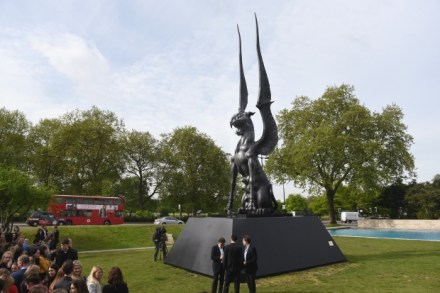
Have you ever walked or driven past a piece of ‘public art’ and wondered how on earth it got commissioned, or whether it is just a bit of leftover junk from a building site? In this week’s Spectator, Stephen Bayley awards the inaugural ‘What’s That Thing?’ prize to the very worst specimen he can find: Dashi Namdakov’s ‘She Guardian’ on Park Lane, pictured above. And it really is awful. You can listen to Stephen discussing the problem with public art on our podcast with Posy Metz from Historic England here. My own personal favourites when it comes to utterly inexplicable ‘sculptures’ in public places are the Dorking Cock, plonked on a
Public offence

[audioplayer src=”http://rss.acast.com/viewfrom22/fightingovercrumbs-euroscepticsandtheeudeal/media.mp3″ title=”Stephen Bayley and Posy Metz from Historic England discuss public artwork” startat=1206] Listen [/audioplayer]There are, as adman David Ogilvy remarked, no monuments to committees. (That’s not quite true; Auguste Rodin’s ‘Burghers of Calais’ — you can find a version in Victoria Tower Gardens — is somewhat collectivist in subject matter.) But there are certainly abundant monuments to the committee mentality, the bureaucratic spirit and art-world groupthink. That is what most contemporary ‘public art’ amounts to. You will have seen ‘public art’ if you wander through developments of luxury apartments on, say, the southbank Thames littoral between Lambeth and Battersea. Or on a progressive university campus anywhere. Sometimes public

‘So quick and chancy’

When asked the question ‘What is art?’, Andy Warhol gave a characteristically flip answer (‘Isn’t that a guy’s name?’). On another occasion, however, he produced a more thoughtful response: ‘Does it really come out of you or is it a product? It’s complicated.’ Indeed, it’s those complications that make Warhol’s works compelling, as is demonstrated by a new exhibition at the Ashmolean Museum, Oxford. One is that it is hard to tell how much he was really in control. When you look at one of his pictures, are you really looking at the work of his assistants or, indeed, of chance? And the way he forces you to think about

Breaking

Was everybody scared? Mum was, certainly. Slip-clinging hold, respectability. World-lost, he didn’t care,   Or didn’t cotton on. Inexplicably, He once broke out, performing memorably: Reckless, and with aplomb.   Mistiming exquisite; Turning their stomachs; Master-class for me in how to flummox Guests: it was The Visit.   Scented and Sunday-clad, – Teacups four-high, stacked, And then paraded like a circus act – Mother pronounced him mad.   Kitchen philosophy, The moment passed. The next time tumbled everything amassed; Her judgment, prophecy.

Weekend world

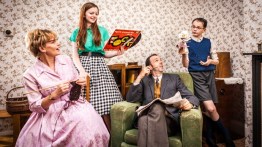
When the time comes to make programmes looking back on the 2010s, I wonder which aspects of life today will seem the weirdest. Quinoa? The fact that we were expected to be ‘passionate’ about our jobs? Being so overexcited by new technology that we constantly stared at phones? Or maybe it’ll just be how many almost identical TV series looking back on previous decades we used to watch: the kind where a family dresses up in period costume and lives for a while like people from previous eras, carefully ticking off the signifiers as they go. (Space hoppers and Chopper bikes for the Seventies, Rubik’s Cubes and shoulder pads for

Straight talking

It’s widely agreed that the most difficult form of opera to bring off is operetta, whether of the Austro-German or the French tradition — interesting that the Italians wisely eschew the genre (so far as I know), while the British stay with G&S and their inviolable traditions, including the audience’s laughing in all the right places. In the past four days I have been to two performances of French operetta, neither of them much of a success, for quite different reasons. Opera Danube is a young company devoted to nurturing singers who recently graduated from one or another of the many music schools. It works with the Orpheus Sinfonia, a

Being and nothingness

Florian Zeller has been reading Pinter. And Pinter started out in repertory thrillers where suspense was created by delaying revelations until the last minute. He tried an experiment. Suppose you delay the revelations indefinitely. The results were interesting. Pinter’s characters were vague, stark silhouettes lacking background and substance. Audiences found them inscrutably suggestive. Zeller follows suit. He presents us with a bourgeois marriage. The father works. The mother sits at home being stylishly empty-headed. Their grown-up son lives with his girlfriend. No other details are offered. It’s evening. Mother, disported on an all-white sofa, greets her husband and languidly interrogates him about his day’s activities and casts aspersions on his

It’s doomed!

The TV sitcom Dad’s Army ran on the BBC from 1968 to 1977 (nine series, 80 episodes) with repeats still running to this day (Saturday, BBC2, 8.25 p.m.) and I sometimes watch these repeats with my dad (92) and we laugh like idiots and I sometimes watch with my son (23) and we laugh like idiots and sometimes the three of us watch together (combined age 169, should that be of interest) and we all laugh like idiots but I was not minded to laugh like an idiot during this film, possibly because I was not minded to laugh at all. If it ain’t broke, don’t fix it, goes the

Unforgettable fire | 4 February 2016

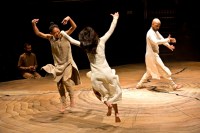
How much of a compromise does a fashionable choreographer loved by all have to make with his paymasters? When he’s unfashionable, it’s only the Arts Council he has to please. When the world wants a piece of him, he has London’s Sadler’s Wells and the Roundhouse, Grenoble, Paris, Luxembourg, Montreal, Hong Kong, Taipei, Wolfsburg, Brighton, Amiens, Bruges, Amsterdam, Rheims and Leicester producers all tugging at his sleeve, offering support for the quasi-divine creation but wanting to get their spanner into the works somewhere. In which light I take my hat off to Khan. A fortnight after seeing his Until The Lions at the Roundhouse, ground down at the time by

Easy Street

Roller skating down the main road in the cycle lane, her easy, smooth and flowing scissor stride on booted castors, measured, steady and elongated, seamlessly pushing through yards and moments, as if traffic was merely imagination and grace impervious to danger.  

Unreliable Narrator

If a clock can be a household’s totem then we remain hopeful ours will show us an accurate blue moon before too long. In the meantime, we’re quite used to people asking (ineptly) What’s with its arrythmia and beaten-tortoise air? The much-polished answer is: uncertain timekeeping is remarkably soothing for the under-twenties, disposed to fantastical lie-ins, while visitors can’t help but declare themselves, either, leaping up horribly at its misdirection or, mildly trusting to its idiosyncratic version of the now. In or above the fray, our clock clucks on plying a number of desirable timezones with its deft black hands as oars.

Location

Old friends, we scarcely speak of death or dying. As ever, the displacements continue, just as when we used to fail to get round to speaking about love or confined ourselves to giving it a mention in letters — about which we didn’t speak. Until I knew better, I thought poets talked of such things, but as we see they share a guarded language of technical asides. If someone treats their work as a strip-tease, they back off, apparently confounded, the action — the real conversation — being somewhere else — but where?

Losing a Crown in the National Portrait Gallery

The cafe was full of connoisseurs of the scones. As he bit into his flapjack a sinister uncoupling took place and he felt the crown of a tooth jerk free — to be rescued behind a discreet paper napkin. Now the geography of his mouth was unfamiliar, harsh and sharp. No wonder those Tudors in their portraits kept their mouths shut. No white-clad guru for them, injecting, probing, drilling and finally murmuring: One more rinse for me please. No, they had to make do with white paint, and opium, and hiding unfortunate swellings under a generous ruff. But no more speculation, for it is Friday afternoon, and he must hurry

Ai Weiwei’s Aylan Kurdi image is crude, thoughtless and egotistical

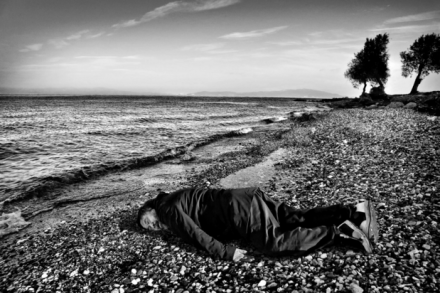
Last September a photograph of three-year-old Aylan Kurdi’s lifeless body washed up on a beach near Bodrum made headlines around the world. The image had a significant effect on shifting public perception to the Syrian refugee crisis as well as sparking a debate around the ethics of the circulation of such images. Academics at the University of Sheffield have estimated that 53,000 tweets were sent per hour at the height of the image’s circulation reaching 20 million people around the world in 12 hours. Last week, over four months after the image appeared, the Chinese artist Ai Weiwei made his own contribution to the debate in a photograph which depicts

Magnetic north

‘Edvard Munch, I cannot abide,’ wrote Nikolai Astrup in a letter to his friend Arne Giverholt. ‘Everything that he does is supposed to be so brilliant that it doesn’t have to be more than merely sketched.’ Near contemporaries, Munch and Astrup were both innovative and admired painters but while Munch is today one of the few household-name artists, thanks to one misunderstood and overrated painting, Astrup has been neglected by everyone outside Norway. Happily, this is a travesty soon to be rectified by Dulwich Picture Gallery, which next month stages the first major exhibition of Astrup’s work to be held in Britain. Unlike many other Norwegian painters, Munch included, Astrup

President Hassan Rouhani needs to get over the shock of the nude

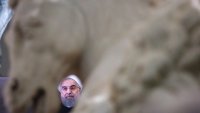
Has a new art installation opened up at the Capitoline museum? One might be forgiven for thinking so: nude sculptures were recently encased in white wooden boxes so that only their heads could be seen. So modern! So fresh! So radical! Except there was nothing radical about it. Instead, Italian authorities took the decision to cover up the ancient nude statues in honour of Iranian President Hassan Rouhani’s official visit to Rome, during his first trip to Europe since international sanctions against his country were lifted. Rouhani and his entourage could not, reportedly, cope with the sight of marble sculptures of naked women, including a Venus dating back to the second century BC. Nor could he

Another Slice

All the books stored above our heads, all the books there aren’t enough hours to read again, and still we hesitate to banish them complete. The second-hand life, charity shops, jumble sales, car boot fields: the slow long-term dance, temporary ownership, possession and loss. Charity shops can take anything unwanted, books and LPs, the unfashionable fashions, but all those hours that used to be you, what ever happened to them? Sometimes, as with burnt toast, things can’t be salvaged or scraped right. You have to discard. Start again.

The Venice Accademia

The Accademia is one of the smallest of the world’s great art galleries, and picture for picture perhaps the most concentrated collection of masterpieces anywhere — though its rambling layout may surprise first-time visitors. But there are changes afoot as it expands into spaces once occupied by the Venice Fine Arts Academy. This means more works on permanent display and larger special exhibitions. In the days of the Venetian Republic, the city saw no reason to have a public picture gallery. Paintings were everywhere: in the Doge’s Palace, administrative buildings, churches, chapels, monasteries, convents, hospitals, orphanages, confraternity houses and in hundreds of private palazzi. But after Napoleon’s overthrow of La