Can there be any thinking person who has passed a lorry filled with live animals peering out through the slats on their way to slaughter, without a momentary shudder? How many of us would take an opportunity to inspect what happens there? Be honest: you recoil from the thought. ‘Slaughterhouse’. So unpleasant we frenchify it as ‘abattoir’.
Hunting leaves me cold yet has an honesty about it: you see and choose your prey, and kill it yourself: morally a million miles from the systematic industrial slaughter of creatures we never look in the eye, couldn’t bear to see killed, and so turn away, pay others to do the killing, and deny our own agency. There are things we’d rather not think about. Take note of them. They’re the first signs of rejection.
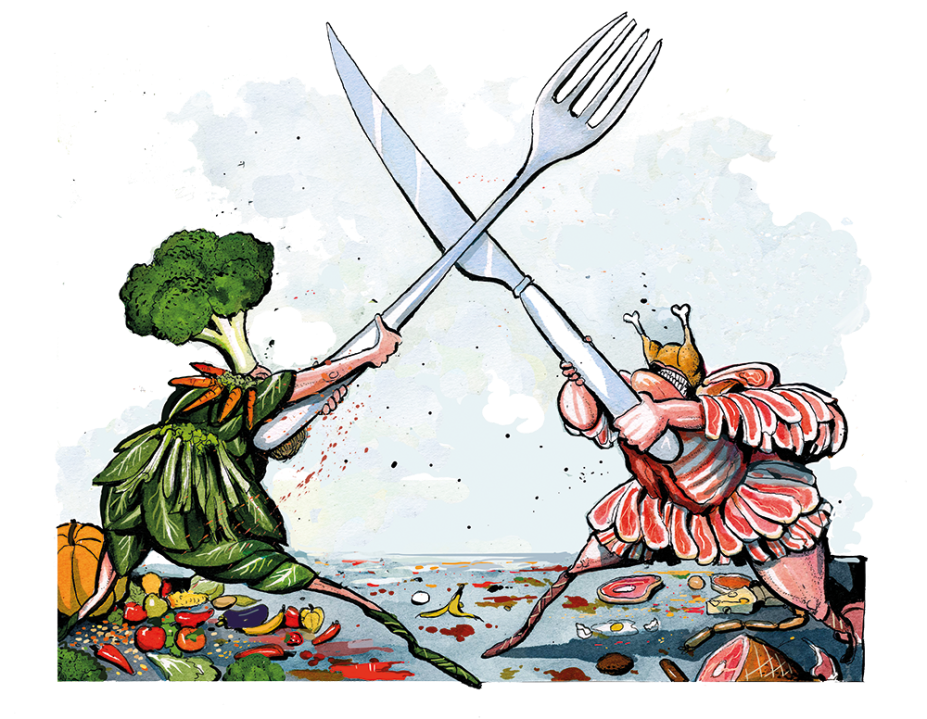
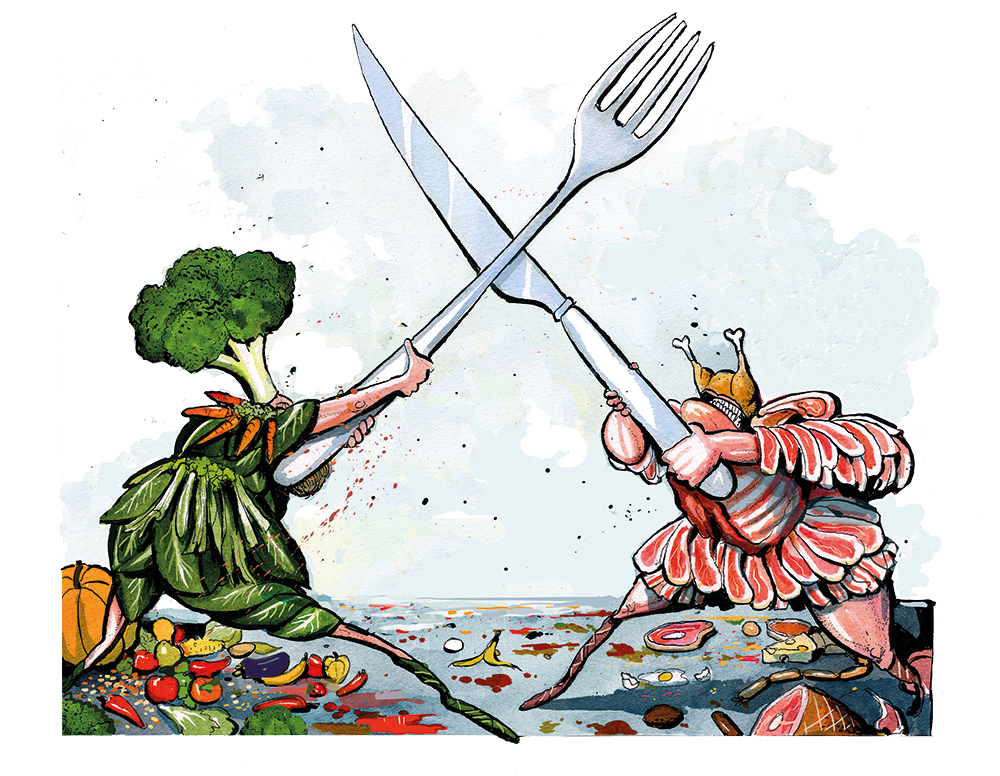
The dream of a nation that has weaned itself off meat is, to such a farming family, a nightmare
Proceeding from acceptance to rejection there are three stages through which a culture passes. First we acknowledge a practice cheerfully; later we find ourselves preferring to banish it from our thoughts; finally we confront it and consider stopping it.
There have always been vegetarians, but in my own lifetime their fashionability has increased, though they and vegans still comprise only about 7 per cent of the population. But around this committed core there’s a huge, softer penumbra (‘flexitarian, ‘pescatarian’, etc): people who ‘try not’ to eat a lot of meat, sometimes on principle, sometimes for health reasons, and choose the vegetarian menu option whenever palatable. Meat consumption in the United Kingdom has been dropping. And notice how the meats that look like what they are – ears, snouts, tongue, trotters – have increasingly departed modern menus.
I’ve cited avoidance as an early sign of moral doubt. Here’s another. Note the slight irritation so often triggered in those of us who do eat meat, when someone else declares they do not. A vegetarian may insist the choice is personal and not a moral judgment, but that’s so often how it feels.
Stung, we start the whataboutery. What about shoes – they’re leather aren’t they? What about cheese – don’t you know where rennet comes from? What about that tin of Whiskas I see on your shelf? Why exempt your cat? Whataboutery is a typical indicator that its author feels confronted by a moral challenge he would rather deflect. To feel stung is an indicator of moral discomfort.
Here, then, follows a what-about that may well be a smothered admission of my own discomfort, but it feels real to me, and I’d welcome a vegetarian’s response, for the movement must have thought long and hard about this.
What about our countryside?
How would Great Britain and Northern Ireland look without livestock? Countryside runs deep in our national psyche, and most of our most beautiful countryside consists in hill, dale and stream, mountain and valley, where sheep and cattle run: this countryside’s appearance largely shaped by grazing (45 per cent of our land area is grazed). The arable parts of our countryside – the flatter bits – are not what we think about when conjuring up the countryside of the English imagination.
Some missionaries for a meat-free world have made the case that instead of getting our protein through meat, we will get it through ‘plant protein’ crops – grazed, as it were, by us humans rather than livestock. This argument doesn’t work where landscape is concerned. Much of the landscape we most cherish depends on animals for its economic viability. My own home countryside, the Derbyshire Peak District, is an example. These green and windy hills are unsuitable for protein crops. Or almost any crops, except grass. And humans don’t eat grass. Livestock do. We enjoy eating the livestock – and admiring the landscapes created by livestock. The model works.
Last month, the government published a ‘land-use framework’ for the decades ahead. Unavoidably speculative, it envisaged a richer mix, more woodland, more other sourcesof income for farmers beyond livestock, more ‘rewilding’. There was nothing wrong with any of the diversification that the report postulated – bring it on – but in my view it did not tackle the biggest question head-on. Most of our hills, dales and uplands cannot be rewilding projects, butterfly conservation, farmstead bed-and-breakfasts. Even wildflower meadows must be grazed or harvested for hay. Woodland is only a small part of our idea of countryside.
Reading the report, I could not but put myself in the position of a small hill farmer of livestock reading it too. He or she and their sons and daughters see rewilding as a spreading nightmare of hawthorn, birch, briar, gorse and bracken: the very thing it’s their business to cut back (or ‘take in hand’ as they’d say). The dream of a nation that has weaned itself off meat is, to such a farming family, a nightmare.
Doubtless their fears are exaggerated. Britain is not going to go veggie in our or our children’s lifetimes. Government-sponsored rewilding efforts will be sharply curtailed by the money needed to subsidise them, which isn’t and won’t be there. The slow extinction of domestic farm animals – until, perhaps, sheep, cows and pigs will only be able to be seen in zoos and game reserves – will take half a century to gather momentum, even if it does. The Vegan Society’s set of demands is plainly intolerable. And the wilder reaches of the vegan imagination, where even domestic pets are phased out, will probably never come to pass.
And yet. There’s such a thing as drift in human cultures, and I sense the current, though slow, is taking us away from seeing ourselves as part of the natural world – as animals who eat other animals, who farm other creatures as even ants do, and whose lives are lived with other animals… away from all that, and towards a separateness that, though vegetarians do love and respect the animal kingdom they urge us to stop abusing, distances itself from our lives, retreating behind the wire netting of zoos and game parks.
It’s easy to tease or even mock our vegetarian or vegan friends; and surely they will never see the day they dream of, or hear the screams from the slaughterhouse silenced for ever. But I believe that one day their world will come. And I think I regret it.


Comments