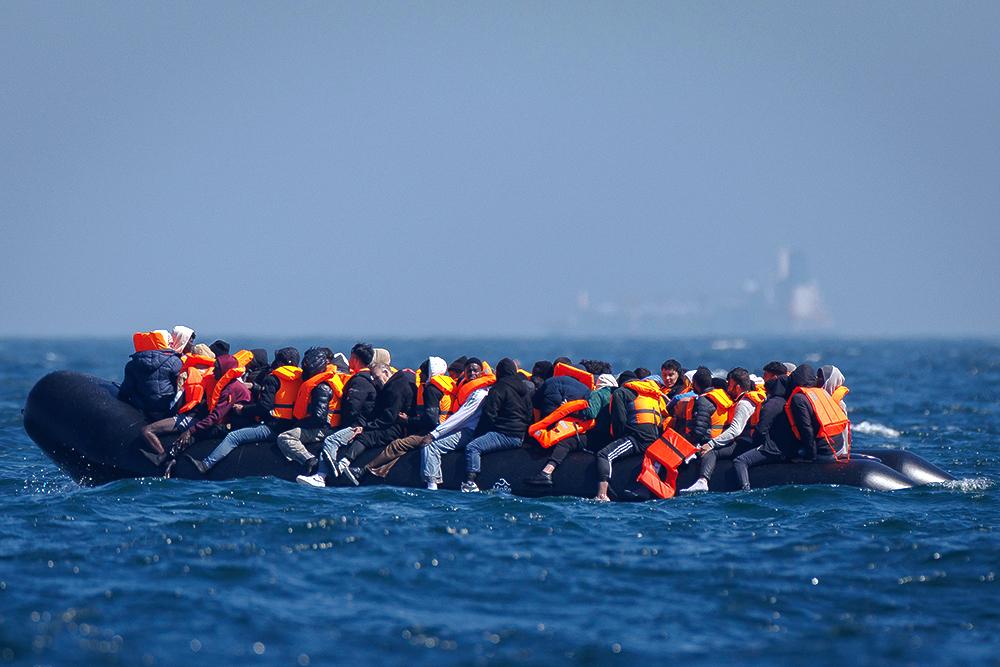


The BBC’s tracking-down of Kardo Ranya as a people-smuggling mastermind is a triumph of investigative journalism. But anyone who thinks this will seriously help ‘smash the gangs’ is deluded. As the drugs trade illustrates, where there is demand there will be supply.
What’s to be done? Imagine you were the party leader of a mainstream British political party. Daydreaming, you see a vision – pouffe! A bang and a flash, and there stands the Fairy Queen herself. ‘What, oh party leader,’ she demands, ‘is your heart’s desire?’
Your reply is unhesitating but – you suppose – hopeless. ‘A winning strategy for the next general election,’ you wail. ‘I ask only for that. Tell me, Enchantress, is there one simple policy that could secure for our party the millions of crosses on the ballot paper that would put me in Downing Street? Speak, oh paranormal one!’
Kemi Badenoch should go in hard on the Rwanda project. It’s already Conservative policy
‘Well now,’ she replies, beginning to sound more like a political analyst than a fairy queen, ‘today’s your lucky day, though you might not think so after the drubbing you got from Reform last Thursday. I get this request all the time from party leaders, and it’s not often I can help. But in your country, and just at this point in history, there happens to be something a government could do that would be easy, wildly popular – and cheap. And its success would be almost immediate. Ten to 12 weeks I reckon.’
Your eyes widen. ‘But surely, your Enchantment,’ you stammer, ‘someone must have thought of this, whatever it is?’
‘Yes,’ she replies. ‘It was Dame Priti Patel who, as home secretary in 2022, first proposed the idea here, though Australian governments had implemented something similar years earlier, with great success. Later, Rishi Sunak’s government pressed on with her proposal, but it all got bogged down in the courts, and Mr Sunak was still struggling with it when he left office – before he had anything to show for the plan…’
She is talking, of course, about the proposal to send would-be immigrants who arrive on our shores without lawful authority straight to Rwanda with no return.

We can leave the daydream there because, here in the real world, Mr Sunak revisited the idea last weekend in a regular column he writes for the Sunday Times. He does not resile from the policy – indeed he doubles down on it – and I’ll return to his remarks in a moment.
What I write next may sound cynical, but so be it. Stopping the boats is vastly more important in this nation’s imagination than it deserves to be in terms of the numbers involved. And that’s a reason not for avoiding it, but for doing it. Big story. Little drawback. Low cost. Massive political dividend.
Immigration overall is certainly an important issue: you may be horrified, concerned or relaxed about it, but the rate at which our population has been expanding, and the sizeable component of new arrivals who come from cultures very different from our own, deserves attention. There are powerful arguments for availing ourselves of the workforce that immigration offers, and powerful arguments against – but no one can deny that demographic change on this scale and at this pace matters, and voters with worries will heed them when choosing how to vote.
But this has almost nothing do with the boats. Close on a million people arrived as immigrants to the UK last year. Some 95 per cent of them did so perfectly legally. And those who arrived without lawful authority? Only 4.8 per cent, of whom the overwhelming majority came across the Channel on dinghies. It follows that ‘stopping the boats’ should not take centre-stage in the imaginations of voters bothered about immigration.
But it does. Put logic aside. Liberal voices have for decades been protesting that boat-related numbers are, in the grand scheme of things, tiny; but liberals should accept that when you keep telling people their fears are exaggerated, and they keep taking no notice, you must in the end accept their disquiet as an unalterable fact. And a political fact – a fact to which, now we’ve left the EU, Nigel Farage’s and Reform’s enduring strength can mostly be attributed.
If a government were to solve this problem by stopping the boats, it’s hard to imagine what Mr Farage’s unique selling point would be. I believe it might entirely burst his bubble. I don’t assume he’s personally preoccupied by the landings, but he knows how preoccupied his supporters are.
Kemi Badenoch should go in hard on the Rwanda project. It’s already Conservative policy but she and her spokesmen have tended to major on the issue of the European Convention on Human Rights (with which the Rwanda policy might conflict) rather than the merits of the policy itself. Threatening to leave the ECHR just looks anti-European – attracts some voters, repels others – and the better approach would be to ignore it, and if we’re found in breach, deal with that when we come to it. Treaties can be tweaked and we’d have allies across the Channel.

Sunak wrote this: ‘Maybe I made a mistake when I talked so starkly about “stopping the boats”. But governments should be able to do that. The reason we could not was because of the courts’ intervention. If people knew that coming here illegally meant either being sent home or to Rwanda, the boats would have stopped – I’m sure of that.’
So am I. And parliament makes the laws and in the end can trump the courts. The gangs will be smashed only when demand for their services falls away. Would-be unlawful immigrants have to know they’ll be straight onto a plane to somewhere distant. These landings feed populism, yet we could stop them within months.
It doesn’t arrive often in politics that great gains in public approval can be achieved at small cost. All power to those Conservatives who understand that this is one of them.






Comments